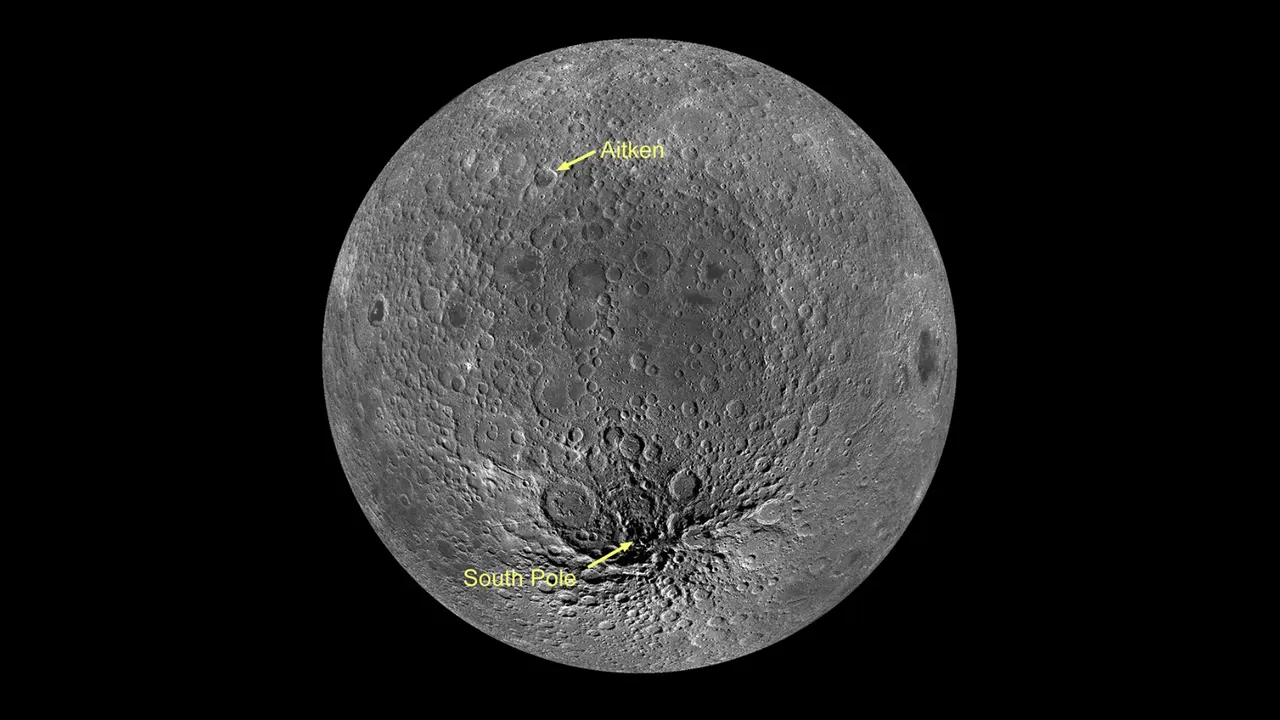
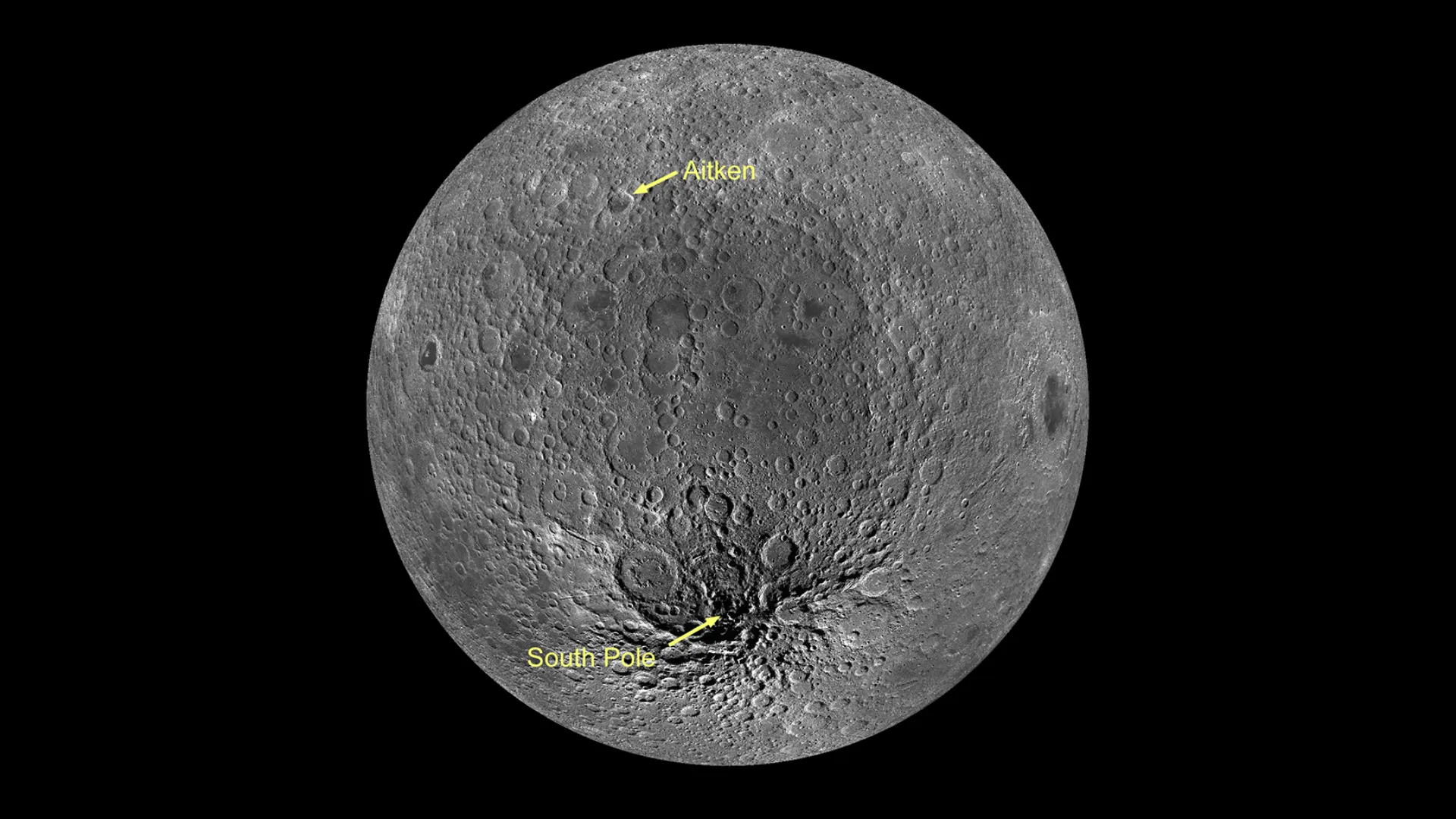
 The moon's largest impact feature, the South Pole–Aitken basin, is so named because it stretches between Aitken crater and the south pole. (Image credit: NASA/GSFC/Arizona State University) Share this article 0 Join the conversation Add us as a preferred source on Google Newsletter Subscribe to our newsletter
 A violent impact that carved out the moon's largest impact basin may have scattered deep lunar material near the lunar south pole — right where NASA plans to send Artemis astronauts.
A new study suggests the South Pole–Aitken (SPA) basin, an impact crater more than 1,200 miles (2,000 kilometers) wide on the moon's far side, was likely created by a differentiated asteroid. The findings might answer some of science's biggest questions about the SPA's creation — and they could have major implications for future lunar exploration.
Using high-resolution 3D simulations, a team of researchers led by Shigeru Wakita of Purdue University found that SPA's distinctive tapered-ellipse shape is best explained by a 160-mile-wide (260-kilometer-wide) differentiated impactor — a large asteroid that had already separated into a dense iron core and a rocky outer layer, much like a tiny planet. It struck the moon traveling north to south at around eight miles per second (13 kilometers per second) at a shallow 30-degree angle, the researchers say.
That shallow angle is key. At that trajectory, the impactor essentially gets "decapitated." Its upper layers shear off while the dense iron core continues plowing forward. "The impactor's core is responsible for the tapered shape of SPA," the authors wrote in the study. By contrast, a simpler, undifferentiated asteroid would have produced a rounder basin.
Crucially, the team found the impact would have flung ejecta from the mantle toward the lunar south pole. According to the paper, Artemis astronauts landing near the pole could encounter deposits containing material excavated from depths greater than 56 miles (90 km).
"Our work suggests that NASA's Artemis III mission, which will send astronauts to the moon, is likely to sample SPA ejecta, if it lands as planned in the south polar region of the moon," the researchers wrote in the study. (NASA has since revised the Artemis program and announced its first crewed moon landing will be on the Artemis 4 mission no earlier than 2028.)
If the simulation is correct, returned samples could help scientists determine the age of the SPA basin and reveal the composition of the moon's deep interior, offering clues to how the moon evolved shortly after its formation more than 4 billion years ago.
The study was published May 7 in the journal Science Advances.
View MoreYou must confirm your public display name before commenting
Please logout and then login again, you will then be prompted to enter your display name.
Logout Stefanie WaldekContributing writer
Space.com contributing writer Stefanie Waldek is a self-taught space nerd and aviation geek who is passionate about all things spaceflight and astronomy. With a background in travel and design journalism, as well as a Bachelor of Arts degree from New York University, she specializes in the budding space tourism industry and Earth-based astrotourism. In her free time, you can find her watching rocket launches or looking up at the stars, wondering what is out there. Learn more about her work at www.stefaniewaldek.com.