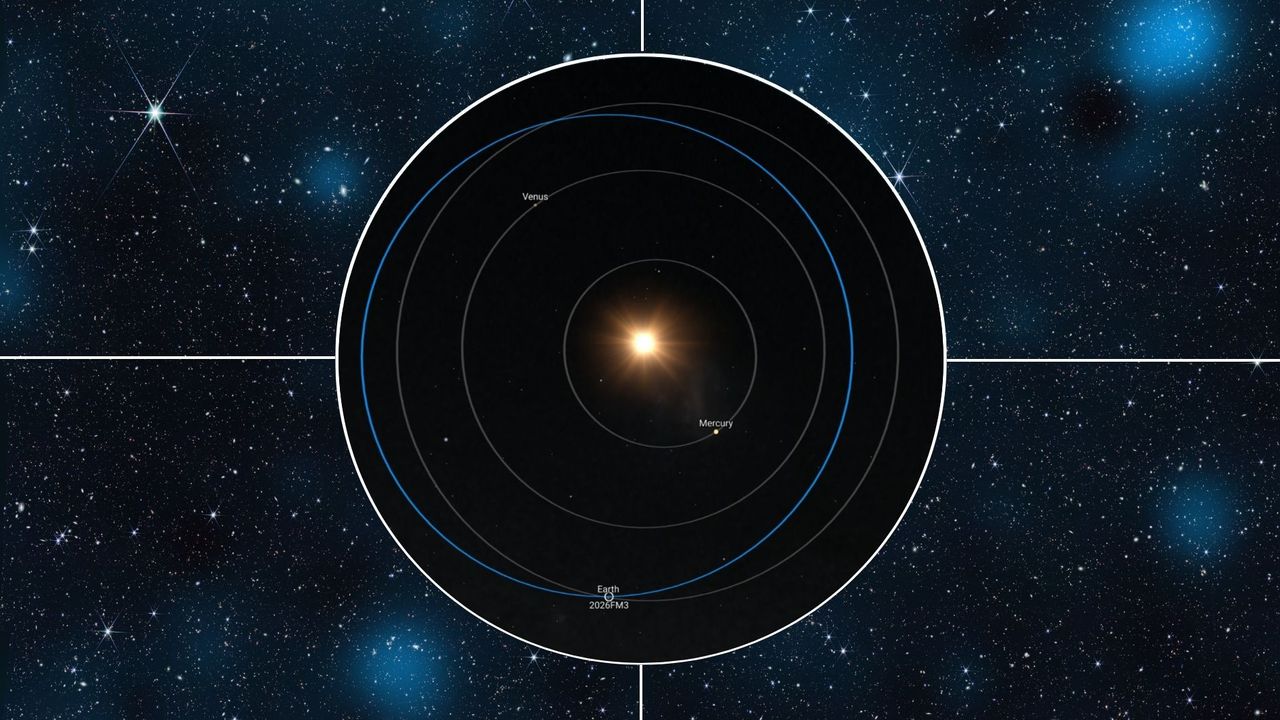
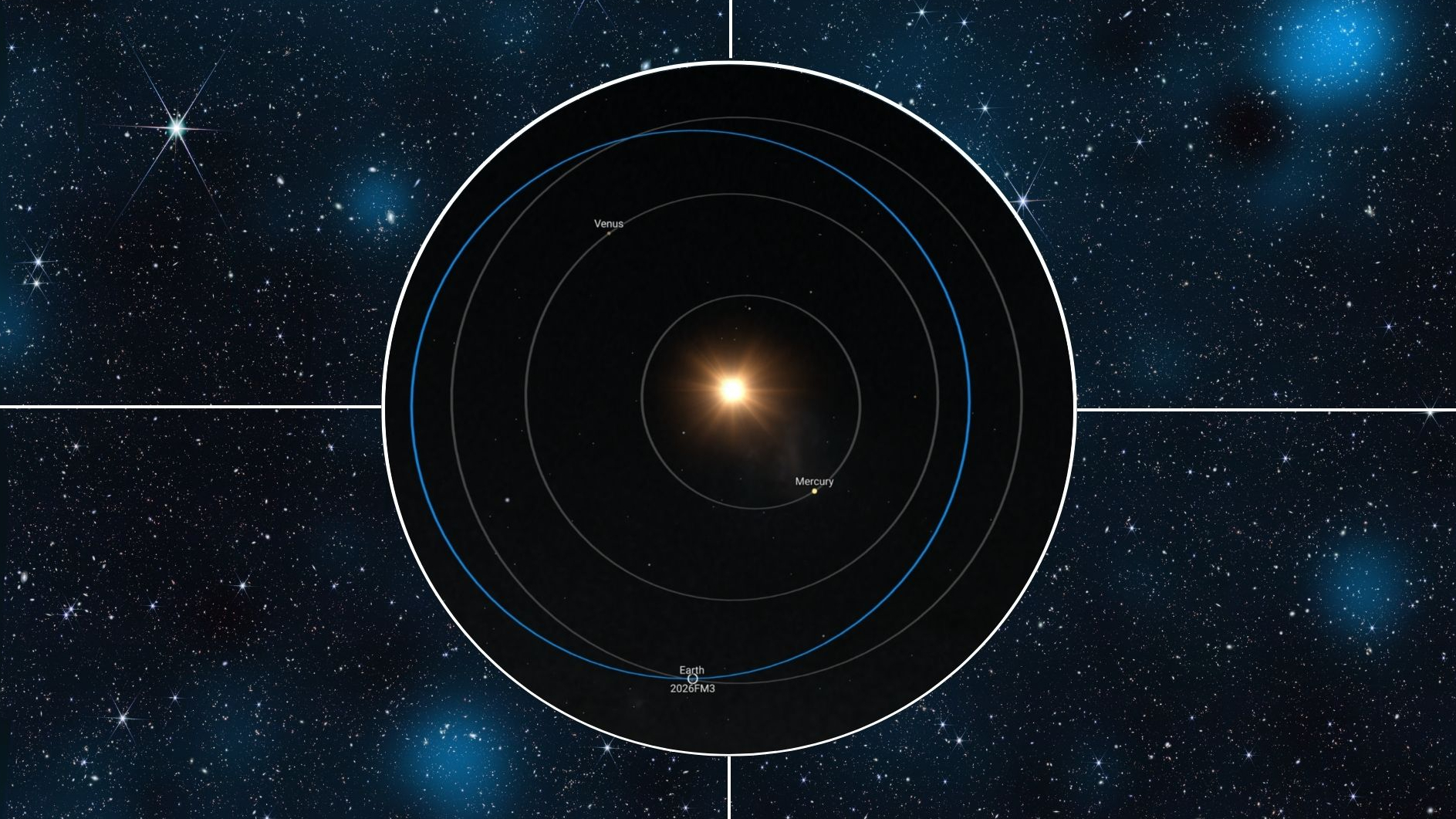
 The asteroid will pass a little over (Image credit: Background: NASA JPL, NASA/STScI/J. DePasquale/A. Pagan. Inset: NEO Coordination Centre, ESA) Share this article 0 Join the conversation Follow us Add us as a preferred source on Google Newsletter Get the Space.com Newsletter
 Breaking space news, the latest updates on rocket launches, skywatching events and more!
Contact me with news and offers from other Future brands Receive email from us on behalf of our trusted partners or sponsors By submitting your information you agree to the Terms & Conditions and Privacy Policy and are aged 16 or over.You are now subscribed
Your newsletter sign-up was successful
Want to add more newsletters?
An account already exists for this email address, please log in. Subscribe to our newsletterA car-sized asteroid will buzz Earth at a little over half the Earth-moon distance late tonight (March 24), just three days after its discovery by the Zwicky Transient Facility at the Palomar Observatory in California.
The close encounter between Earth and the asteroid designated 2026 FM3 will occur at 10:07 p.m. EDT on March 24 (0207 GMT on March 25). The flyby will see the solar system object pass 147,836 miles (237,918 kilometers) from our planet's southern hemisphere — only 0.619% of the distance to the moon — while travelling at 11,461 miles per hour (18,444 kilometers per hour), according to NASA.
Article continues belowEarly observations have revealed that the asteroid travels a near circular path around the sun that intersects Earth's orbit twice over the course of its 354-day period. The asteroid's closest known brush with our planet occurred in September 1965, when it missed Earth by just 30,559 miles (49,181 km) — a hair's breadth in astronomical distances.
However, current observations show that 2026 FM3 will make no such close approaches to Earth over the next 100 years, and it is far too small to be considered a potentially hazardous asteroid by NASA's Center for Near Earth Object Studies regardless.
The dense gaseous shell of Earth's atmosphere forms a protective barrier against smaller asteroids, which can on occasion be seen forming brief, fiery trails in the sky in the form of meteors, or "shooting stars". Larger pieces of debris create dramatic fireballs, as was seen in recent events that occured over Ohio and Texas, which can fragment to scatter chunks of debris over the land below.
2026 FM3 is just one of over 41,000 near-Earth asteroids discovered to date — a number that is likely to swell dramatically as powerful new observatories come online, such as the Vera Rubin Observatory, which pinpointed the locations of 2,000 previously unknown asteroids in its initial dataset.
Get the Space.com NewsletterContact me with news and offers from other Future brandsReceive email from us on behalf of our trusted partners or sponsors Anthony WoodSkywatching Writer
Anthony Wood joined Space.com in April 2025 after contributing articles to outlets including IGN, New Atlas and Gizmodo. He has a passion for the night sky, science, Hideo Kojima, and human space exploration, and can’t wait for the day when astronauts once again set foot on the moon.
View MoreYou must confirm your public display name before commenting
Please logout and then login again, you will then be prompted to enter your display name.
Logout MORE FROM SPACE... 1Future Artemis missions could use fiber-optic cables to monitor moonquakes
- 2Hubble revisits the Crab Nebula after 25 years | Space photo of the day for March 24, 2026
- 3Arriving safely on Venus and Titan: Different atmospheres affect heat shields differently, study shows
- 4The best Amazon Big Spring Sale deals for 2026: Sizeable savings on drones, Lego, streaming, star projectors and much more
- 5Get one last look at the Pleiades before it disappears from the spring sky