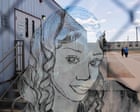
 Guardian composite image, featuring a drawing of Olivia by her sister, Estefania. Composite: The Guardian/Getty Images/Courtesy of OliviaGuardian composite image, featuring a drawing of Olivia by her sister, Estefania. Composite: The Guardian/Getty Images/Courtesy of OliviaA day in the life of a 19-year-old in ICE detention: ‘I feel that this nightmare is not going to end’
Olivia has been detained for months at the sprawling Dilley center in Texas. She has lost 20lbs, and wakes up every day with a headache
Each day in detention feels like 48 hours for Olivia.
The 19-year-old asylum seeker from the Democratic Republic of the Congo has been at the Dilley Immigration Processing Center in Texas for more than four months.
“Another day passes, another night comes,” she said. “And sometimes I feel that this nightmare is not going to end.”
She is one of about 5,600 immigrants, more than half of them children, who have been detained at the sprawling Texas facility since it reopened last year. In recent months, human rights advocates, pediatricians and lawmakers have all called on the Trump administration to shut down the facility – and to stop incarcerating children.
Olivia was apprehended with her mother and two younger siblings in November. Then they were separated, reunited at Dilley and separated again after ICE agreed to release them, but not her. Since then, Olivia has grown increasingly listless as the days pass.
Speaking to the Guardian over video call, she recounted her day-to-day life.
12am: sleepless nights
The nights, Olivia said, are the hardest.
During the first weeks after her arrest, she would scream in her sleep, but now she struggles to sleep much at all. “At night, when no one is paying attention, everyone is asleep, that’s when I can cry,” she said. So she paces, and she cries until she’s too exhausted to keep her eyes open.
Usually, this is at about 3am.
Not long afterwards, the nightmares begin. Sometimes she thinks about her brother Manuel, who drowned when he was eight years old, during her family’s journey from South America to the US. She, her mother and her younger siblings – Manuel, Estefania and Joel – had fled political persecution in DRC, stopped over in South America, and completed their long journey to the US in December 2022.
She feels sad that she and her family been through so much, kept fighting to survive, kept going even after they lost Manuel – only to end up at Dilley.
Other times, she wakes up thinking about everything that has happened since her family was apprehended.
Five months ago, she was living in Maine, with her mother; Joel, who is now 17; and Estefania, 14, awaiting a final decision on her family’s asylum case. Olivia had recently graduated high school, and completed a certification to become a nurse’s assistant.
After the family’s asylum case was denied, and their lawyer appealed the decision, but in the meantime the family decided to leave the US and seek asylum in Canada. They were almost immediately detained at the northern border.
Olivia’s mother and siblings were sent straight to Dilley – a former medium-security prison 70 miles (113km) south of San Antonio. But because Olivia was 19, legally an adult, authorities separated her from her family and moved her from one detention center to another, and then another. She was made to wear an orange jumpsuit – just like in the crime procedurals she used to watch on TV.
Immigration officials wouldn’t answer her questions about where she was, or where her family was. In nightmares now, her mind flashes back to her time at those detention centers and the shackles she had to wear for long stretches. During a call with the Guardian, she stood up to show the scars they left on her wrists and ankles.
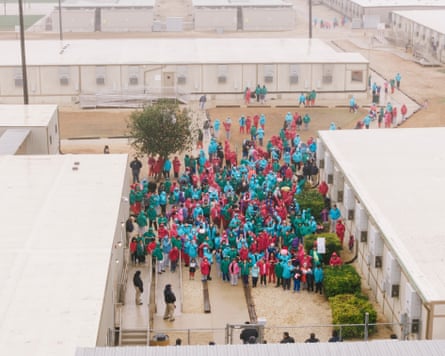 Detainees at the South Texas Family Residential Center wave signs during a demonstration in Dilley in January. Photograph: Brenda Bazán/AP
And she thinks about the cold. The third facility where she was held, somewhere in New York, she calls “the fridge”. Officials had confiscated her coat, so she was wearing only one layer. “I had never felt as cold as I did in this place,” she said. Now at Dilley, she sleeps with a coat on, even on warm nights, because she still hasn’t been able to escape the feeling that she’s going to freeze.
Eventually, she too ended up at Dilley; but she was held separately from her family, along with about 225 other single, adult women. A mental health professional who evaluated her there, as part of her immigration case, said that she presented with symptoms of post-traumatic stress disorder (PTSD) and major depressive disorder.
6am: ‘Another day passes’
Most of Olivia’s mornings at Dilley start in the same way: she wakes up at around 6am to eat breakfast. Usually, it’s pancakes or bread, a boiled egg, milk and some coffee. It’s not great, but it’s better than what they get for lunch or dinner, so she tries to eat at least a little bit.
Then she goes back to sleep for a few more hours, until 11am or noon. When she wakes up, she usually has a headache. She needs contact lenses but her prescription expired about a month ago, and she hasn’t been able to see an optometrist, so she’s constantly straining to see. The harsh lights at the detention center makes it worse.
Some days, she passes the whole day in bed – she has little energy or motivation to get up.
There are a few days when she manages to walk around, or chat with some of the other young women at the facility. It was one such day, during her second week at Dilley, that she discovered that her mother and siblings were being held in a different part of the same detention center.
Another girl had invited her to walk to the library together. That’s when she heard a distant voice, calling: “Olivia! Olivia!” She couldn’t see well without her contact lenses, but she recognized the voice: “I told my friend that I had heard my sister’s voice, and she said that that could not be possible.”
But Olivia couldn’t let it go. So her friend helped her locate a family counselor, who confirmed it: her mother and siblings were indeed at Dilley. The next day, she was able to visit with them.
“We hugged, my mother cried, and we talked about things that had happened to us,” she said. “We cried a lot, but at the end we laughed because we were together.”
Olivia found out that every day since she’d arrived at Dilley, Estefania would go outside and yell out her sister’s name – just in case. It was a stroke of luck that Olivia heard her.
After that, the officials at Dilley offered them an hour together on weekdays and three or four hours on Saturdays. The rest of the time, Olivia was alone.
She often cried after seeing them. She worried about Estefania, a bubbly and active teen who loved to make art who, since coming to Dilley, had lost interest in drawing. She was angry that Joel, a promising football player who was planning to enroll in college in the fall, had suddenly changed into someone who seemed almost too grown-up for his age.
When lawyers were able to secure her mother and siblings release in mid-March, Olivia said it was the “happiest day of my life”. But the day after that was the saddest. She didn’t know when she’d be able to see them again.
The Department of Homeland Security said it was within policy to shackle Olivia. The agency also denied separating families, despite being informed that Olivia had been separated from hers.
2pm: ‘I feel a huge emptiness inside’
Now that her family is gone, the afternoons tend to drag on even more.
There’s a small TV in her room, which she shares with another woman. Sometimes they watch movies, or the news. Olivia prefers to watch crime procedurals or hospital dramas (her favorite is The Good Doctor) but her roommate only speaks Spanish so usually they settle on telenovelas.
Early on, she made a few friends who would invite her to play volleyball or soccer in the yard, but she stopped because she got worried about injuring herself and having to deal with the medical system at the facility. And besides, most of the other young people she knew have been released. “As time went by, people were leaving, and I started to lose my mind,” she said. “Basically, I stopped doing things.”
Several times, Olivia said, immigration officials have come to her, told her that she has a deportation order, and asked her to sign papers consenting to her deportation. None of it made sense, because Olivia has a “stay of removal” – which means she can’t be deported – while her asylum case is being appealed.
In a comment to the Guardian the DHS said: “Being in detention is a choice. We encourage all illegal aliens to take control of their departure.” It urged immigrants to self-deport using the agency’s app.
Olivia’s appeal process could take a year – and she doesn’t know how much longer she can bear being detained at Dilley.
“I feel a huge emptiness inside,” she said. She struggles to eat – she doesn’t have an appetite, and the food doesn’t taste very good either. She has lost about 20lbs (9kg) since arriving at Dilley.
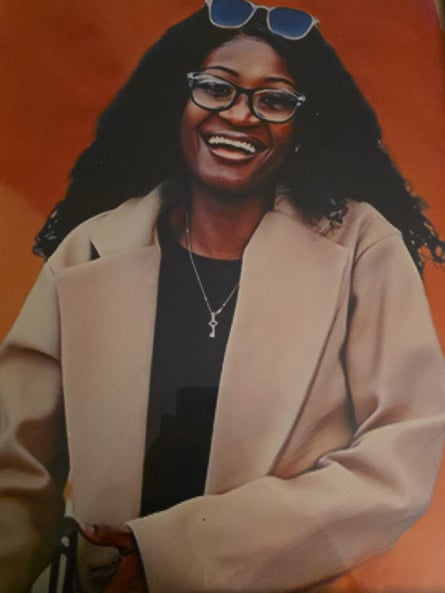 A painting of Olivia, done by her uncle. Photograph: Courtesy of Olivia
In a report published last week, the legal services non-profit Raíces and advocacy group Human Rights First documented “widespread due process violations, inhumane conditions, and lasting physical and psychological harm inflicted on families” incarcerated at Dilley. Nearly 4,000 medical professionals sent a letter to Donald Trump calling for the release of all children held at the facility, writing that detention was causing “predictable, severe, and lasting harm” to their health.
In a statement sent to the Guardian, DHS denied the poor conditions at Dilley detailed in the report. Detainees said they found hair, worms, bugs, dead flies in their meals.
At about 2pm every day, however, Olivia feels a pang in her belly. Back in Maine, that’s when she used to get back from her shift working at a hospital cafeteria. “I would take a shower, and my mother would cook my favorite food, which is an African dish of grilled pork chops and a vegetable. And I’d drink mango juice,” she said. Those were her favourite afternoons.
The best days now are the ones when she gets to speak with her family over video calls. Joel shares Bible verses with her. Her sister cries a lot, but she also imagines all the things they’ll get to do once Olivia is released. And her mother, she can tell, just feels bad.
“My mother is a typical African mother and has a lot of restrictions. You can’t do this, you can’t do that,” she said, laughing. But nowadays she tells Olivia she can do whatever she wants with her life. Olivia thinks she feels guilty for everything her children have had to endure.
To spare her mother, Olivia has mostly avoided talking about how bad she has been feeling. She didn’t tell her mother that she was one of very few Black people in her part of the facility, and that the other detainees would often make racist comments about her hair. She didn’t share that one time, when her roommate became really sick, some of the other detainees told her she had better hope the girl didn’t die – “because she was in a room with a Black person and if she died they would blame me”, Olivia said.
7pm: thinking of Maine
On some evenings, she reads through messages from her friends back in Maine. She had a huge social circle, and a WhatsApp group chat with about 30 people. Now a couple of them are in regular touch, and send her letters with updates and Bible verses. “Honestly, it’s not a very good feeling to talk to my friends because I see that everybody has gone on with their lives and my life is interrupted,” she said. “A friend of mine is pregnant. And there’s going to be a baby shower, which I would not be able to attend.”
If she were in Maine now, she might have been starting a new job as a nurse’s assistant. Eventually, she wants to become a nurse and work with children. She and her friends had also made plans to travel, to visit one US state per year until they had toured the whole country.
Now she thinks, instead, about when she’ll escape Dilley’s sprawling beige landscape of flat dormitory buildings and trailers.
As soon as she’s back in Maine, she’ll head to the eastern shore, to her favorite island off the coast. “I used to go there when I was sad, and have an ice cream,” she said. “I want to see that place again, and be in nature.”
-
The Guardian is only using first names for Olivia and her family, to protect their safety and privacy.
- ICE (US Immigration and Customs Enforcement)
- Trump administration
- US immigration
- US politics
- Democratic Republic of the Congo
- Texas
- Africa
- features