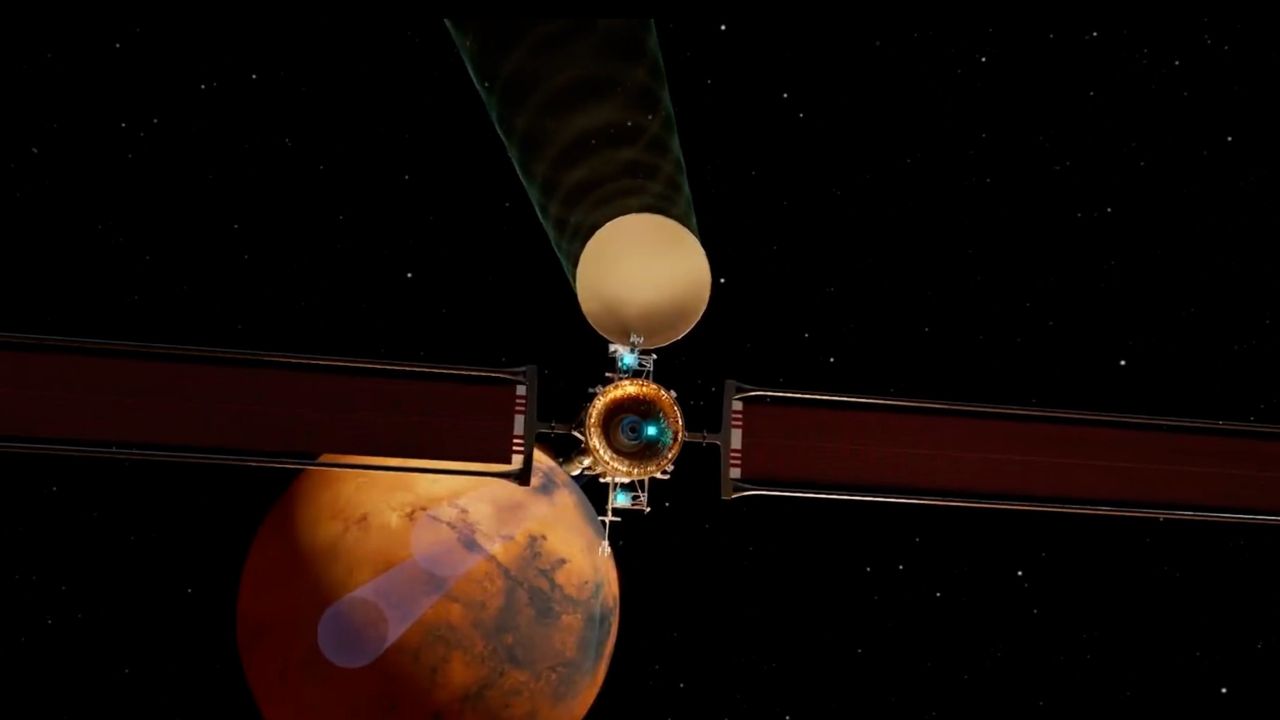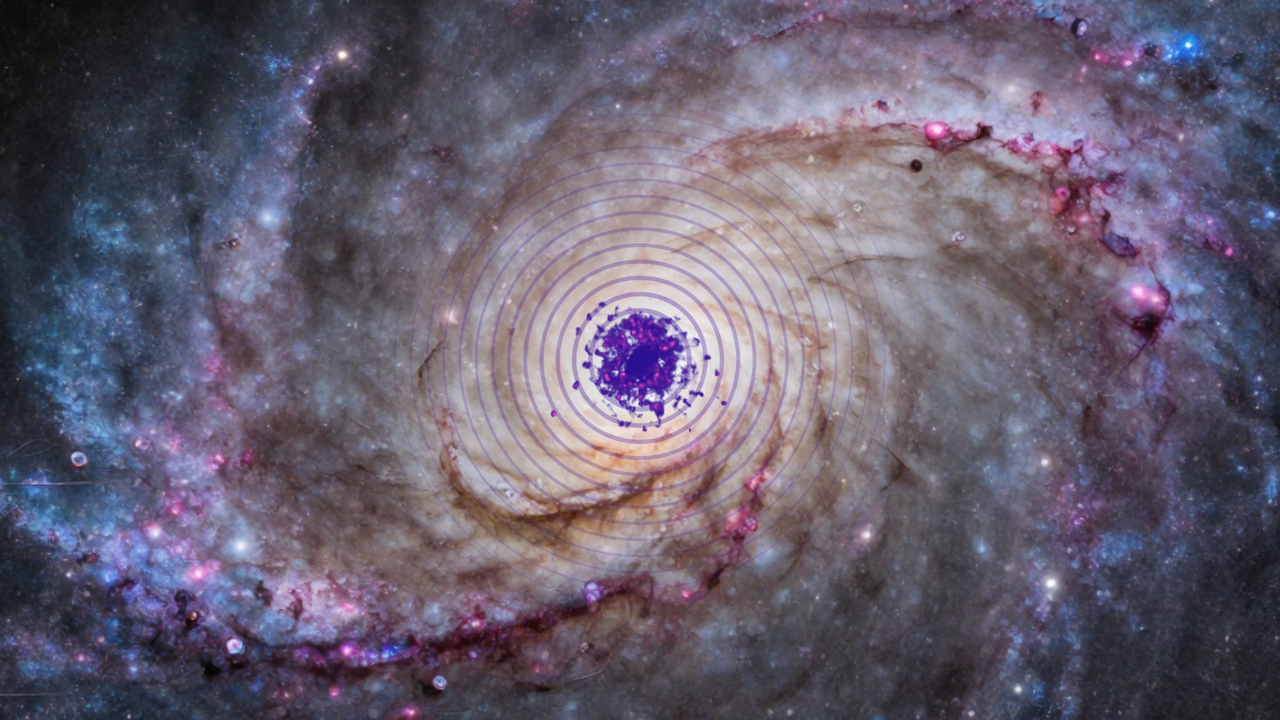
One of the most hotly debated mysteries in astronomy is set to continue, as new research fails to rule out self-annihilating dark matter as the source of gamma-ray emissions from the heart of the Milky Way. Known as the Galactic Center Excess, a spherical gamma-ray glow extending out for thousands of light-years from the core of our galaxy, this high-energy light has baffled researchers for over a decade.
While several possible explanations for the Galactic Center Excess have been put forward, including a population of rapidly spinning neutron stars called pulsars, one of the most prevalent has been a specific type of dark matter particle. Dark matter is the mysterious stuff that accounts for 85% of the universe's matter. It is effectively invisible because it doesn't interact with light or with "ordinary" matter composed of atoms. That fact has led to many possible dark matter candidate particles being proposed, including some that self-annihilate. This is akin to what happens when an electron meets its antimatter counterpart, or positron. The two annihilate each other, releasing energy into the cosmos.
For self-annihilating dark matter, these particles would be their own antiparticles, meaning when they interact, they would annihilate and release energy as gamma rays. With dark matter outweighing ordinary matter by a ratio of five to one, one might expect this annihilation to be occurring constantly, flooding the cosmos with gamma rays, but dark matter rarely interacts with itself in this model. Thus, dark matter annihilation is only a factor when this mysterious stuff is densely clustered in a region like the heart of a galaxy.
Unfortunately, investigating the heart of the Milky Way is challenging indeed.
"Interpreting the signal is particularly difficult because the Galactic Center is an exceptionally bright and crowded region of the gamma-ray sky," team member and University of Vienna researcher Florian List said in a statement.
Getting to the point
To investigate if annihilating dark matter could indeed account for the Galactic Center Excess, List and colleagues turned to machine learning trained on more than a million simulated gamma-ray observations. Previous similar approaches had pointed to comparatively bright, unresolved light sources as a potential source of the Galactic Center Excess. However, this new research showed that these point sources, including pulsars, would be extremely faint, and that is good news for scientists who favor annihilating dark matter as the cause of these gamma rays.
That is because, whereas previous research has suggested just a few hundred pulsars could be enough to account for the Galactic Center Excess, these findings indicate that the pulsar population at the heart of the Milky Way would have to be greater than 35,000.
"Our new analysis shows that the sources would have to be so faint that they would be almost indistinguishable from the emission expected from annihilating dark matter," team member Nick Rodd, a scientist at the Lawrence Berkeley National Laboratory, said.
While this research may keep dark matter in the game as a plausible explanation, it far from confirms the annihilation of this mysterious stuff as the source of the Galactic Center Excess. "The origin of the Galactic Center Excess is one of the longest-running debates in astrophysics," List said. "Our work does not show that dark matter is responsible for the signal. However, it suggests that it is still too early to rule out this possibility."
The team's research was published on Thursday (Feb. 5) in the journal Physical Review Letters.
View MoreYou must confirm your public display name before commenting
Please logout and then login again, you will then be prompted to enter your display name.
Logout Robert LeaSenior Writer
Robert Lea is a science journalist in the U.K. whose articles have been published in Physics World, New Scientist, Astronomy Magazine, All About Space, Newsweek and ZME Science. He also writes about science communication for Elsevier and the European Journal of Physics. Rob holds a bachelor of science degree in physics and astronomy from the U.K.’s Open University. Follow him on Twitter @sciencef1rst.