
A Guardian investigation reveals how the prediction market can shape news – and how it rules on ‘the truth’
By Aisha Down“Horekunden” was rapidly losing patience.
His frustration was with the Institute for the Study of War, a US thinktank which produces a daily map of the frontline in Ukraine.
For Horekunden, and other anonymous gamblers, the map was a “disjointed, incoherent mess … like the painting of a five-year-old”. Therefore it was no use to them in their aim: to settle a bet on the online prediction market Polymarket.
The map they were unhappy with depicted the city of Kostyantynivka, which Ukrainian troops have been holding for five months amid shelling and swarms of drones. Thousands of civilians still live there.
There is now more than $500,000 (£371,000) staked on whether Russia will capture Kostyantynivka this year . These bets will be settled if the ISW releases a map showing Russia holds the city’s train station.
In a thriving online economy, thousands of people are discussing how to profit from war. They are betting on Ukraine. They were betting on the US-Iran ceasefire – $280m in play. They are betting on whether the US will invade Iran – $7.5m wagered.
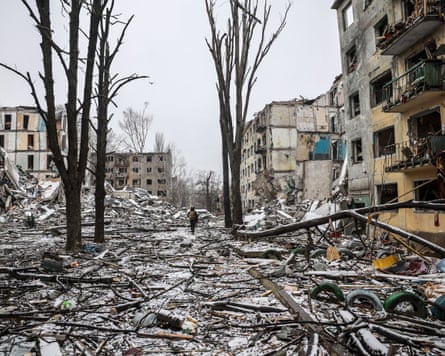 A Ukrainian serviceman walks in the rubble of residential buildings in Kostyantynivka, Ukraine. Polymarket users have bet on whether Russia will take the city. Photograph: Oleg Petrasiuk/24th Mechanized Brigade of Ukrainian Armed Forces/AFP/Getty Images
In groups hosted by the messaging app Discord, they debate what might come to pass. “Shit can go really wrong. WW3 may happen,” wrote a user this week who had money on whether the US would strike the oil terminal on Iran’s Kharg Island.
“As long as America gets Iran’s uranium I can see all of the above peacefulness materializing,” wrote another, who appeared to be gambling on this week’s ceasefire.
And, sometimes, they appear to be collaborating to influence the course of events, or at least how events are recorded. Critics have called this immoral; US senators have called for Polymarket to be regulated.
Polymarket, however, views itself as a source of truth.
Several weeks ago, amid reports that it appeared to be hosting insider bets on US strikes against Iran, it posted a “Note on Middle East Markets”.
“After discussing with those directly affected by the attacks, who had dozens of questions, we realized that prediction markets could give them the answers they needed in ways TV news and X could not,” it said.
The rise and rise of Polymarket
In July 2024, shortly before Donald Trump was re-elected in the US, Polymarket had reported about $400m total traded on its platforms that year. It now can trade upward of that in a single day. It calls itself a “prediction market” – a way to gather data on the future by offering the public a way to bet on it.
But longtime users say it increasingly resembles a casino – where everything, from Trump’s fury to the second coming of Jesus Christ can be monetised. So where they can, players in this powerful “casino” have started trying to shape the world to secure a payday.
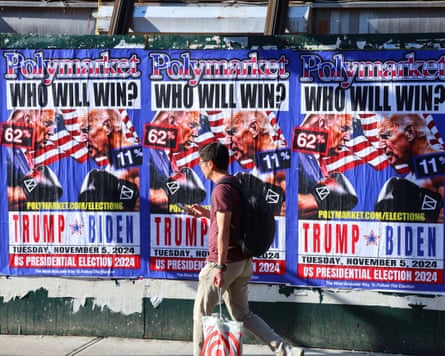 In July 2024, about $400m had been traded on Polymarket’s platforms. Photograph: Abaca Press/Alamy
Polymarket gamblers recently threatened an Israeli journalist, demanding he change his copy so that they could win a bet over whether Iran had struck Israel on a given day. Experts say that users on Polymarket might be able to manipulate broader markets, with effects that could ripple out to institutions and pension funds.
As for the Ukrainian frontline, after venting about ISW’s map on the Discord channel, Horekunden decided to take things further. He appealed to another user, @tsybka, whose X profile describes him as a “top 0.001% trader” on the platform.
“You managed to contact them once before with your outreach, so I’d appreciate it if you could try passing this along,” Horekunden wrote.
“This is nonsense, they won’t listen to anyone,” replied @tsybka, who did not respond to an inquiry from the Guardian.
“Either way this map is so fucking bad it’s incredible,” he wrote. Then he decided to telephone ISW himself. “Unfortunately there’s nothing we can do because all the other mappers are too easy to bribe.”
The ISW insisted it did “not engage with the users or representatives of such platforms”.
“We strongly condemn and have never consented to the exploitation of our products for the abhorrent purpose of gambling on war,” said a spokesperson.
‘No one wants to make money off war or people dying, but …’
“I love to gamble,” said Joseph Francia.
Now in his early 30s, Francia counted cards in casinos while studying economics at Berkeley, and spent weekends in Reno, Nevada, playing blackjack. He’s not a thrill-seeking “Yolo” (you only live once) gambler, he said: he likes to bet when he has an edge on the house.
At university, he and a friend decided to collect data from a number of offshore sportsbooks, and start placing arbitrage bets: playing on the discrepancies in odds given by different betting sites.
“If the odds on the Lakers are really good on one site, and the odds on the Pacers are really good on another site, you could bet on basically both teams on different sportsbooks and make guaranteed profit,” he said.
That project was a student lark in 2017. But in 2025, he remembered it when he was suddenly laid off from his full-time job, just as prediction markets were taking off.
“I’m a spiritual, religious person,” he said. “The more secular people would say, this opportunity is coincidence. But in my head, I was like, this is a sign of something to some extent. Let me lean into this.”
So Francia started Prediction Hunt, a Discord channel and online community where thousands of people gather to trade tips and ideas for how to make money – and bet smart – on Polymarket. The Guardian spent roughly three weeks in this Discord channel.
There are alerts to track “fade” bets, where you try to follow the smart money: profitable wallets were betting “yes” on the Iranian regime falling by 30 April, for example, while unprofitable wallets were betting “no”.
There are alerts to track potential insiders, so you can copy their bets: one of these appears to have an inside line on interest rate decisions by the US Federal Reserve.
 Women hold portraits of the late supreme leader of Iran, Ali Khamenei and his son Mojtaba Khamenei. Polymarket hosted bets on whether Mojtaba would take over from his father. Photograph: Majid Saeedi/Getty Images
And there are the arbitrage alerts, where you can guarantee yourself a profit by playing odds across multiple markets. In early March, one such alert pointed at two different sets of odds, between Polymarket and another online prediction market, Kalshi, on whether Mojtaba Khamenei would be the next supreme leader of Iran.
Here is how that would work: buy “yes” on Polymarket for 33.6 cents and “no” on Kalshi, a rival platform, for 47 cents. You would spend 80.6 cents for these two bets, but one of them is guaranteed to win – either Mojtaba Khamenei would or would not be named successor. The payout for a correct bet is $1, meaning the 19.4 cents difference is profit. Put down $1,000 and you would make $194 in profit.
“Those are really tricky because I think there absolutely is a gruesome aspect to it,” said Francia, asked about the bets on war.
“No one wants to make money off war or some amount of people dying. But at the same time, I’ve heard people say – like, if you’re in Ukraine, or in some country going through war and devastation, and you’re in the fog of war, right?
“You don’t know what’s propaganda, what’s true, what’s fake. Is your government saying everything’s safe because they actually believe so? Or because they want to instil confidence in their people? Those are legitimate questions and a good place to turn to is Polymarket.”
War betting is “tough frame”, said Mike Kane, another user of the channel. “I don’t know if it was Kalshi or Polymarket – they had a bet on, you know, when will troops be on the ground in Iran … I mean, those are real-world events that are going to happen. And it does have an impact on our lives.”
 Polymarket users might bet on how many times Donald Trump might say the word ‘ballroom’ in a speech. Photograph: Aaron Schwartz/EPA
The Guardian spoke to several other users of the Discord channel. A US high school student said he mostly played in the “mentions markets”, where users bet on how many times a public figure might say a specific phrase in a speech – for example, whether or not Trump might say the word “ballroom”.
It was easy to get an edge in this; the student studied transcripts of past speeches, by Trump and others, on YouTube. So far he’d made $200, he said, although he’d elsewhere lost money on sports bets.
Another named “Hacker666” said he mostly bet on sports, and declined to give further detail: “I dont give out personal information … Due to privacy concerns as i have received multiple threaths (sic) already because of my wealth.”
Anonymous group that rules on the truth
In July 2024, the US pollster Nate Silver joined the advisory board of Polymarket. Silver, known for his near-perfect prediction of the state-by-state outcome of the 2012 US election, was excited about this idea: he praised Polymarket and its “increasingly vital role in helping people understand and plan for the future”.
That year, Polymarket succeeded where Silver’s polling averages failed, accurately predicting Trump’s win in the 2024 US presidential elections.
Silver suggested Polymarket’s ability to monetise everything could be positive, allowing pollsters, statisticians and the interested public to study, in far greater depth, the hurly-burly of events.
It offered a “real-time data source” about questions that were otherwise “hard to quantify”, he said.
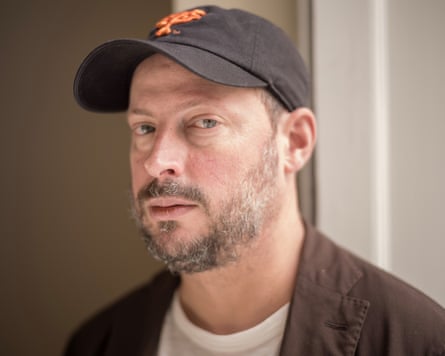 The pollster and author Nate Silver said Polymarket played an ‘increasingly vital role in helping people understand and plan for the future’. Photograph: Sarah M Lee
Markets are buying this. In October, the Intercontinental Exchange, the owner of the New York Stock Exchange, said it would invest up to $2bn into Polymarket – and would soon start distributing Polymarket’s sentiment analysis to investors. Goldman Sachs has cited Polymarket’s odds on the US-Iran conflict in newsletters; the Nasdaq has recently asked the SEC to approve listing binary options – yes-no Polymarket-like bets – tied to its index. Boosters say this is for the best. Polls are failing; mainstream media is missing the narrative. Prediction markets are “a ‘truth signal’ that moves faster than polls, pundits, or official reports”, wrote a Forbes columnist. “It used to be the news channels were the callers,” said Kane. “They used to be the final say in big events. Like this officially happened because CNN and Fox News said so. But thanks to Polymarket, there’s a new signal.” But if Polymarket can move larger markets, this raises dark eventualities. First is the possibility that gamblers on Polymarket could manipulate far larger markets. Many pools on the platform have only a few bettors, meaning small amounts of well-laid cash could change what Polymarket gives as the odds for a certain event. The platform’s data sharing “opens up an opportunity to manipulate financial markets by skewing the odds on Polymarket”, said Yash Kanoria, a professor at Columbia who works on market design. Larger markets might chase what they believe to be insider knowledge, or a “truth signal” – for example, that the Federal Reserve won’t change interest rates. Then there’s the issue of who decides Polymarket’s “truth” when the outcome of an event is in question.
On Monday, anonymous user “Harshad” asked in a Discord channel if there was “any chance” that he could still win his bet about whether US forces would enter Iran by the end of April. His money was on “no”.
But Polymarket appeared to be resolving the market to “yes”, after the US conducted an operation to rescue a crew member shot down on a mission over Isfahan over the weekend.
“Just sell bro,” wrote one user.
“I still think usa enter in Iran means official ground invasion like venezuela,” wrote Harshad.
“You have invade market for that,” said another user, referring to a separate bet on whether the US will seize control over a part of Iran’s territory.
“Read the rules,” said another.
 An F-15E Strike Eagle. Polymarket users debated whether a crew member shot down over Iran qualified as US forces entering the country. Photograph: Ben Margot/AP
At the moment, when there is a dispute, markets on Polymarket are settled by an anonymous group of people who hold a crypto token called UMA.
It’s an unusual way to decide what has happened. Some longtime users suggest it opens the platform to corruption. Different individuals hold different amounts of UMA, and therefore have different voting power.
It isn’t known who the largest UMA holders are, or what might affect how they vote. It is entirely possible that the people who finally settle a bet on UMA have large amounts of money staked on it. “It’s the protocol that you should vote the right way,” said Ben Yorke, formerly a researcher at Cointelegraph. “But [UMA] gets it wrong all the time. And there have been cases where votes are decided by, like, one or two very large UMA holders.”
UMA holders are coming to their own rulings about world events. There are tens of disputed markets on Polymarket, where some gamblers disagree with others about what really took place – for example, does an intercepted missile count as a strike? Does a social media post from Trump count as a formal declaration of a ceasefire?
The holders recently decided, for example, if US forces really did “enter Iran by 30 April”. They decided whether it can be said that the US and Iran really did reach a ceasefire this week. And they reviewed whether to pay out over $600,000 after Israel confirmed that it killed Muhammad Dawad, allegedly a Hamas explosives expert, on Monday, thus taking a “military action against Gaza” on 6 April.
Right now, their votes largely just affect whether anonymous users such as Harshad and “neverLose” cash out.
But if Polymarket becomes more of a “truth signal”, then the people who might decide what that truth is are a group of anonymous people who have chosen to own large amounts of a cryptocurrency token – and may have money on an outcome.
If this seems frightening – and fraught with corruption – some ask if it is any worse than the rules, and opacities, that govern more traditional markets. “It just feels like it’s the whole market, right? Look at, like, Nancy Pelosi and her stock portfolios outperforming everything, it’s really hard to say where the insider trading stops,” said Yorke. “That sort of makes prediction markets at least a little bit more clear, because at least you can track the wallets. With the S&P 500, no one knows, really, who’s buying stocks.”
The Intercontinental Exchange and Polymarket did not respond to requests for comment.
Explore more on these topicsShareReuse this content