
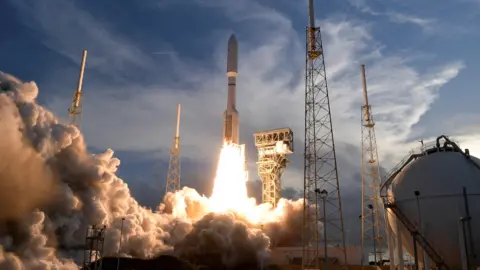
 ReutersA rocket carrying Amazon satellites takes off from Cape Canaveral, Florida, in April 2025
Amazon is aiming to build-up its satellite business to offer internet and mobile phone services by spending $11.57bn (£8.5bn) on an acquisition of Globalstar.
The deal, announced Tuesday, will allow Amazon to get thousands of satellites into low-earth orbit through the Amazon Leo project the company has been working on for several years.
Amazon said the Globalstar takeover fits its "long-term vision for space-based connectivity" and that it will deploy a "next generation" satellite system in 2028.
By doing so, Amazon will be in closer competition with Starlink, an increasingly popular satellite-based internet and phone service company launched by Elon Musk in 2019.
Starlink has a significant head-start on Amazon's Leo, which currently only has around 200 satellites in orbit.
Musk's company, which is private, says it already has more than 10,000 active satellites offering internet and mobile phone service to more than 10 million paying customers.
Starlink is a subsidiary of SpaceX and is likely a significant source of revenue for that company, potentially bringing in between $500m and $1.2bn from individual user fees alone.
SpaceX is preparing to become a publicly listed company this year, with a valuation expected to exceed $1 trillion.
Even with Globalstar's currently active constellation of about 50 satellites, Amazon Leo will need to significantly ramp up production to meet its goal of thousands of active satellites in orbit by 2028.
Amazon chief executive Andy Jassy said last week in an annual letter to shareholders that Leo already has commitments from Delta Airlines, JetBlue, AT&T, Vodafone, DIRECTV Latin America, Australia's National Broadband Network, and NASA to use Leo satellites for their offerings and operations once more satellites come online.
Amazon is taking over all of Globalstar's infrastructure, which includes operations in Louisiana, Georgia, Dublin, Ireland, Rio de Janeiro, Brazil, Toulouse, France, and two locations in California.
Globalstar started in 1991 as a satellite communications company.
It has a notable customer in Apple, through which it has offered since 2022 iPhone and Apple Watch users the ability to use their devices in an emergency "SOS" mode via its satellites.
Apple in 2024 took a 20% stake in Globalstar.
Amazon said on Tuesday that it had also reached an agreement with Apple to continue offering the "SOS" functionality on its mobile devices.
Like Amazon, Globalstar is a publicly listed company with a market valuation that has hovered around $10 billion this year.
Amazon's takeover price is offering investors $90 per share in cash, or the equivalent value in Amazon stock.
Another recent entrant into the satellite internet competition is Blue Origin, the rocket startup from Amazon founder and former chief executive Jeff Bezos.
The company said its satellite project, called TerraWave, is aiming to launch by the end of 2027 at least 5,400 satellites focused on offering internet connectivity to large businesses.