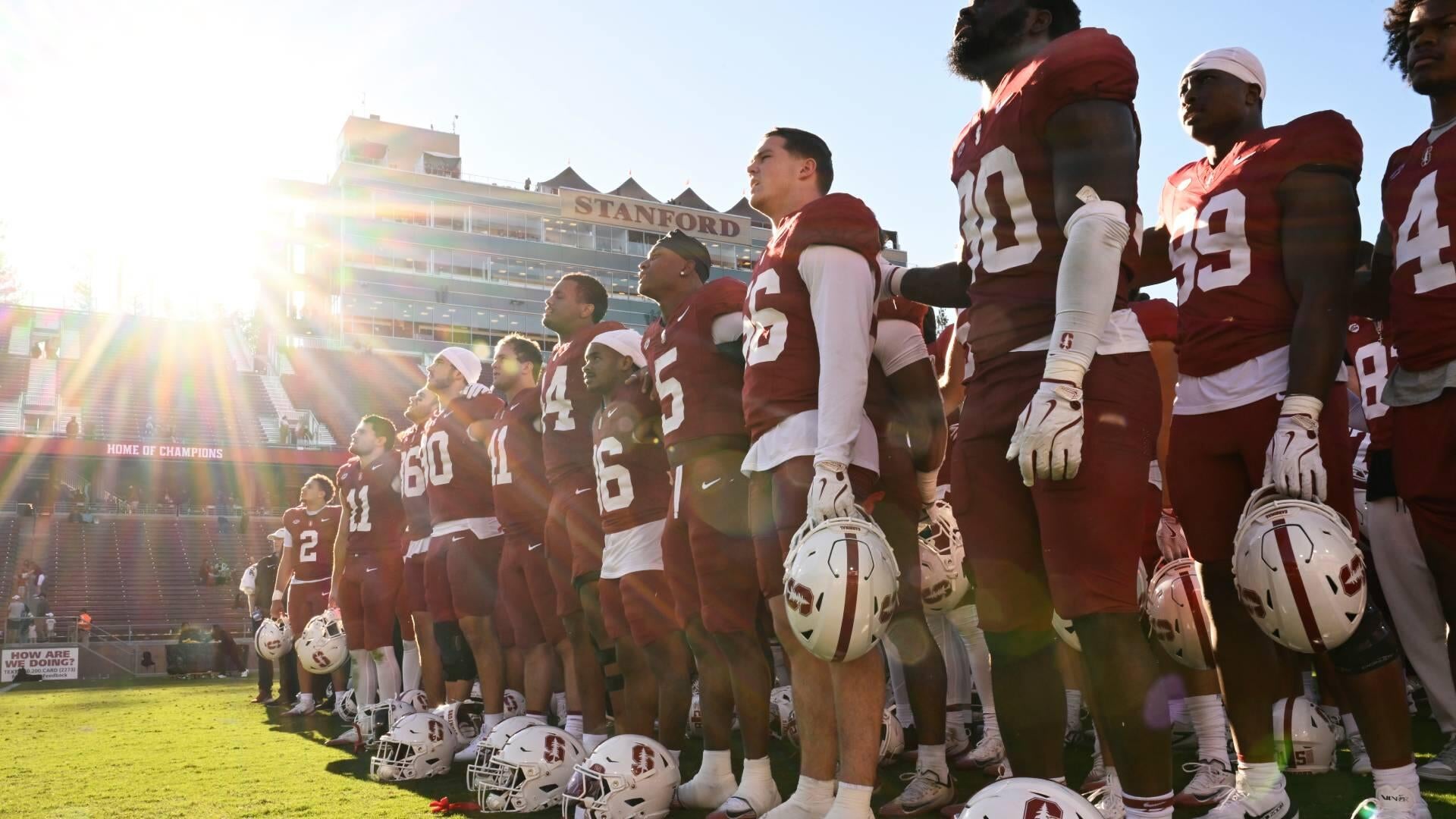
The Stanford offensive line calls themselves the "Tunnel Diggers Union." It's a colloquial term for now, but one day, there's a chance unionization comes to college athletics, and Stanford football players are determined to be at the forefront of that change.
They've established a player-led fraternity chapter with the goal of educating teammates, but the long-term objective is unionization and collective bargaining with the ACC in a future in which every football team has elected representatives. At Stanford, linebacker Ernest Cooper and offensive lineman Fisher Anderson serve as the elected player representatives.
High-minded conversations about the future of college athletics are often held without the athletes' voices, whether it's attorneys and advocates debating the issue on social media or conference commissioners and the NCAA traveling to Capitol Hill to lobby Congress for federal legislation related to college sports. A March roundtable at the White House did not include any current college athletes.
Employees or not?
Even a simple question CBS Sports has repeatedly asked often goes unanswered by players: Do you want to be classified as an employee of Stanford, the ACC or the NCAA?
"My honest answer is yes, but it's definitely multifaceted," Anderson said. "I think the two biggest reasons for me would probably the potential benefit of being an employee, such as creating a union and getting the benefits of a collective bargaining agreement. And I think it would also help our situation just practically on campus by the university standards."
"I see no reason why not," Cooper said. "I definitely agree that football is a full-time job, right? We're here year-round, we're training year-round, and guys are now blessed enough to get paid for the job they're doing. We're kind of already an employee of the university."
Athletes do not necessarily have to be full-time employees to unionize. Recently, gig workers in California unionized to fight for their rights. There is already conference involvement in player payments, and industry sources believe bargaining on a conference-by-conference basis would be easier than a school-by-school approach. Sources told CBS Sports that Big Ten athletes who receive revenue-sharing compensation get their 1099 tax forms from the conference rather than their individual schools.
Jason Stahl, the founder of the College Football Players Association, has worked with Cooper and Anderson for more than a year after a former Stanford team employee connected them. The players spent time getting to know Stahl and evaluating his intentions before deciding he was the right person to bring to the team.
Stahl has worked to organize players at multiple schools over the years, often quietly. In 2021, he was secretly brought into Penn State's team facility to speak with a group of Nittany Lions before a team employee accidentally walked in, exposing the meeting. Days later, ahead of that year's Big Ten Media Days, an independent news outlet incorrectly reported that Penn State players were unionizing. The effort effectively ended after then-Big Ten commissioner Kevin Warren got involved and the players stood down.
Stahl met with Stanford players in late June and early July, but this time the school was aware of the meetings. Cooper and Anderson also met with general manager Andrew Luck, a former member of the NFL Players Association. Luck did not respond to a request for comment from CBS Sports, but both players described the meeting as amicable.
"I would say it was neutrally positive, and in the sense that [Stanford] is completely aware of what we're doing," Anderson said. "And I think, legally, (they) are bound to have as minimal interaction with this sort of entity as possible."
Laying the foundation
Stahl stresses these efforts are only the foundation, but sees formal unionization as something that could happen by the end of the decade. He does not believe there is one specific path to that outcome, though congressional legislation appears unlikely to provide it.
The current Protect College Sports Act could be shelved if Congress does not vote on it before the August recess, and the bill does not address player employment or collective bargaining. Other organizations are also pushing for change, including athletes.org, which released a collective bargaining framework earlier this year.
"We need to build our strength because none of this matters until we get, let's say, over 1000 ACC football players, right?" Stahl said. "And then those same players have to sign over their collective bargaining rights to us. They have to authorize us to be their collective bargaining agent. So there (are) several different steps that this has to take, I would say over the next one to three years. But step one: create a fraternity chapter on your campus, engage in an ACC football organizing drive, and let's try to get every ACC football player in the nation signed up having a chapter with leadership on their campus."
Past attempts
The most public unionization effort in college athletics came at Northwestern in 2014 and ended a year later when the National Labor Relations Board essentially punted on whether athletes were employees. The board ruled it did not have jurisdiction because Northwestern was a private institution, while most other conference members at the time were public universities.
ACC commissioner Jim Phillips, who was Northwestern's athletic director at the time, did not respond to a request for comment through a spokesperson. When Northwestern players sought to unionize in 2014, Phillips said, in part, "Northwestern believes that our student-athletes are not employees and collective bargaining is therefore not the appropriate method to address these concerns."
In 2024, Dartmouth men's basketball players voted 13-2 to unionize, but later withdrew their petition due to uncertainty about the newly Republican-led National Labor Relations Board.
There is more openness to college athlete unionization than ever before, including within the ACC. Last week, Boston College coach Bill O'Brien called for a collective bargaining agreement, a structure he knows well from his time as an NFL head coach and general manager. Syracuse Chancellor and President Kent Syverud told ESPN in December that the best path forward is negotiation in which athletes have "a real collective voice in setting the rules."
Athletic directors such as Boise State's Jeremiah Dickey and Tennessee's Danny White have also publicly broached the topic, and many more administrators have done so privately.
As for the change Anderson and Cooper are working toward, it's doubtful they will be around to see it come to fruition.
"We also hold in tension the fact that we won't be the ones who finish the race that we just started, you know, Lord willing, we're both playing the NFL next year. The next generation of leaders in college athletics, not only at our school but at every school, has kind of enacted this players' association that, in turn, could form a union that creates the CBA," Anderson said. "There are a ton of things left that need to happen for this kind of vision to take place. I'm personally convinced of this future being the safest and best possible situation for a college football player. Conversely, I'm convinced that if we do nothing, or if this plan fails and no other plan is enacted, college football will be worse off in the future and may even implode on itself if left unchecked. It's definitely exciting stuff."
Add CBS Sports on Google Join the Conversation comments