Deep Dive
Immigration
An immigration court few have heard of is quietly shaping policy behind the scenes March 20, 20265:00 AM ET


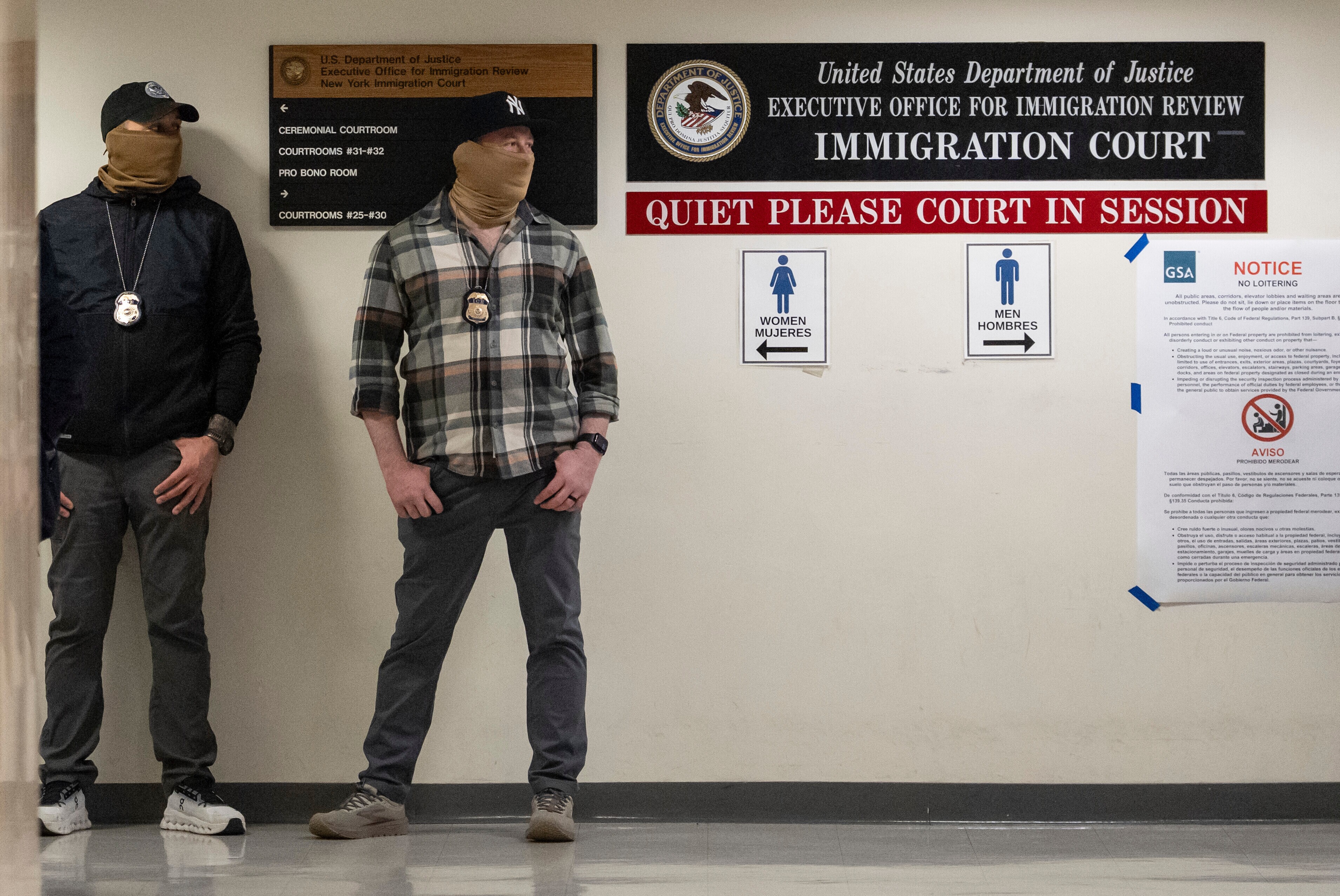
Cases in immigration courts nationwide can be appealed to the Board of Immigration Appeals. Here, federal agents stand outside an immigration court in New York on March 6, 2026. Yuki Iwamura/AP hide caption
toggle caption Yuki Iwamura/APThe Trump administration has reshaped a lesser-known corner of the Justice Department to set immigration policy and escalate mass detentions and deportations.
An administrative court known as the Board of Immigration Appeals has published a body of immigration case law that significantly narrows the due process and relief from deportation available for immigrants, an NPR analysis of its decisions shows.
The White House has done that by shrinking the size of the board by nearly half — and stacking the remaining slate of 15 judges with President Trump's appointees.
Last year, their decisions backed Department of Homeland Security lawyers in 97% of publicly posted cases; that's at least 30 percentage points higher than the average from the last 16 years.
Loading...
The board has made it harder for immigration courts to offer immigrants bond in lieu of detention. It's made it easier to deport migrants to countries other than their own. And a new proposed regulation would make it harder for people to appeal their immigration decisions at all.
The board did this last year while quickly pumping out 70 published decisions, a record number of precedent-setting cases.
"The board has an impact on immigration law that is much, much bigger than the number of people that are on it," said Andrea Sáenz, a former board judge appointed by former President Joe Biden and terminated by Trump last year. "That's because they have this ability to set immigration precedents and rules for the whole country."

Law
Trump wants to bypass immigration courts. Experts warn it's a 'slippery slope'
Immigration courts are housed within the Executive Office for Immigration Review, or EOIR, at the Justice Department and are not a part of the independent judiciary.
Immigration and Customs Enforcement attorneys appear before these courts to make their arguments about why someone should be removed from the country. Immigrants, meanwhile, appear before these courts to make their case about why they should be allowed to stay in the U.S.
The point of the Board of Immigration Appeals, former members and immigration attorneys said, is to catch mistakes made by immigration judges. After an immigration judge issues a decision, both the immigrant and ICE have a right to appeal that decision.

Immigration
His mistaken deportation was thought to be unique. But 'the problem is getting worse'
"The stakes are so incredibly high in the immigration proceedings and the law is so complicated and convoluted and difficult," said Victoria Neilson, supervising attorney at the National Immigration Project at the National Lawyers Guild. "Even assuming that [immigration judges] are acting in good faith, they're going to get things wrong sometimes because the laws are changing all the time."
Former BIA judge Katharine Clark had been at the DOJ for over 15 years and joined the Board in 2023.
She worked there until she received her reduction in force notice last year.
She said she reviewed thousands of cases in her role. These reviews were meant to catch overlooked details in an immigrant's case or testimony that could make the difference between approving or denying a deportation order.
"We lose an absolutely crucial method of catching errors by immigration judges who are absolutely flooded with cases," Clark said about the administration's gutting of the board. "In this situation, mistakes are essentially inevitable."

Immigration
U.S. has a quarter fewer immigration judges than it did a year ago. Here's why
A DOJ spokesperson, who provided a statement sourced to the agency, said EOIR is "restoring integrity to the immigration adjudication system, and Board of Immigration Appeals decisions reflect straightforward interpretations of clear statutory language."
"President Trump and the Department of Justice will continue to enforce the law as it is written to defend and protect the safety and security of the American people," the spokesperson said.
"Under the leadership of Chief Appellate Immigration Judge Garry Malphrus, the BIA is now recommitted to following the law and fulfilling its core adjudicatory mission."
Trump changed the makeup of the board
Within a month of taking office, leadership in the new Trump administration moved forward with a reduction in force, cutting the number of appellate judge slots on the board from 28 to 15. The first to be dismissed were the most recent hires: those appointed by Biden.
Those had been there longer were also a part of the reduction in force or resigned soon after.
Loading...
The changes in the workforce mirror a pattern seen across the federal government, especially immigration courts, where in the last year at least 100 judges were fired, and more resigned or retired. An NPR analysis last month found there are now a quarter fewer immigration judges than there were at the start of 2025.
Justice Department leaders have sent several memos and directives signaling to judges and appellate members that they want streamlined asylum and bond denials.
EOIR did not respond to a request for comment on the reduction in force. In the federal register notice announcing the reduction, the agency says a larger board wasn't more productive at reviewing more cases.
"Although many factors may have contributed to this outcome—including organizational and administrative challenges—the data demonstrate that increasing the Board's size has not brought about the hoped-for increases in productivity envisioned by prior expansions," the notice states.
Making rapid policy changes
BIA's public decisions set the precedent and tone for what immigration judges nationwide should do and how the general public should interpret immigration law and policy.
The number of such decisions has skyrocketed under Trump — as the board seeks to cement a particular interpretation of the law. An NPR analysis looked at BIA decisions over the past four administrations, going back to 2009.

Immigration
The DOJ has been firing judges with immigrant defense backgrounds
It found that in 2025, the agency published 70 decisions. That is nearly as many as all of the decisions posted publicly under Biden and the single highest yearly total since 2009.
Judges that make up BIA panels reviewing appeals could consider tens of thousands of cases a year, but the vast majority are never made public.
"There are thousands and thousands of unpublished decisions that come out of the board every year that are your ordinary cases. And then normally, you'd maybe have two or three dozen precedents that are intended to explain a part of the law in more detail," said Sáenz, now with Co-Counsel NYC, a nonprofit immigration law organization. "And they're intended to be binding on the whole country and all immigration judges and [U.S. Citizenship and immigration Services] to say, this is how you actually follow this piece of the law."
ICE attorneys generally receive favorable orders in most cases against immigrants before the board, according to the data included in NPR's analysis; 2015 was the only exception, where immigrants won more cases than the administration did.
But in 2025 the government won 97% of the public cases brought before the board — a new high. In one of two cases in which the board did not side with DHS, DHS attorneys failed to appear at the initial hearing.
Loading...
Already in 2026, NPR has tracked 21 decisions with DHS winning all but one of them, according to an NPR analysis of published decisions. The one case where the board ruled in favor of an immigrant involved the person withdrawing their appeal for asylum; they had already been granted another protection from deportation.
"Tangible effect on the lives of millions"
The administration "came in this time knowing we don't necessarily need to have immigration judges in place, we need to have the policy in place," said former BIA judge Homero Lopez, who was appointed by Biden and let go last year. "And the policy gets made by the board, not by the immigration judges."

Immigration
Democrats seek limits on who can serve as immigration judges amid mass layoffs
Neilson, the attorney at the National Immigration Project, said recent decisions "have formed the backbone for how immigration judges" are allowed to consider asylum and bond cases.
"They've issued several decisions that make it impossible or nearly impossible for those who can seek bond from the immigration judge to even get bond," she said.
The BIA has made at least three decisions that limit whether an immigrant can be granted bond to be out of detention while their case plays out in the courts.
In one case, Matter of Yajure Hurtado, the board ruled that immigration judges have to deny bond and detain noncitizens who entered the country illegally. Several district court judges have rebuked the Trump administration's mandatory detention policy. Still, EOIR leaders in January instructed immigration judges to defer to Hurtado's case as precedent and to deny bond.

Law
He was detained for 104 days. A year later, he's still fighting for the right to free speech
Federal appellate courts are now weighing in on the matter.
"The decisions that the board has made to take away the option of getting immigration bonds for various large groups of people has been by far the most impactful thing that has happened there since I left," said Clark, the former BIA judge. "It really has had a tangible effect on the lives of millions of people."
Other BIA decisions have paved the way for the government to more easily deport people to third countries — those countries other than their home country.

Immigration
ICE tried to send one immigrant to a country he never lived in. Then he lawyered up
Proposed rule meant to curtail further appeals
At the start of 2026, the administration started phasing in more changes. A newly proposed rule would have shortened the window for immigrants' appeals to the board from 30 days to 10, and made it easier for appeals to the BIA to be dismissed before being heard.
The rule was aimed at reducing the BIA's pending backlog, which topped 200,000 cases as of the end of last year, according to EOIR.
Five immigrant rights organizations sued the administration, successfully arguing the rule would limit due process by straining legal services in order to meet the shorter deadlines.

Immigration
Trump administration to shutter an immigration court, adding to judges' backlog
A federal district judge last week blocked most of the new rule from taking effect, calling it unlawful and unenforceable.
Judge Randolph Moss on the U.S. District Court for the District of Columbia said the government offered only one reason why immigration attorneys might see a reduced workload thanks to the rule: they would "quickly lose virtually every appeal that they bring before the Board."
"Defendants' argument is like telling Habitat for Humanity that a rule limiting new home construction will help, rather than hurt, the organization because it will incur fewer costs acquiring lumber and nails," Moss wrote in his opinion.

Immigration
NPR analysis shows skyrocketing number of 'no-shows' in immigration court
The lawsuit is still ongoing. EOIR said it does not comment on litigation-related matters.
"If someone feels like they had their fair day in court and they just didn't meet the legal standard, people can kind of accept that," Nielson said. "But if you give up everything to follow the rules and then suddenly the rules disappear, that seems very un-American."
This story used artificial intelligence to help analyze 634 cases that were decided by the Board of Immigration Appeals from January 1, 2009 to March 18, 2026. For each case, the AI tool determined whether the panel had decided for the Department of Homeland Security or for the immigrant. NPR reporters tested and verified the accuracy of the tool's results, and an independent lawyer who manually tracked court cases for 2021 and 2015 reviewed the analysis and confirmed the results.


