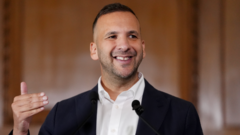
FILE – Britain’s Prime Minister Andy Burnham speaks to staff and media at 10 Downing Street in London, Monday, July 20, 2026. (AP Photo/Kirsty Wigglesworth, File)
 The accession of Andy Burnham as Britain’s new prime minister marks a watershed moment in contemporary British governance. Yet the structural tremors of his premiership are registering far beyond domestic administrative boundaries.
When a newly minted British prime minister deliberately bypasses the traditional mahogany drawing rooms of Whitehall to stage his inaugural foreign engagement on the damp dockyards of a naval installation, the theater carries an explicit strategic message. Hosting Ukrainian President Volodymyr Zelensky at Portsmouth on July 27 was ostensibly framed as an exercise in diplomatic continuity. Yet this maritime photo-op occurred against an abrasive transatlantic soundtrack that exposes a deepening structural chasm between London and Washington.
President Trump greeted the transition in Britain by publicly dismissing the United Kingdom as a stricken disaster, before arranging a separate audience with the Ukrainian leader. Mainstream editorial boards on both sides of the Atlantic have rushed to categorize these early frictions as little more than personality clashes or the inevitable static of a transitional phase. That diagnosis confuses superficial symptoms with deep-seated systemic causes. What is actually unfolding is the quiet, methodical downgrading of Washington from Britain’s indispensable partner to merely one major node among many within a fractured, multipolar global order.
For the better part of a century, the Atlantic alliance functioned on the unshakeable premise of a special relationship defined by shared geopolitical assumptions and an implicit British deference to American primacy. Successive governments in London treated Washington as the immutable anchor of national security, willingly subordinating continental economic and regional security interests to the overarching demands of Atlanticist orthodoxy.
Burnham’s political DNA, however, rejects this uncritical deference. Shaped by decades of municipal governance and a domestic mandate focused on regional devolution, industrial regeneration, and infrastructure renewal, his framework evaluates international partnerships through a hard-nosed lens of immediate economic utility rather than sentimental attachments to Washington.
When a leader’s primary political vocabulary prioritizes regional industrial capacity and domestic resilience, foreign policy ceases to be an ideological crusade and becomes an instrument of national self-preservation. Under this pragmatic calculus, European security architectures and regional continental alignments assume an entirely different weight. London is no longer positioning itself as the eager deputy sheriff of American hegemony, but rather as an autonomous European hinge for continental defense. This repositioning is taking place precisely at a time when the White House approaches European security through the lens of open transactional contempt.
The systemic implications for Western deterrence are profound and far-reaching. For generations, Washington has taken British strategic alignment for granted, operating under the comfortable assumption that London would inevitably fall in line regardless of domestic political churn or abrasive rhetoric emanating from the White House. But treating allied capitals with public disdain accelerates a process of quiet estrangement. When middle powers conclude that the risks and costs of tethering their national security to an increasingly erratic superpower outweigh the benefits, they naturally begin to diversify their diplomatic portfolios and hedge their bets across regional networks.
The United Kingdom has historically served as the primary translator and structural bridge between European capitals and American power. If the foundational anchor of that partnership begins to drift away from Washington’s orbit, every other European capital is forced to recalculate its exposure. The operational support architecture for Ukraine relies heavily on British intelligence, logistical coordination and political resolve. By opting to host Volodymyr Zelensky at a naval base on his very first full day of foreign engagement, Burnham signaled that European defense obligations will henceforth be managed closer to home, insulated from the volatile weather patterns of American domestic politics.
For lawmakers and defense planners across the U.S. Congress, this divergence should serve as a stark warning. Capitol Hill has long rested upon a bipartisan consensus that the special relationship is a permanent fixture of global stability. Yet as British political incentives pivot toward continental integration and domestic economic rebuilding, long-standing congressional assumptions about automatic allied compliance are colliding with cold geopolitical reality. If Washington persists in alienating its core European partners through coercive trade posturing and erratic diplomacy, the integrated command structures of NATO will inevitably face unprecedented strain.
The growing friction between Downing Street and The White House is not a temporary squall that will dissipate with a shift in weather. It reflects divergent national trajectories that have been widening for years. While Washington retreats deeper into isolationist nationalism and zero-sum economic posturing, middle-tier powers are rediscovering that maintaining sovereignty in a turbulent era requires building autonomous regional coalitions.
The special relationship is not ending with a dramatic diplomatic rupture or a formal treaty abrogation; it is quietly expiring through mutual indifference and strategic divergence, leaving American influence in Europe increasingly isolated and exposed at the worst possible historical juncture.
Imran Khalid is a physician and has a master’s degree in international relations.
Add as preferred source on Google Tags Andy Burnham Donald Trump United Kingdom Volodymyr Zelensky Volodymyr ZelenskyCopyright 2026 Nexstar Media Inc. All rights reserved. This material may not be published, broadcast, rewritten, or redistributed.
Comments: Link copiedMore Opinions - International News
See All
 Opinions - International The Iran War has reopened the world’s most dangerous shipping lane by Siyad Madey, opinion contributor 4 days ago Opinions - International / 4 days ago