The excitement was palpable as the four Artemis II astronauts spoke to Earth on day two of their journey around the Moon on a range of issues from faulty toilets to sleeping in space, to the weight they were carrying with this historic mission.
Commander Reid Wiseman started the live broadcast by recalling the "spectacular view of Earth from space".
"You can see the entire globe from pole to pole... It was the most spectacular moment and it paused all four of us in our tracks," he said.
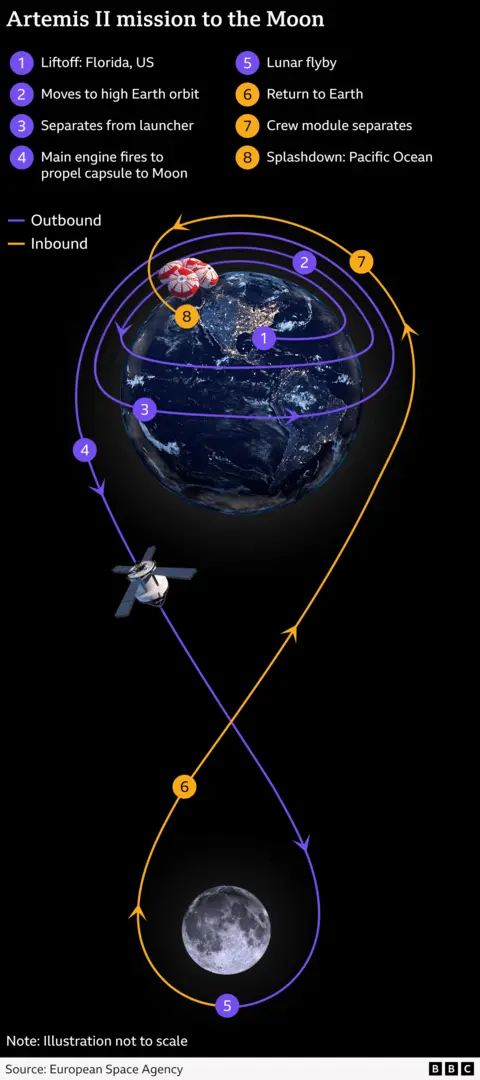
The team, which includes pilot Victor Glover and mission specialists Christina Koch and Jeremy Hansen, has completed a critical engine burn that could propel the Orion spacecraft to the far side of the Moon.
Why isn't Artemis II landing on the Moon?
Artemis II astronauts describe 'spectacular moment' in space after leaving Earth's orbit
Inside the mission to fly humans further than ever
Next stop, Mars? Why Nasa's mission matters
Artemis II is in orbit - what happens next?
The crew were accompanied by a plushie of their Moon mascot, designed by eight-year-old Lucas Yee from San Francisco, as they broadcast live from space.
Wiseman said the team realised the "gravity" of the historic mission, which will take them further from Earth than any other human has ever gone.
Their 10-day journey will ferry them up to 252,799 miles (406,840km) from Earth, exceeding the previous record set by Apollo 13 – 248,655 miles – in 1970.
The crew will not be landing on the Moon on this current mission, and will instead use it to prepare for a potential lunar landing by 2028.
"There is nothing normal about this... [It's a] Herculean effort," said Reid, who spent the early part of his career as a fighter pilot before getting selected by Nasa as an astronaut in 2009.
"Humanity has once again shown what we are capable of. It's your hopes for the future that carry us now on this journey around the Moon," added Hansen, who is the first Canadian to go to the Moon.
Hansen described his debut flight as an "extraordinary" experience.
"[It's a] tremendous amount of disbelief for me... I wish I could have gotten here sooner," he added.

The crew said their launch had been unexpectedly smooth despite some teething toilet issues – which got resolved after Koch, the crew's self-appointed "space plumber", dismantled parts of the toilet under instruction from mission control.
"I like to say that [the plunger] is the most important piece of equipment in space," Koch said with a laugh.
"It was a priming issue. Luckily we're [now] all systems go."
The windows are another part of the spacecraft not quite working as planned after they were dirtied by the astronauts spending a lot of time "glued to the windows" while taking photographs.
Nasa ground crews have instructed them to use some water and a dry wipe to clean them.
The Artemis II crew also shared how they managed naps in the tight confines of the Orion.
Koch, for instance, sleeps "suspended like a bat" while Glover fits himself into a narrow nook between space equipment and the ceiling of the spacecraft.
"It's comical... [but] more comfortable than you would think," he said. "It's nice to sleep with weightlessness again."
Asked by a presenter about existing divisions within the US, Glover urged Americans to unite behind the mission.
"No matter where you're from or what you look like, we are one people," he said.
It is unclear if the presenter's question referred specifically to divisions around Nasa's Artemis programme. Some take pride in it as an "America First project", while others have shown scepticism over its high cost and technical setbacks.
The Artemis II mission is also happening against the backdrop of deepening political divisions in the US.
"We call amazing things that people do 'moonshots' for a reason. This mission has shown us what we can do when we, not just put our differences aside, but when we bring our differences together to accomplish something great," Glover said.
"It has given us [something] we all can hold on to for the rest of our days. And I hope people will tune in and give us a chance."
The crew is expected to hold a few more video conferences over the course of the mission. A crucial one to watch will be after a planned communication blackout during which the Orion passes behind the far side of the Moon. All contact with mission control will be cut off for those 41 minutes.
ArtemisNasaThe MoonSpace explorationUnited States