
 Shortly after Artemis II splashdown on April 10, U.S. Navy divers captured underwater imagery of the Orion spacecraft’s heat shield. (Image credit: U.S. Navy) Share this article 0 Join the conversation Follow us Add us as a preferred source on Google Newsletter Sign up for the Live Science daily newsletter now
 Get the world’s most fascinating discoveries delivered straight to your inbox.
Become a Member in Seconds
Unlock instant access to exclusive member features.
Contact me with news and offers from other Future brands Receive email from us on behalf of our trusted partners or sponsors By submitting your information you agree to the Terms & Conditions and Privacy Policy and are aged 16 or over.You are now subscribed
Your newsletter sign-up was successful
Want to add more newsletters?
Join the club
Get full access to premium articles, exclusive features and a growing list of member rewards.
Explore An account already exists for this email address, please log in. Subscribe to our newsletterArtemis II aced its trial-by-fire reentry, despite some concerns that the Orion spacecraft's heat shield would not hold up, a ghostly photo of the spacecraft's underside taken soon after splashdown reveals.
NASA's preliminary post-splashdown investigation indicates that Orion's heat shield suffered minimal char loss, its ceramic tiles were uncracked, and the reflective thermal tape was still present in numerous places — ensuring that the capsule’s four-person crew was safe during their fiery plunge through Earth’s atmosphere.
"Initial inspections of the system found it performed as expected, with no unusual conditions identified," NASA officials wrote in a statement released Monday (April 20). "Diver imagery of the spacecraft’s heat shield initially taken after splashdown and further inspections on the recovery ship found the char loss behavior observed on Artemis I was significantly reduced, both in terms of quantity and size."
The Artemis II heat shield, an ablative coating of silica fibers inside a polymer resin, was designed to protect the mission's crew from the 24,664 mph (39,693 km/h) reentry — a blistering speed that transformed the surrounding air into a plasma inferno half as hot as the sun's surface.
But the shield's doubtful suitability for this final leg of the journey left experts concerned. Notably, Charles Camarda, a former NASA astronaut and heat-shield research engineer who flew on the first space shuttle following the Columbia disaster, lambasted the decision as "playing Russian roulette" with the crew's lives.
That's because the Artemis II mission's heat shield was the same as the one used for Artemis I, and that shield cracked and charred upon reentry.
For the uncrewed Artemis I mission, NASA performed a "skip" reentry, in which Orion bounced off Earth's upper atmosphere, like a stone on a lake, before reentering. According to NASA, this maneuver would extend the range that Orion flew between reentering the atmosphere and splashing down in the Pacific Ocean, thereby improving landing accuracy and making the ride smoother for astronauts.
Sign up for the Live Science daily newsletter nowContact me with news and offers from other Future brandsReceive email from us on behalf of our trusted partners or sponsorsBut a later inspection of the heat shield alarmed NASA engineers, revealing that the shield's Avcoat material had charred and cracked, and was missing several bolts. Ground testing at NASA's arc jet facility replicated the conditions of reentry, finding that the skip return had enabled pockets of gas to build up inside and fracture the shield.
Luis Saucedo (left), NASA’s acting Orion vehicle integration manager, inspects the Orion spacecraft with the Artemis II crew in the well deck of the USS John P. Murtha the day after splashdown. (Image credit: NASA/Bill Ingalls)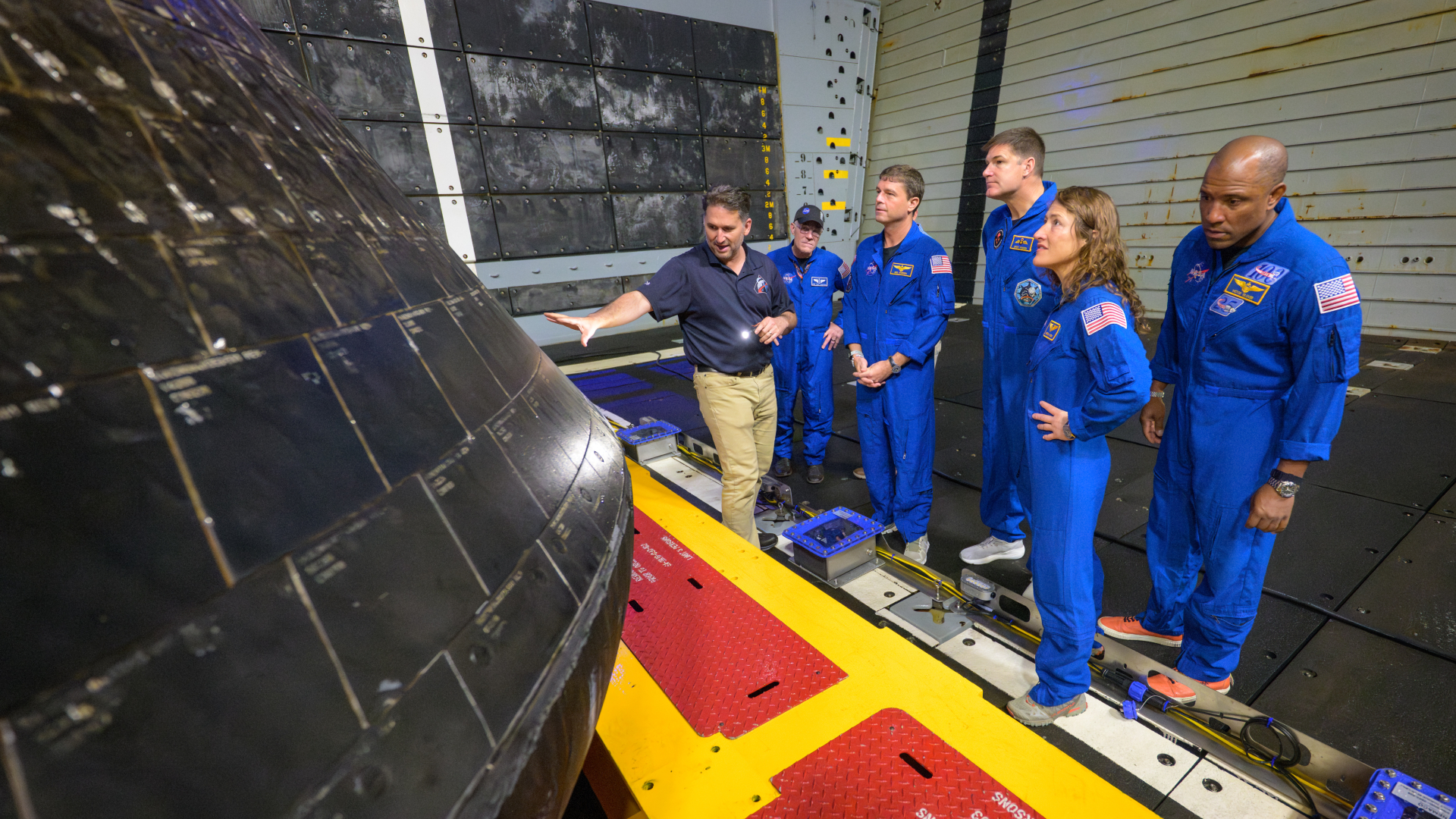
This led NASA to opt for a lofted entry profile for Artemis II (the same type of reentry used in the Apollo missions), sacrificing accuracy and astronaut comfort to send the mission's "Integrity" spacecraft on a more direct path through the atmosphere. Now, an early analysis appears to show the agency's bet paid off.
Related stories- There are 'reasons to be confident' about faulty Artemis II heat shield ahead of 25,000 mph reentry, space expert Ed Macaulay says
- 'So much magic': Artemis II shares first images from the far side of the moon, including new 'Earthset' and total eclipse in space
- 'This generation's moment': How the Artemis missions will reframe humanity's relationship with the moon
Meanwhile, the mission's Space Launch System rocket, once notorious for its numerous leaks and launch scrubs, also performed well, according to NASA. The agency got its numbers right too, achieving a landing with pinpoint precision similar to those of the Apollo missions.
"Orion splashed down with precision, just 2.9 miles [4.7 kilometers] from the targeted landing site," NASA representatives wrote in the statement. "Initial assessments showed entry interface velocity was within one mile-per-hour [1.6 km/h] of predictions."
While NASA is using its initial assessments to herald future missions in the Artemis program as being "on track," doubts persist. Artemis III is slated to launch for an Earth-orbit docking test with its lunar lander module in 2027 before Artemis IV and V target successive moon landings in 2028. Whether those landers — alongside other mission-critical hardware, such as lunar spacesuits — arrive in time or delay the program further remains to be seen.
Are you a NASA nerd? See how well you score on our Artemis quiz to find out!
TOPICS Ben TurnerActing Trending News Editor
Ben Turner is a U.K. based writer and editor at Live Science. He covers physics and astronomy, tech and climate change. He graduated from University College London with a degree in particle physics before training as a journalist. When he's not writing, Ben enjoys reading literature, playing the guitar and embarrassing himself with chess.
View MoreYou must confirm your public display name before commenting
Please logout and then login again, you will then be prompted to enter your display name.
Logout LATEST ARTICLES 1Meet AGI CPU — a specialist processor that engineers believe will power the next wave of AI
- 2Egyptian mummy has part of the 'Iliad' in its abdomen, archaeologists discover
- 3Artemis moon landing could face long delay while NASA waits for next-generation spacesuits
- 4Gene therapy improves hearing in 90% of patients with inherited deafness in largest trial of its kind
- 5'Iran's Maldives' could drown in oil due to spills from air strikes, satellites show