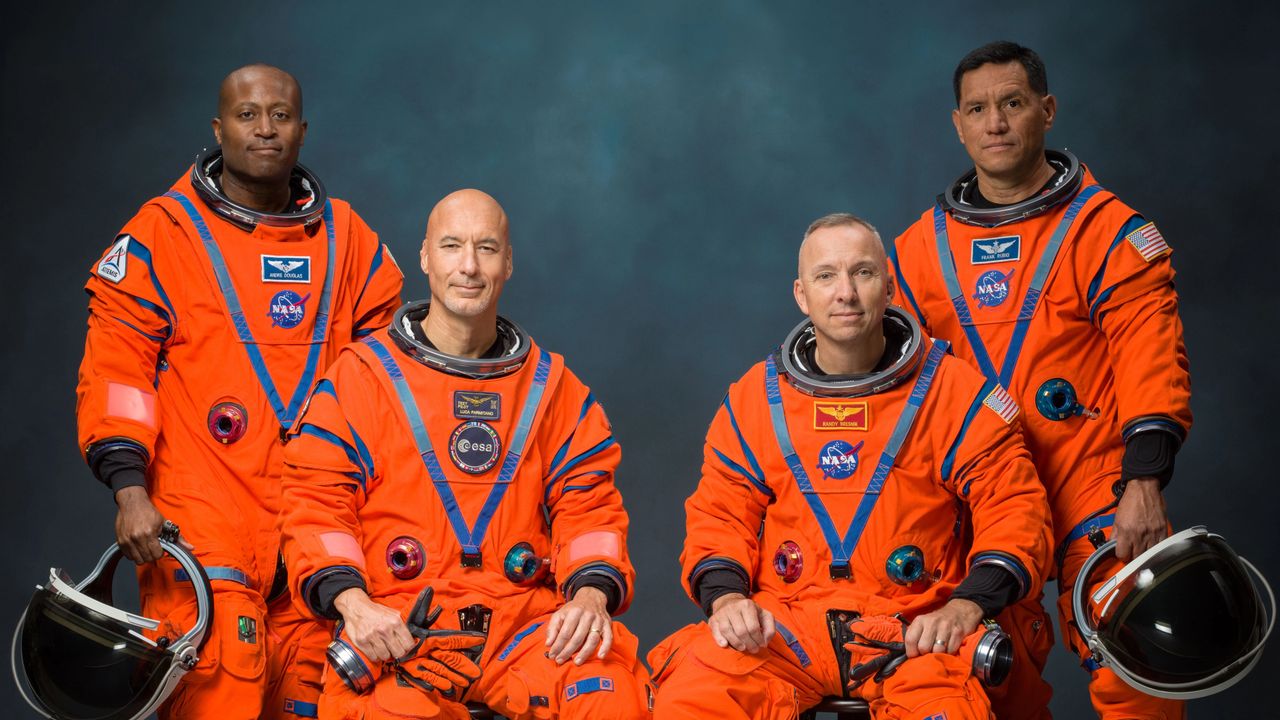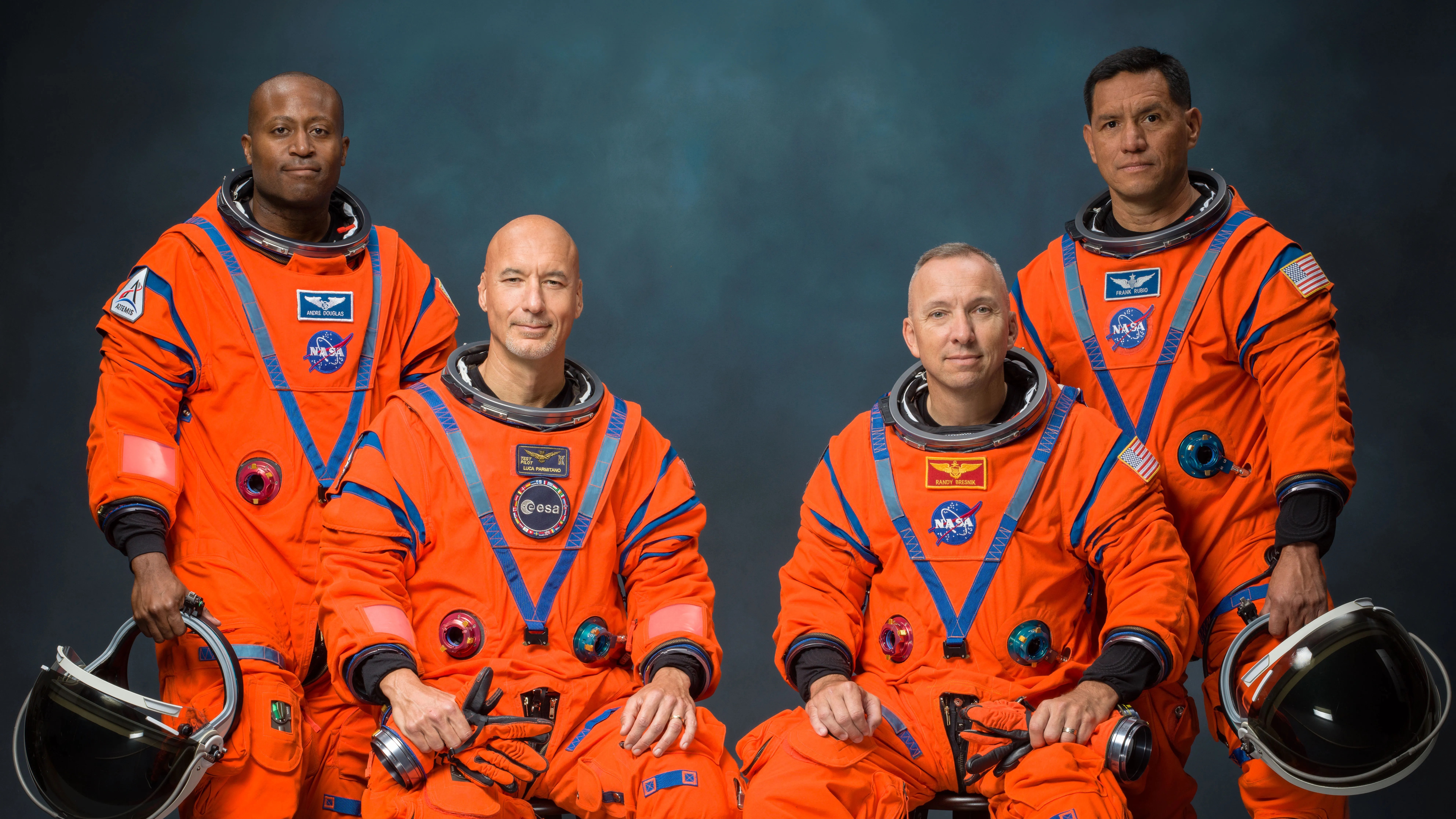
The Artemis III crew from left to right: Andre Douglas, Luca Parmitano, Randy Bresnik, and Frank Rubio (Image credit: NASA)
Share this article Join the conversation
Follow us Add us as a preferred source on Google Newsletter Subscribe to our newsletter
NASA has named the crew for its upcoming Artemis III mission, which the space agency says will be one of the most complex missions in history.
The four-person crew will consist of NASA commander Randy Bresnik, ESA astronaut and pilot Luca Parmitano, and NASA mission specialists Andre Douglas and Frank Rubio, alongside NASA backup crew member Robert Hines. Targeted for 2027, this next phase of NASA's moon program will launch astronauts into low Earth orbit to test one or both commercial lunar landers developed by SpaceX and Blue Origin.
If the orbital test goes according to plan, it paves the way for the next mission, Artemis IV, which in 2028 will send Americans to land on the moon for the first time in 54 years — assuming NASA sticks to its latest Artemis timetable.
Latest Videos From
 Watch full video here:
 The mission is set to last almost two weeks, four days longer than Artemis II's 10-day flight. This will give NASA more time to test key life support systems, as well as in-flight docking.
And NASA has a lot more riding on Artemis III than its human crew. The space agency has an ambitious plan to establish a permanent presence on the moon in the coming years, but to get astronauts back on the lunar surface, it is relying on SpaceX and Blue Origin, each of which have been assigned to develop a lunar lander and have suffered notable recent setbacks.
Meet the crew
Luca Parmitano is a European Space Agency astronaut who will serve as the pilot for Artemis III. Parmitano was the first-ever Italian International Space Station commander.
"I apologize in advance if I get emotional. First and foremost, I'm grateful," Parmitano said at a June 9. news conference. "I'm grateful that NASA has allowed me to be a part of this incredible group of people, of this crew and for letting me fly."
Sign up for the Live Science daily newsletter now
Get the world’s most fascinating discoveries delivered straight to your inbox.
Contact me with news and offers from other Future brandsReceive email from us on behalf of our trusted partners or sponsors
"But we wouldn't be going anywhere without fuel," he added. "And the fuel that lets everything move is right here — Maya, Sarah, Marta, my extended family. You are the energy that feeds my soul and your love is the spark that unites every passion. Thank you, grazie."
Randy Bresnik, a NASA astronaut who will serve as commander for Artemis III, is a former F/A-18 test pilot and a member of the Space Shuttle mission STS-129. Bresnik trained as a "cave-a-naut" and aquanaut to test human survival in Earth's most extreme environments.
Meanwhile, mission specialist and NASA astronaut Andre Douglas was a backup crew member for the Artemis II test flight, but will be front and center this time.
"Wow, what an amazing day it is today. My brain, it is going a mile-a-minute right now, but my heart, my heart, it is so warm, it is so full," Douglas said at the news conference, before thanking his family.
And finally, Frank Rubio is a NASA astronaut and mission specialist who has spent more than 28 years as an aviator and physician in the US Army, reaching the rank of colonel. Rubio spent 371 days at the International Space Station from 2022 to 2023, breaking the record for the longest single duration spaceflight by a U.S. astronaut.
To the moon?
The crew's test flight will prove pivotal for the future of the Artemis program, as major setbacks suffered by the Starship and New Glenn rockets have raised troubling questions about their readiness for a moon mission.
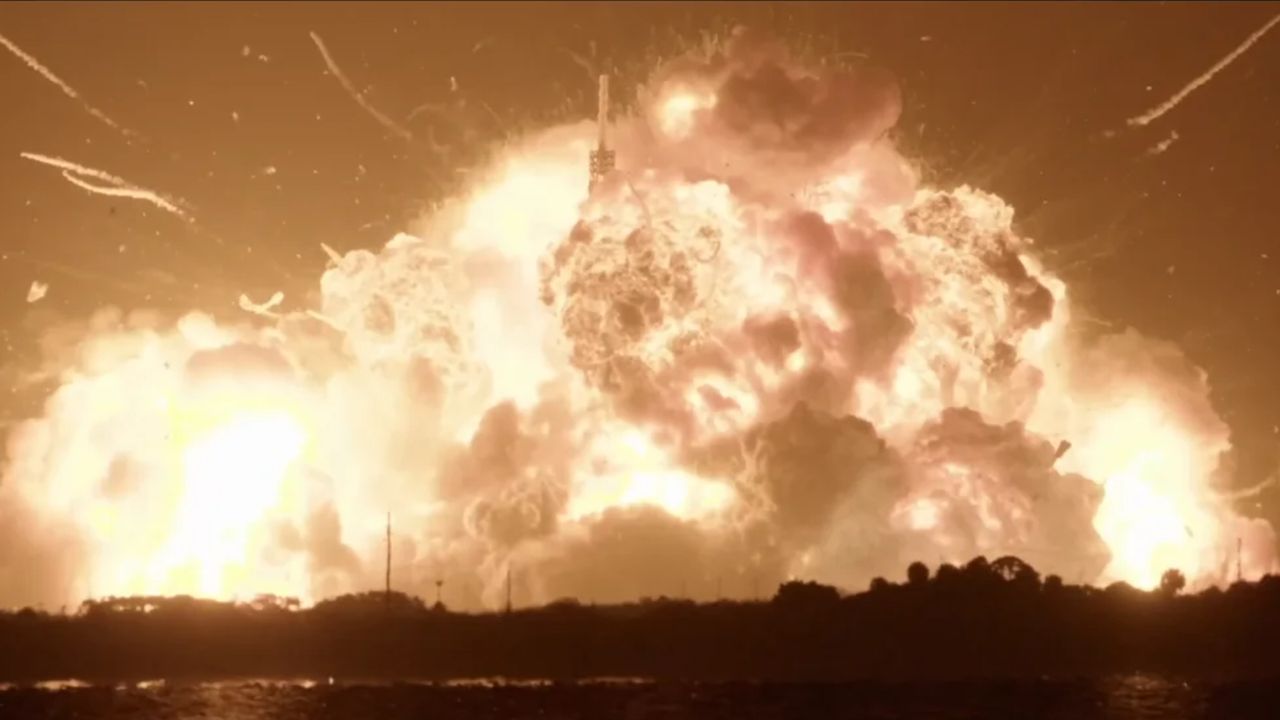
Both rockets will be indispensable in transporting landers to an orbital rendezvous with the Artemis crew, yet both are currently grounded by the Federal Aviation Administration following explosive failures, with a May 28 "anomaly" by the New Glenn rocket being a contender for the largest non-nuclear detonation in American history.

The 321-foot-tall (98 meters) New Glenn rocket erupted into a gigantic fireball just seconds into a "hotfire test" at Florida's Cape Canaveral Space Force Station at around 9 p.m. EDT (1 a.m. GMT) on May 28, plunging NASA's moon plans into uncertainty.
(Image credit: SpaceFlight Now)
However, NASA says it is working closely with Blue Origin to get the New Glenn rocket's development back on track.
"While we recognize the request about how Blue Origin's recent anomaly impacts our plans, setbacks are a learning opportunity," Jeremy Parsons, acting assistant deputy associate administrator for NASA's Moon to Mars Program, said at the news conference. "We are confident that New Glenn will be ready for Artemis III, along with Blue Origen, but NASA is stepping in and bringing all of our expertise and capabilities to bear."
Representatives from Blue Origin and SpaceX also spoke during the announcement. John Couluris, the senior vice president of lunar permanence at Blue Origin, said that Blue Origin was making "excellent progress" on the investigation into what happened during the May 28. "anomaly," and i8n cleaning up the pad. Couluris added that the company's lunar engineering and production teams were continuing production for Artemis vehicles.
Meanwhile, SpaceX's vice president, Jessica Jensen, spoke of the company's "substantial progress" on developing Starship for the NASA mission.
The outlook is less cloudy for NASA's Space Launch System (SLS) rocket, which already demonstrated it was capable of sending humans on a trip around the moon during the spectacular Artemis II mission earlier this year. NASA astronauts Reid Wiseman, Victor Glover and Christina Koch, along with the Canadian Space Agency's Jeremy Hansen, rode to the moon and back in NASA's Orion spacecraft.
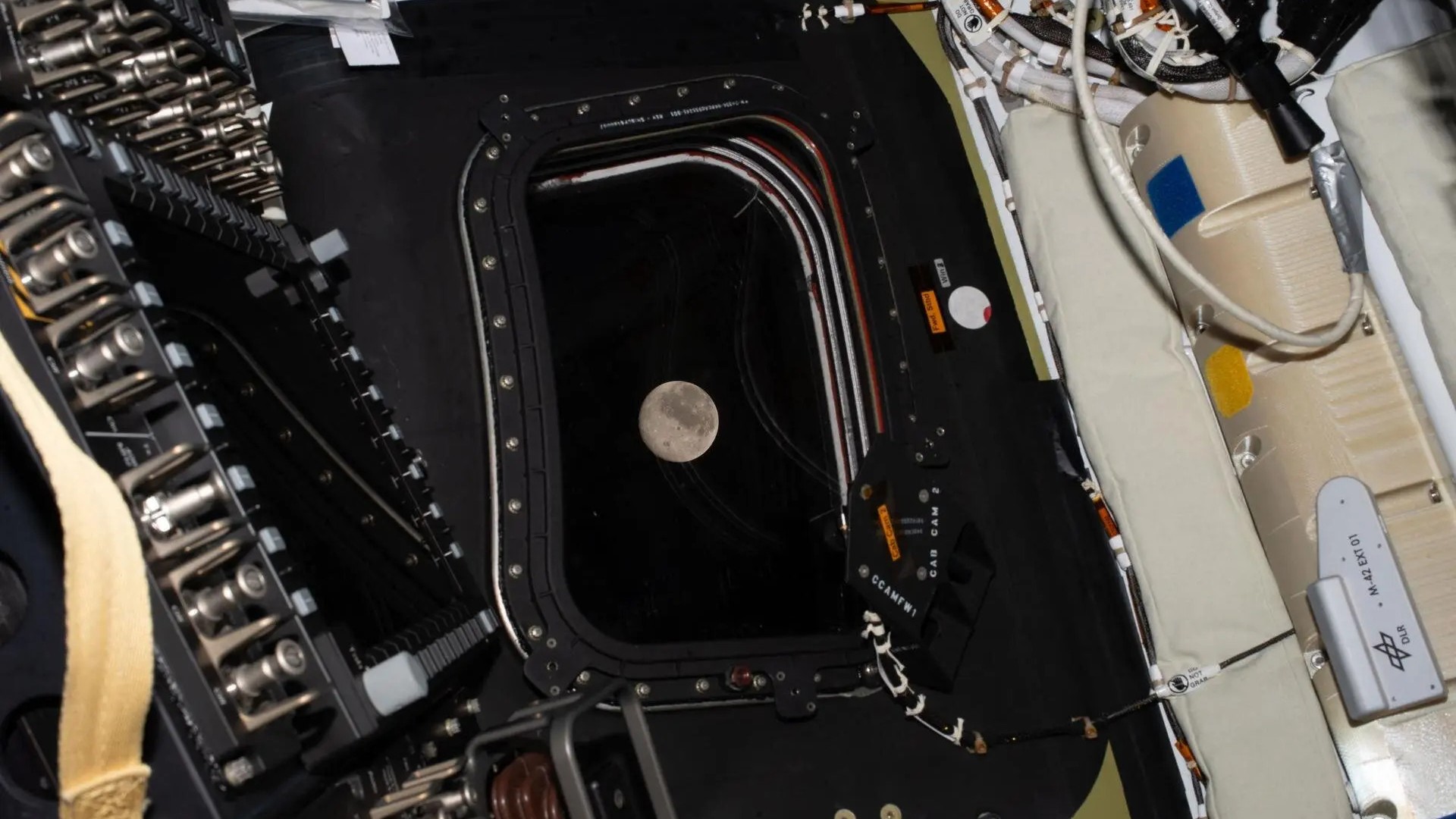
The moon as seen through the one of the Artemis II Orion capsule's windows.
(Image credit: NASA)
The space agency plans to repeat that success in 2028 by slingshotting astronauts aboard the Orion spacecraft around Earth to place them into the moon's orbit. At the same time, a separate New Glenn or Starship rocket will launch, bringing a lander that will dock with Orion so two of the four astronauts can climb aboard. The commercial lander will then lower astronauts down onto the moon's surface and then launch them back up to Orion for the trip home.
Originally, the Artemis III mission was supposed to include this moon landing — the first since the Apollo era. However, the mission was retooled as part of a sweeping overhaul of the Artemis program that changed Artemis III to a test flight orbiting Earth. The moon landings are currently scheduled for Artemis IV and Artemis V in 2028, with Artemis V to lay the foundation for NASA's permanent lunar base.
"While this is a mission to Earth orbit, it is an important stepping stone to successfully landing on the Moon with Artemis IV," Jeremy Parsons, Moon to Mars acting assistant deputy administrator at NASA's Exploration Systems Development Mission Directorate, said in a statement back in May. "Artemis III is one of the most highly complex missions NASA has undertaken. For the first time, NASA will coordinate a launch campaign involving multiple spacecraft integrating new capabilities into Artemis operations."
NASA has made it clear that lander readiness will determine which commercial provider gets the nod for the planned 2028 moon landings. Artemis III will be a pivotal step in determining that readiness, with one or both lander candidates scheduled to take part. If they both fail, the Artemis program will face its most significant setback yet.
Despite the success of Artemis II, the Artemis program is behind schedule and over budget. NASA was supposed to be back on the moon by now, but a string of delays has left it chasing increasingly ambitious targets.
RELATED STORIES
In March, NASA Administrator Jared Isaacman announced "near‑impossible" plans for the U.S. space program, including a $20 billion moon base and humanity's first nuclear-powered interplanetary spacecraft, which is also supposed to launch in 2028.
Beyond looming lunar lander woes, other commercial sector delays beset NASA's procurement pipeline. For example, NASA chose Axiom Space as a rover partner even though its late spacesuits could push the moon landings out to 2031. Astrobotic and Intuitive Machines, meanwhile, were selected to send payloads, but both failed in their only other lunar delivery missions to date.
Besides testing key systems, the Artemis III crew will also be working with NASA's science team to closely study the Earth's atmosphere, the environment around Orion during the mission and the impact of space's influence within the Orion capsule. One key phenomenon under investigation will be orbital drag, which causes spacecraft in low Earth orbit to lose altitude over time and is sensitive to space weather.
"While Artemis II was all about moon joy, Artemis III will be about Earth joy," Nicky Fox, associate administrator of NASA science, said at the news conference. "By observing Earth's atmosphere and how space weather impacts it, we can better understand how to protect the critical space-based technology there and all that we rely on, as well as our future astronaut crews traveling through that region."
TOPICS
 Patrick Pester
Trending News Writer
Patrick Pester is the trending news writer at Live Science. His work has appeared on other science websites, such as BBC Science Focus and Scientific American. Patrick retrained as a journalist after spending his early career working in zoos and wildlife conservation. He was awarded the Master's Excellence Scholarship to study at Cardiff University where he completed a master's degree in international journalism. He also has a second master's degree in biodiversity, evolution and conservation in action from Middlesex University London. When he isn't writing news, Patrick investigates the sale of human remains.
View More
You must confirm your public display name before commenting
Please logout and then login again, you will then be prompted to enter your display name.
Logout