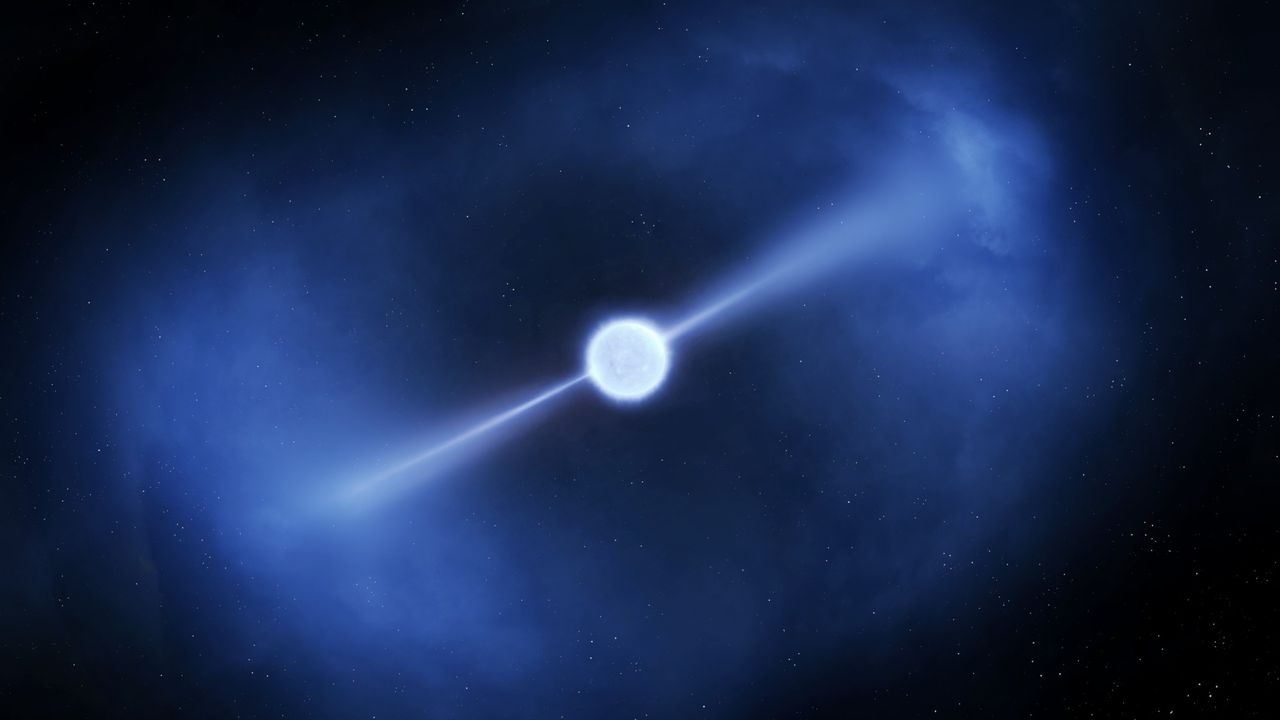
Silent neutron stars at the center of supernova blast sites may actually be whispering softly, following the detection of faint radio emissions coming from one such object for the first time. The discovery raises the prospect that there could be many more pulsars in our galaxy than we thought.
When a massive star explodes as a supernova, the devastation leads to the star's core collapsing under its own gravity to form either a neutron star or a black hole. When a neutron star is formed, it is born spinning and its magnetic field is usually powerful enough to whip up charged particles and beam them away in a jet moving at close to the speed of light. This jet emits radio waves, and as the neutron star spins we see this radio jet flashing in our direction. This makes it seem like the neutron star is pulsing, hence we call it a pulsar.
Puzzlingly, not all neutron stars at the center of supernova remnants are pulsars. About a dozen discovered so far have been dead quiet in radio waves, and astronomers call these quiet neutron stars 'central compact objects', or CCOs. One possible explanation for CCOs is that their magnetic fields are too weak to produce detectable radio jets. For decades, astronomers have tuned into them, finding only radio silence — until now.
A team led by Zhang Lei of the National Astronomical Observatories of the Chinese Academy of Sciences tuned into one particular CCO, named 1E 1207.4-5209 with the MeerKAT radio telescope in South Africa. They discovered that the CCO is pulsing with radio waves after all, but very faintly, once every 424 milliseconds. This matches the known spin period of the pulsar – it's a veritable whirling dervish.
Found at the center of a supernova found 10,000 light years away within our Milky Way galaxy, 1E 1207.4-5209 has been nicknamed the "Blue Eye Pulsar" by Li Di, a professor of astronomy at Tsinghua University in China. Its name is a virtue of the fact that when the faint radio emission is combined with X-ray images that show the neutron star shining brightly, it looks like a blue eye.
The Blue Eye Pulsar has an intriguing history. The supernova that formed it exploded over 4,100 years ago. In 2015, X-ray observations noted that the pulsar had experienced a 'spin glitch', which is a small increase in rotation of a neutron star probably caused by some kind of disruption or shifting of material within the neutron star's dense interior.
Lei's team propose that this glitch either strengthened or reoriented, or both, the magnetic field of the Blue Eye Pulsar sufficiently to trigger radio emissions, or at least make feeble radio waves that were already there detectable.
Following a glitch, a neutron star's rotation rate gradually slows back down to its original rate, at which point we might expect the Blue Eye Pulsar's radio emission to switch back off. Lei's team suggests that continued monitoring of the Blue Eye Pulsar could answer this question.
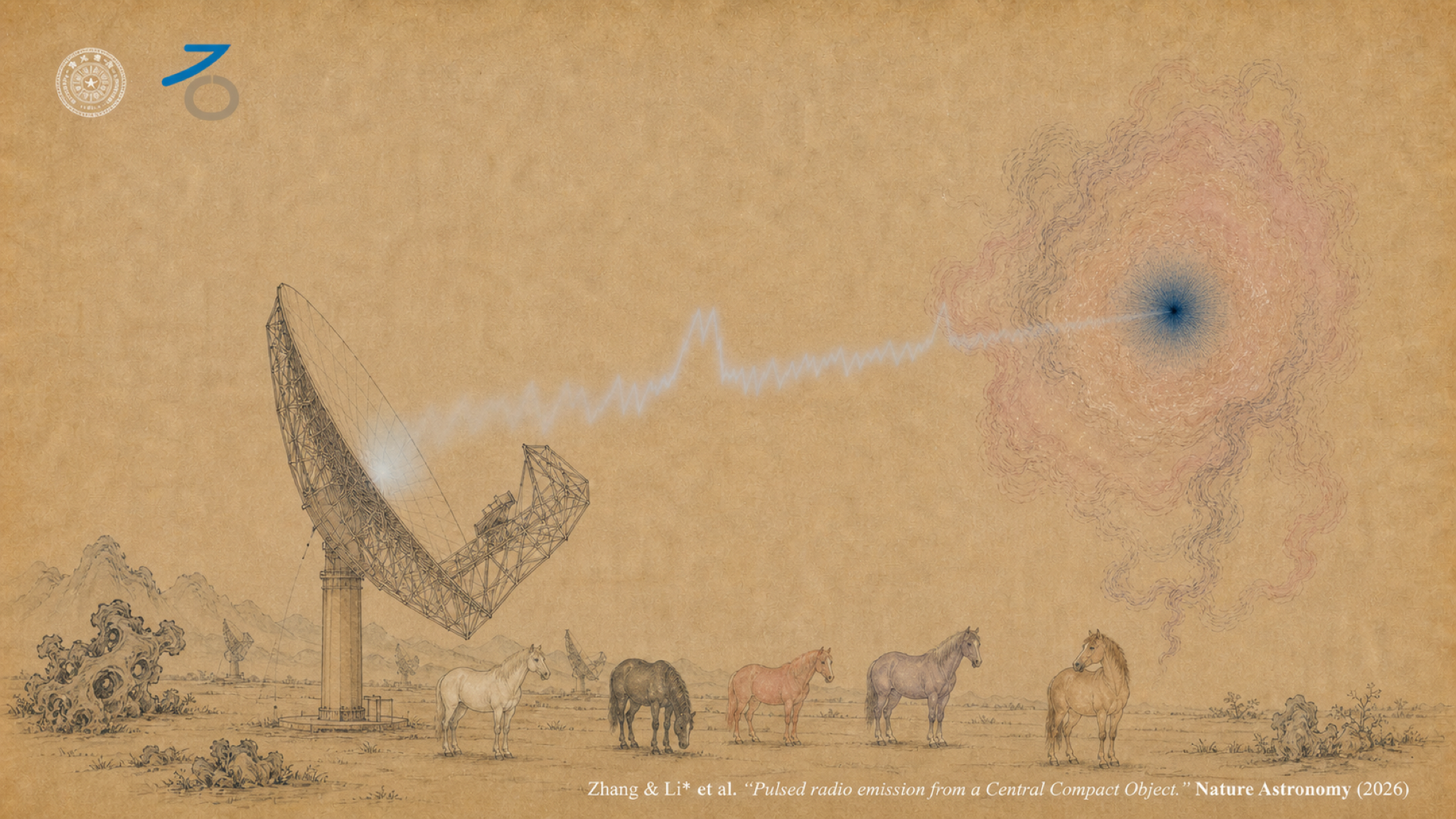
If that answer is what Lei's team think it to be, then it could mean that there is a large population of very feeble pulsars that remain undetected in the galaxy. Old pulsars, which persist long after the supernova remnant they were born in has dissipated, are also fairly quiet radio emitters because they are slowing their spin rate over time. However, it is possible that we have misidentified some of these pulsars as being old when they could in fact be relatively young but softly radio emitting.
The findings may also explain why some supernova remnants seem to be missing pulsars. Key among them is the expanding cloud of debris formed from the explosion of supernova 1987A in the Large Magellanic Cloud. Although astronomers are pretty sure there is a neutron star in the heart of the remnant based on indirect evidence, no pulsar radio emissions have yet been detected.
The detection of radio waves from the Blue Eye Pulsar was reported June 25 in Nature Astronomy.