Astronomers estimate that our home galaxy, the Milky Way, has churned out more than 10 million black holes over its 13-billion-year history. Yet so far, they have found only 70.
Now, a group of astronomers in the U.K. is trying to close that vast gap by enlisting the public. Their project, called Black Hole Hunters, is looking for volunteers with a computer and a few spare minutes to sift through troves of data gathered by a NASA space telescope. By flagging recognizable patterns that could point to a "missing" black hole, volunteers can help fast-track a search that would otherwise take years, the team says.
"You'll be narrowing down precisely where we need to point our telescopes next," project co-lead Adam McMaster, an astronomer at the University of Southampton in the U.K., said in a statement, "and you might be the one to discover a black hole."
Cosmic magnifying glasses
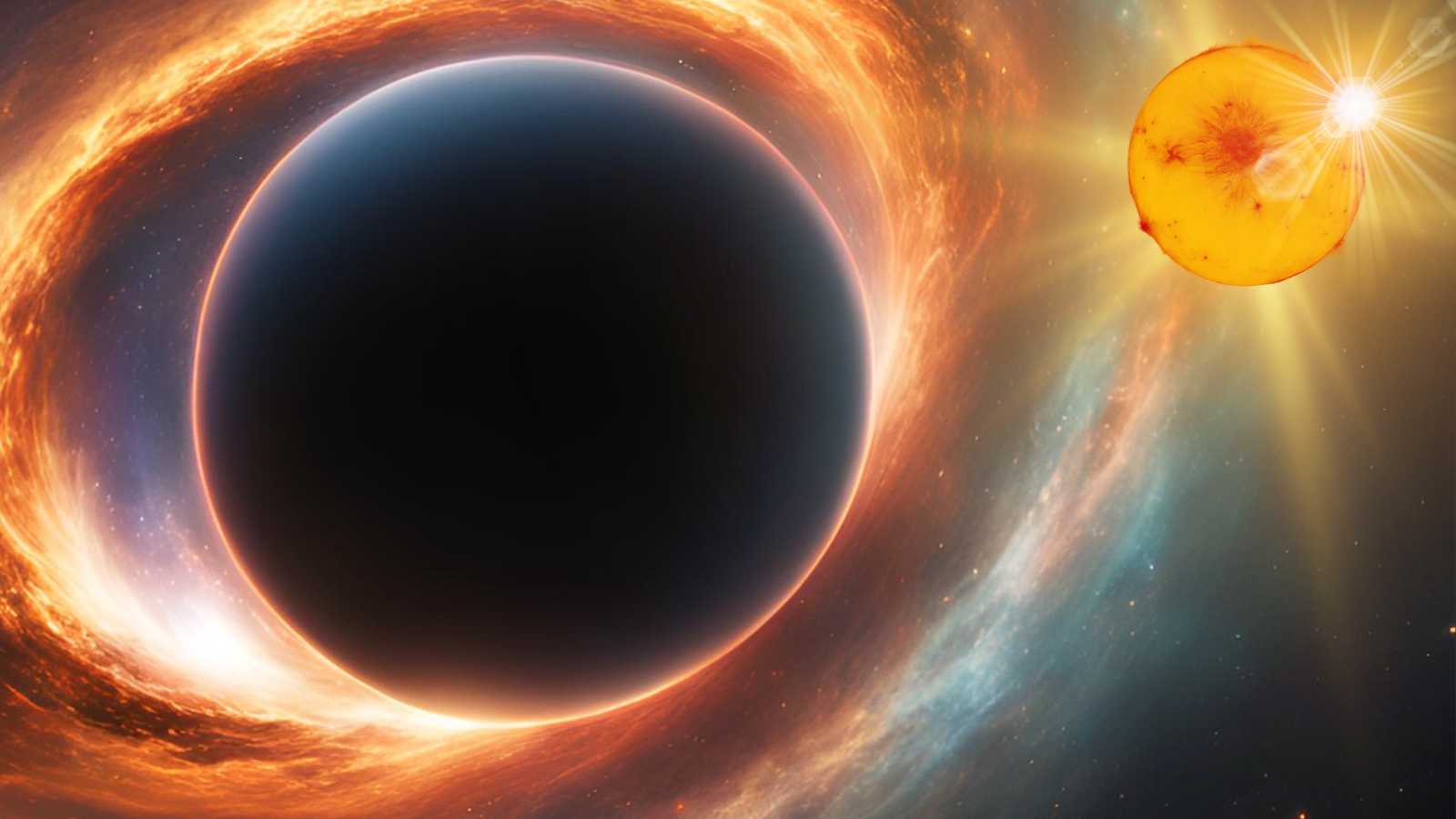
Black holes form when massive stars roughly 20 times heavier than our sun run out of fuel and collapse, leaving behind an abyss with gravity so immense that even light cannot escape. While invisible themselves, these cosmic behemoths reveal their presence by bending the light of nearby objects, and the Black Hole Hunters project is searching for one specific manifestation of this effect.
It happens thanks to the fact that massive stars often form in pairs, and a star can sometimes survive the violent supernova explosion that turns its companion into a black hole. When that happens, the two bodies continue to orbit each other. If such a duo aligns just right with Earth, the black hole will periodically pass directly between its companion star and our planet. And when it does, the black hole's gravity acts like a cosmic magnifying glass, bending and magnifying the star's light, causing it to briefly appear brighter to watchful telescopes.
To find these hidden giants, the project relies on data from NASA's Transiting Exoplanet Survey Satellite, or TESS. Although the satellite's primary mission is to hunt for planets beyond our solar system, its method of data collection — tracking tiny, continuous changes in a star's brightness over time — is ideally suited for identifying black hole magnification events, the project description notes.
"It's a simple task with no expertise required," McMaster said in the statement. "We will show volunteers examples of what to look for so all they have to do is recognise the right patterns."
Automated algorithms conduct a preliminary sweep of the TESS data, screening millions of potential stars for the most obvious black hole candidate locations, according to the project description. But, the researchers say, artificial intelligence struggles with the messy realities of the cosmos, such as stellar flares and the natural pulsations of stars that can trick the algorithms into false positives.
The human touch
That makes human volunteers a key part of the search. To keep errors in check, each graph is shown to multiple volunteers, and their answers are combined so that individual mistakes average out, according to the project's website.
"I can search for black holes on my laptop from my bedroom — and could make a real impact on real space science," Grace Clarke, an undergraduate student of physics and astronomy at the University of Southampton who's involved with the project, said in the same statement. "The data's easy to understand — it's just pattern recognition — and you don't need a degree in astronomy to read it."
The crowdsourced shortlist of promising signals lets astronomers aim follow-up observations at specific stars, such as precise measurements of whether a star is being tugged at by an unseen companion. Those measurements take time and are expensive, so a good shortlist helps researchers spend scarce telescope time wisely, the team says.
Since launching on the Zooniverse platform in October 2021, the project has attracted nearly 23,000 volunteers, who have completed more than 12 million classifications, according to its website.
Before turning to TESS, the team ran a similar search using data from SuperWASP, a ground-based survey that, like TESS, monitored stars for signs of planets from 2004 to 2016. Those results are still being analyzed and are expected to be published soon.
The team also plans to widen its search with observations from other instruments, including the European Space Agency's Euclid mission and NASA's recently launched Nancy Grace Roman Space Telescope.
"With potentially thousands of new discoveries, we need all the help we can get," McMaster said in the statement.