 (Image credit: Spaceflight Now) Share this article 0 Join the conversation Add us as a preferred source on Google Newsletter Subscribe to our newsletter
 After its rocket explosion, Blue Origin wants to complete repairs and put another New Glenn on the launchpad before the end of 2026, according to CEO Dave Limp. That's very ambitious.
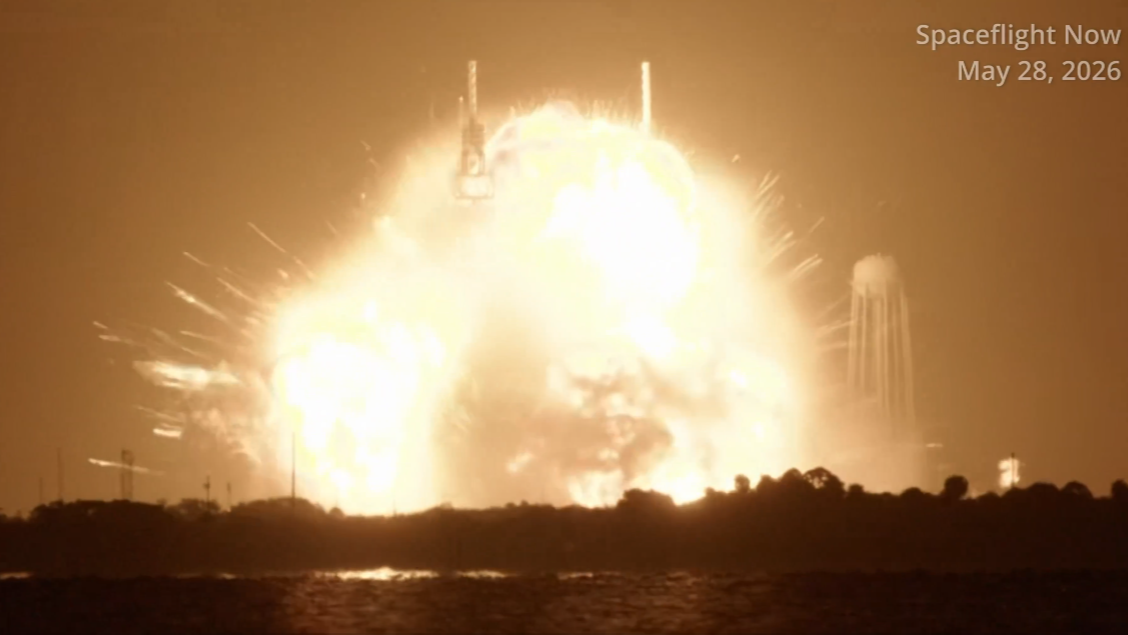
The company's New Glenn rocket stood at Launch Complex-36 (LC-36) at Cape Canaveral Space Force Station last Thursday (May 28) for a static hot fire test ahead of the vehicle's fourth launch. Blue Origin has yet to complete an investigation into the incident, but whatever the cause, New Glenn exploded on the launchpad in an enormous fireball visible for more than a hundred miles, destroying the launch vehicle and spreading damage across LC-36 and the surrounding vegetation.
Now that the smoke has settled, Limp has shed some light on the extent of that damage, and thinks the company can have New Glenn ready for launch before the end of the year. "before the end of this year," he said in a post on X, which ended with the phrase, "Gradatim Ferociter," the company's motto that means "step by step, ferociously."
Limp said that amongst the ruins of LC-36, which can be seen from space, there was still some promising news to share. In addition to the facility's water tower, "the propellant farm, oxygen, liquid hydrogen and LNG (liquid nitrogen) tanks are all in good shape," he said. But the pad didn't survive unscathed.
The large tower that helps coordinate systems and ground infrastructure at the pad sustained significant charring in the blast, but is in fine-enough shape that Limp said it can be repaired rather than needing to be torn down and rebuilt. The transporter-erector — the strongback that delivers and erects New Glenn at the pad — was destroyed beyond repair, but instead of rebuilding the structure, it will be replaced by "an alternative vertical conop (operational concept)," Limp said, which Blue Origin "had already been working for some time."
Setting the goal to return New Glenn to flight before the end of 2026 is an ambitious one, and with a timeline nearly half as long as comparable undertakings at other launch facilities.
Some LC-36 updates. Now that we’ve had access to the pad and integration facility we can share a bit of good news. The propellant farm, oxygen, liquid hydrogen and LNG tanks are all in good shape. This is good luck because these are very long lead items. The water tower is also…June 2, 2026
For example, SpaceX launched its first Starship rocket test flight in April 2023, before building a flame trench under the launchpad at its Starbase facility in South Texas. As a result, the 33 Raptor engines of the vehicle's Super Heavy booster blasted a crater in the pad's concrete, spewing heavy debris throughout the pad and surrounding area as the rocket lifted off.
The second Starship test flight occurred about seven months later, in November 2023, aligning with Blue Origin's hopeful timeline for LC-36, but damage from the power of a rocket's engines, and damage from that entire rocket exploding on the launchpad are different levels of destruction.
In 2016, a SpaceX Falcon 9 rocket at Launch Complex-40 exploded during the same type of static hot fire test that New Glenn was undergoing, and facilities there didn't support another launch for a year. And it was almost two years between launches at NASA's Wallops Flight Facility after the Orb-3 mission in 2014, when an Antares rocket failed seconds after liftoff and crashed back down to its pad just below.
LC-36 is Blue Origin's only launchpad, meaning each day that it remains out of operation is another delay to the company's efforts to prove New Glenn's reliability not only to its customers, like Amazon, which has contracted Blue Origin to launch several Leo wireless internet satellite missions, but also NASA, which is relying on New Glenn for critical parts of the Artemis program and the agency's efforts to return astronauts to the moon.
NASA has contracted SpaceX's Starship and Blue Origin's Blue Moon spacecraft as the first two lunar landers for Artemis, and a delay in Blue Origin's ability to launch Blue Moon to orbit could mean the company takes a backseat to humanity's return to the moon.
A post shared by Space.com (@spacedotcom)
A photo posted by on
It could also lead to a delay in that return all together. Starship and Blue Moon both have a ways to go before NASA will certify the vehicles to fly astronauts, so any time lost on that front by Blue Origin could further narrow NASA's options and increase the risk of setbacks to the agency's lunar landing timeline.
NASA is currently targeting 2027 for Artemis 3, a mission to low Earth orbit for astronauts aboard the Orion spacecraft to practice rendezvous and docking maneuvers with one or both lunar landers, based on their availability. The first Artemis lunar landing mission is scheduled for 2028, and whatever role Blue Origin plays between now and then will likely be heavily influenced by its ability to get LC-36 up and running again.
View MoreYou must confirm your public display name before commenting
Please logout and then login again, you will then be prompted to enter your display name.
Logout Josh DinnerStaff Writer, Spaceflight
Josh Dinner is Space.com's Spaceflight Staff Writer. He is a writer and photographer with a passion for science and space exploration, and has been working the space beat since 2016. Josh has covered the evolution of NASA's commercial spaceflight partnerships and crewed missions from the Space Coast, NASA science missions and more. He also enjoys building 1:144-scale model rockets and spacecraft. Find some of Josh's launch photography on Instagram, and follow him on X, where he mostly posts in haiku.