What it is: RAD-Bow-And-Arrow Radio Galaxy
Where it is: 2 billion light-years from Earth
When it was shared: June 22, 2026
The universe is full of structures that remind us of Earthly objects, such as the Cat's Eye Nebula, a "cosmic hamburger," and the famous Crab Nebula. Now, one more has been added to the list: a radio galaxy shaped like a bow and arrow.
The newly discovered galaxy, dubbed the RAD-Bow-And-Arrow Radio Galaxy (RAD-BAARG), sits roughly 2 billion light-years from Earth.
Radio galaxies are powered by actively feeding supermassive black holes that launch powerful jets of charged particles in opposite directions. As these high-speed jets crash into the surrounding medium, they form huge lobes of magnetized plasma that can stretch for thousands to millions of light-years. Inside both the jets and the lobes, electrons spiral around magnetic-field lines and emit radiation that is detected at radio wavelengths.
As a result, most radio galaxies look roughly symmetrical, like two matching balloon-like radio lobes inflated on each side of the central galaxy. RAD-BAARG, with its lopsided structure, appears to be an oddball.
RAD-BAARG was first spotted by citizen scientist Pranim Limbo while inspecting ultrasensitive radio images from the LOFAR Two-metre Sky Survey. Limbo made the discovery through India's RAD@home Astronomy Collaboratory, a citizen-science research initiative in India, in collaboration with an international team of researchers.
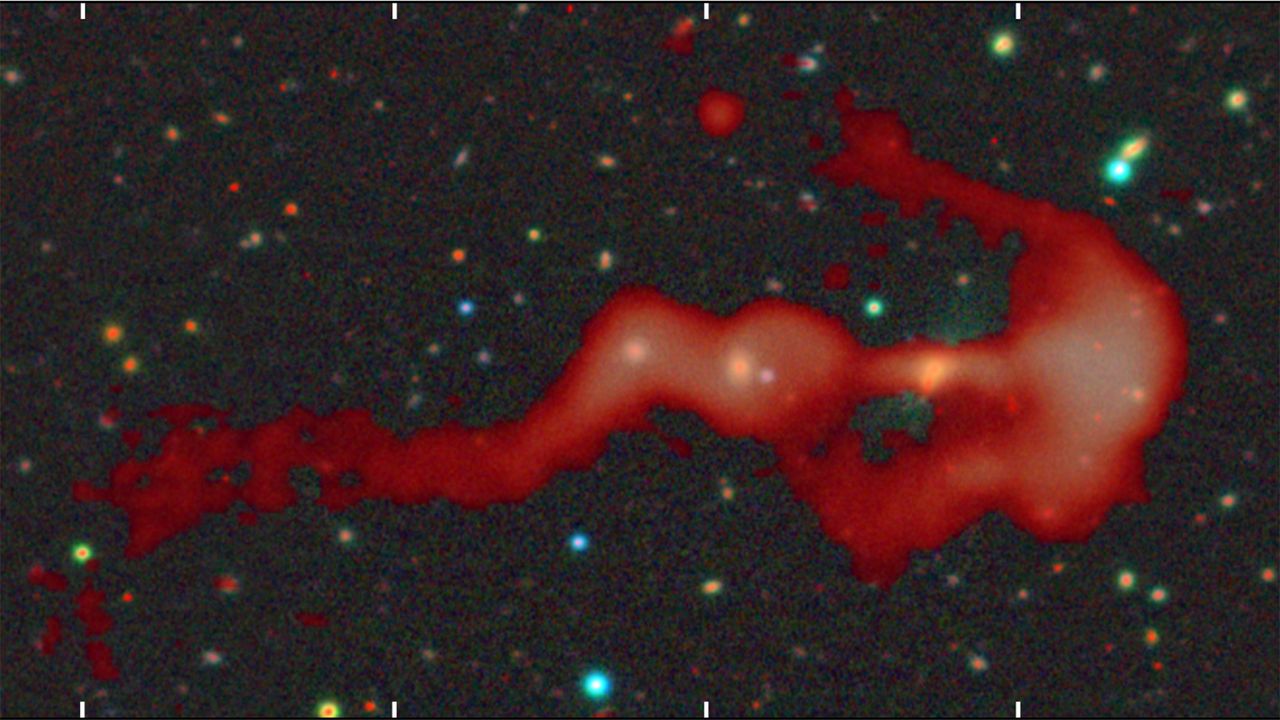
The new image shows RAD-BAARG in stunning detail, with red tracing the radio emission captured by the LOFAR telescope, combined with an optical image from the Beijing-Arizona Sky Survey.
Researchers think the strange shape may have been influenced by the galaxy's environment. RAD-BAARG appears to be falling toward a nearby cluster of galaxies, plunging through the intracluster medium, the hot, thin gas that fills the space between galaxies, the researchers explained in a paper published June 22 in the journal Monthly Notices of the Royal Astronomical Society.
"The structure of this source is unlike that of any radio galaxy I have seen in the last 25 years," Ananda Hota, principal investigator of the RAD@home Astronomy Collaboratory and first author of the paper, said in a statement.
When a galaxy moves through this gas faster than the speed of sound within it, it creates a shock front, similar to how a fighter jet generates a sonic boom. This compressed wall of gas piles up ahead of the galaxy as the gas falls inward.
One of RAD-BAARG's jets appears to be running straight into this shock front, causing it to bend and compress into the shape of a drawn bow. The enormous bow-like structure extends nearly 1.8 million light-years across. On the opposite side, the other jet doesn't face the same resistance. Instead, it twists into a distorted S shape before fading into a faint tail forming the "arrow."
According to the study, RAD-BAARG has a length of about 2.3 million light-years. That places it in the category of "Giant Radio Galaxies," which are some of the largest standalone single structures in the universe.
Astronomers have long predicted that infalling galaxies should generate bow shocks as they plunge through the hot gas of a galaxy cluster. But actually catching one has been extremely difficult, since the surrounding gas is too diffuse and faint to detect easily. Sitting in a complex, chaotic environment, RAD-BAARG is rare not only for its unique shape but also for providing a direct, detailed view of this elusive phenomenon. In other words: That’s a bullseye.
See more space photos of the week:
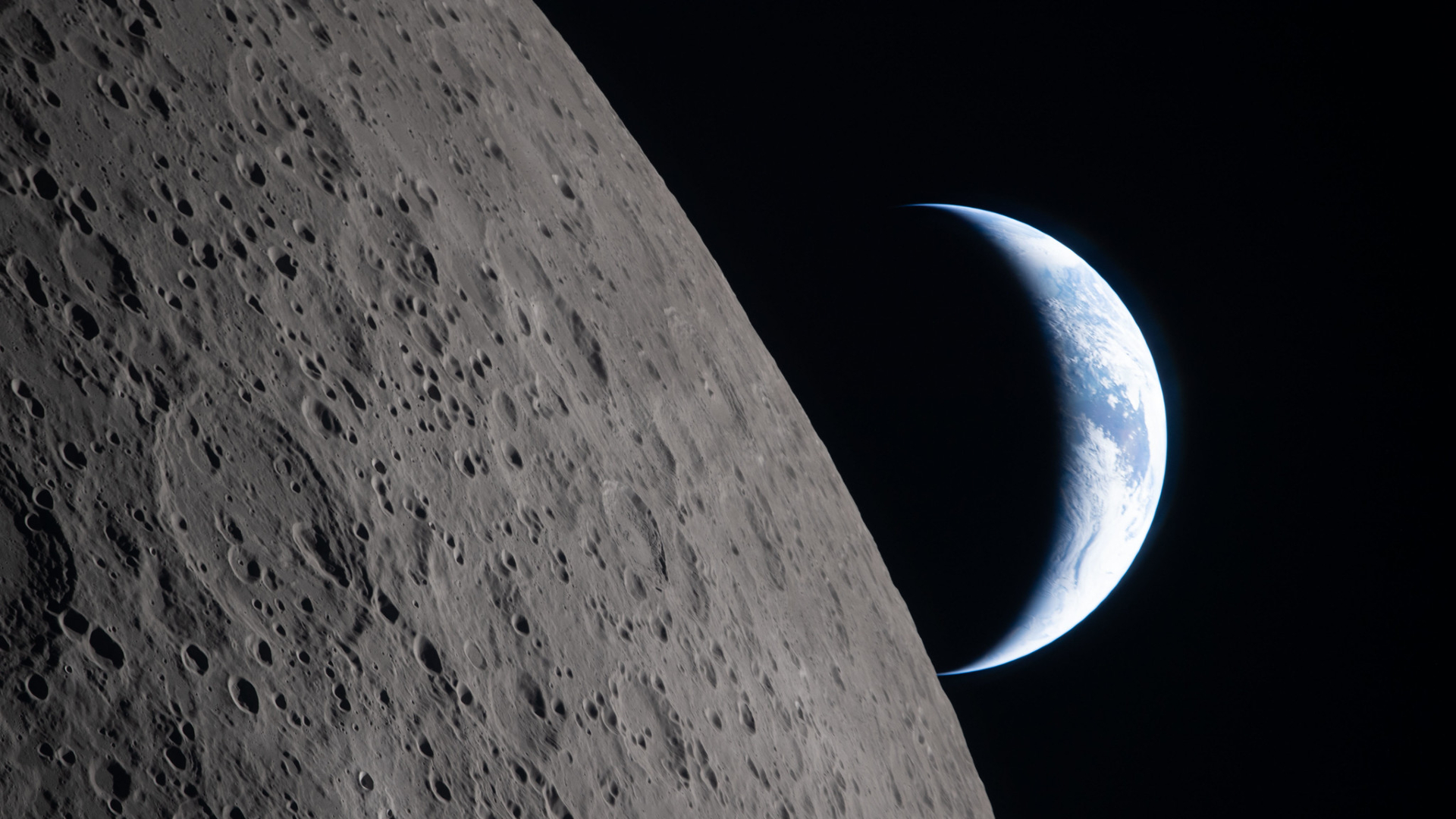 'Human minds should not go through this'
The Artemis II crew recalls the unreal moment when Earth disappeared
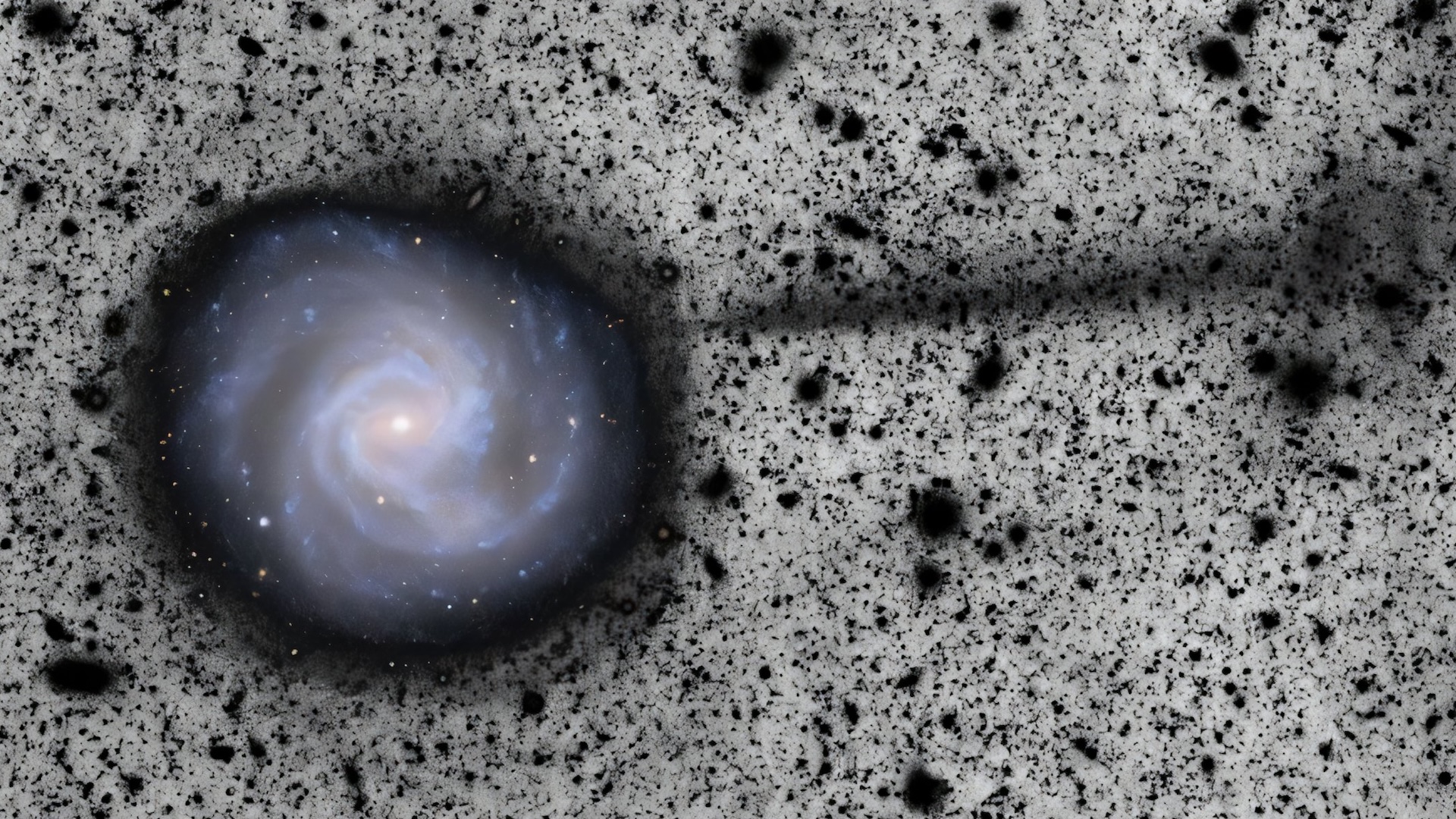 Hidden structure in 1st Vera Rubin image
First-light images from the Vera C. Rubin Observatory reveal a 163,000-light-year stream of stars emanating from a nearby galaxy.
 JWST peeps the 'Eye of God'
A spectacular James Webb telescope image reveals intricate structures inside the Helix Nebula.