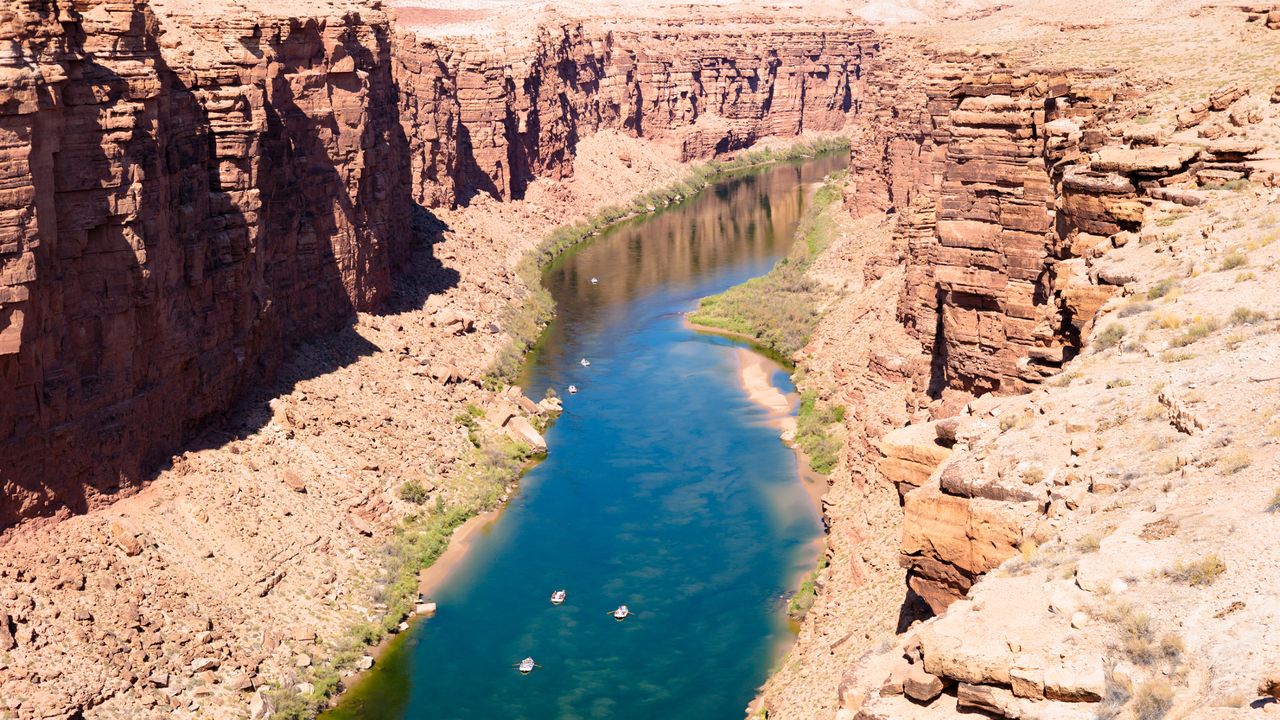
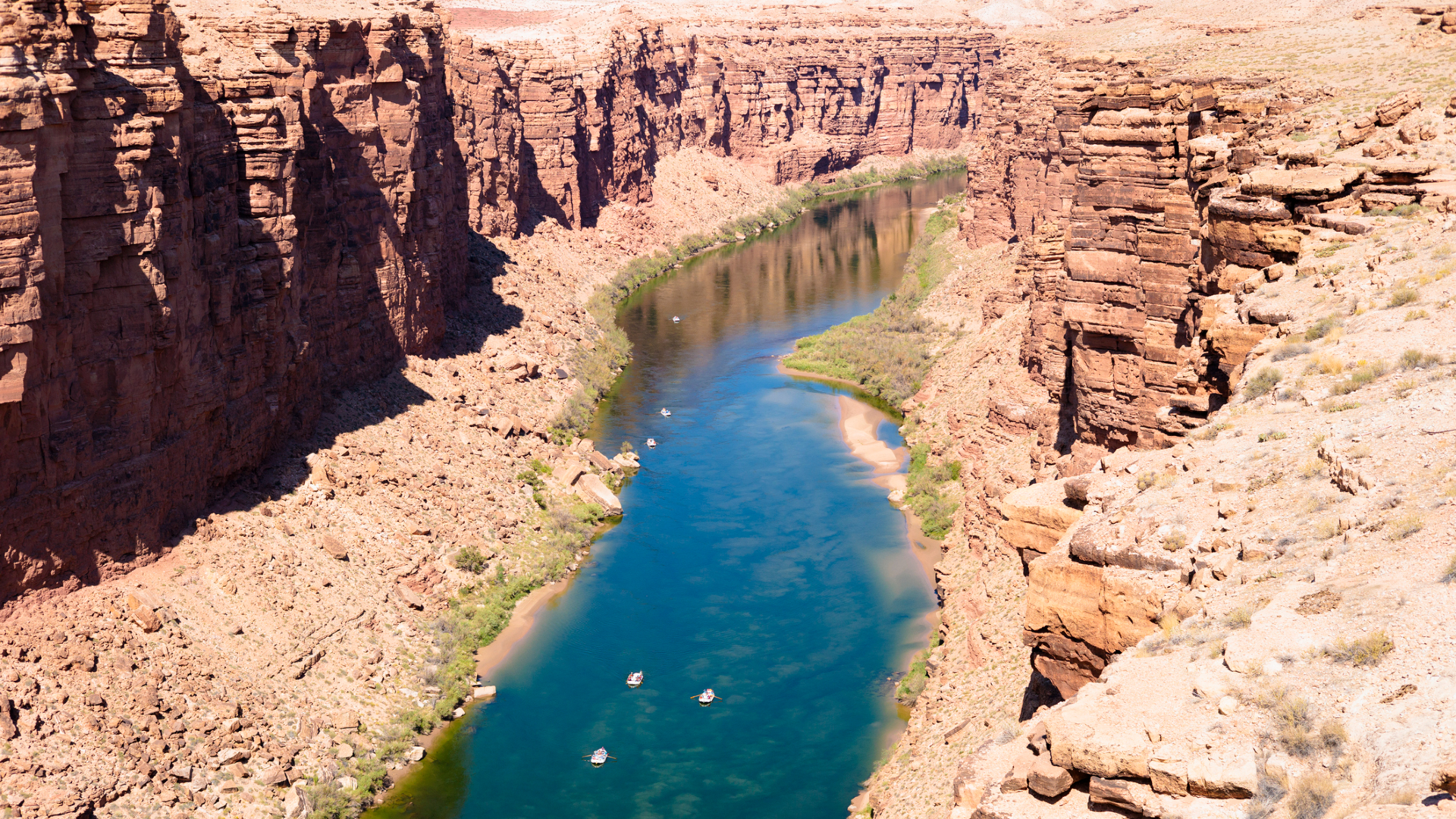
 The Colorado river supplies multiple states with water necessary for agriculture and drinking. (Image credit: Gary Yeowell via Getty Images) Share this article 0 Join the conversation Follow us Add us as a preferred source on Google Newsletter Sign up for the Live Science daily newsletter now
 Get the world’s most fascinating discoveries delivered straight to your inbox.
Become a Member in Seconds
Unlock instant access to exclusive member features.
Contact me with news and offers from other Future brands Receive email from us on behalf of our trusted partners or sponsors By submitting your information you agree to the Terms & Conditions and Privacy Policy and are aged 16 or over.You are now subscribed
Your newsletter sign-up was successful
Want to add more newsletters?
Join the club
Get full access to premium articles, exclusive features and a growing list of member rewards.
Explore An account already exists for this email address, please log in. Subscribe to our newsletterThe seven U.S. states that make up the Colorado River basin are struggling to agree on how best to manage the river's water as its supply dwindles due to climate change and a period of prolonged drought. Their negotiations, which are not open to the public, missed a Feb. 14, 2026, deadline the federal government had established, after which federal officials said they would impose their own plan.
The federal government has not yet done so, but the prospect of such an action is not good news for the nearly 40 million people who depend on the Colorado River for water, energy, agriculture and recreation, nor for the estimated US$1.4 trillion in economic activity the river supports.
Article continues belowThe five most common sources of conflict between people are values, data, relationships, interests and structure. The current Colorado River negotiations include all five. We believe a process designed and facilitated by negotiation experts could help break the logjam.
We recognize it can be very hard to reach an agreement when what’s at stake are countless lives, massive amounts of money, enormous quantities of hydroelectric power and not nearly enough water.
But compromise on Colorado River management is possible and, in fact, was achieved to curb California's water use in the 2000s, to negotiate an interim agreement to coordinate operations at the Lake Mead and Lake Powell reservoirs in 2007, and to enact contingency plans to manage drought in 2019. But this time around, circumstances are different.
Previous negotiations
The negotiations leading up to those agreements were often facilitated by officials from the U.S. Bureau of Reclamation who focused on reaching broad agreements on general principles and concepts before delving into details. Federal staff also actively guided key agreements and provided the science and computer models to make well-informed decisions. And the states' negotiators knew the Department of Interior would act unilaterally to make damaging cuts to water supply if states couldn't come to their own agreement.
Sign up for the Live Science daily newsletter nowContact me with news and offers from other Future brandsReceive email from us on behalf of our trusted partners or sponsorsThe negotiators for the states had long-standing relationships and built trust by frequently communicating outside formal meetings and seeking to listen to and understand other states' perspectives, even if they didn’t agree.
The states also agreed to use the bureau's computer model for analyzing scenarios of climate change and management decisions. That meant all the negotiators were looking at the same data when delving into possible options. And the political and social environment was less polarized than today.
The current situation
In this round of negotiations, federal leadership has been lagging. The Department of the Interior has not made clear what the consequences might be for the states if they fail to agree. The U.S. Bureau of Reclamation has been without a permanent commissioner since President Donald Trump retook office in January 2025.
And federal staff have only recently begun helping to facilitate the discussions.
The states are fractured into subgroups, according to whether they are in the river's Upper Basin – Colorado, Wyoming, Utah and New Mexico – or the Lower Basin, which includes Arizona, Nevada and California. Each basin group holds strong positions and has generally been unwilling to shift.
Each basin group is using a different set of assumptions for the bureau’s computer model to explore options. And the discussion often gets stuck on details, which prevents progress toward broader agreements.
In addition, the political context has shifted significantly, with increased polarization and politicization of the issues, creating barriers to effective dialogue and deliberation. Today, compromise can seem unattainable.
But those relatively new challenges to Colorado River compromise are not an excuse for failure.
A way forward?
The current negotiations have all been done behind closed doors. From talking with people involved in the negotiations, we understand the negotiators have been left to set their own agendas and meeting plans and conduct their own communications and follow-up, with no formal facilitators.
It's reasonable to expect the negotiators to be ready to represent their states' interests, working through an incredibly complicated landscape of hydrology, climate and management scenario modeling, water law and administration, and politics. But we believe it's unreasonable — and unrealistic and unfair — to expect them to also be experts at designing and facilitating an effective process for sorting out their differences.
Federal officials are not necessarily the best people to run the process either. And if the agency that ultimately needs to approve any deal is the one leading the process, real or perceived biases about the states or key issues in the agreement could further complicate the discussions.
We believe that agreement between the seven states is still possible. It may be less effective to bring in a third-party facilitator at this stage in the negotiation process, though, because of the degraded trust, hardened positions and shortage of time.
One possible outcome is that the Bureau of Reclamation will select and enforce one of the five management alternatives it outlined in January 2026. But that could lead to decades of litigation going up to the Supreme Court. No one wins in this scenario.
A more hopeful possibility is that the bureau adopts short-term rules that would give the states another chance to negotiate a longer-term deal — ideally with an unbiased third-party facilitator for support.
A collaborative and consensus-based planning process in the Yakima River Basin in Washington state in the early 2010s is evidence that while nobody gets everything they want in a negotiated agreement, "if they can (all) get something, that's really the basis of the plan," as a Washington state official told The New York Times.
This edited article is republished from The Conversation under a Creative Commons license. Read the original article.
 Karen SchlatterDirector, Colorado Water Center, Colorado State University
Karen Schlatter is the director of the Colorado Water Center at Colorado State University. Established as one of the 54 Water Resources Research Institutes under the Water Resources Research Act, the center, part of Colorado State University’s Office of Engagement and Extension, facilitates outreach, education, and applied interdisciplinary research to address complex water challenges faced in Colorado and beyond.
Schlatter leads the center as a hub that engages water stakeholders, community members, and CSU faculty, Extension, and students in co-development of research and education programs to promote sustainable water management for the benefit of Colorado communities.
View MoreYou must confirm your public display name before commenting
Please logout and then login again, you will then be prompted to enter your display name.
Logout LATEST ARTICLES 1Live Science Today: Jensen Huang AGI claim and major leap to reanimation after death
- 2Extreme blast of Arctic air from polar vortex paints a picturesque plume off Florida coast — Earth from space
- 3Chemistry student develops clear polish that turns your fingernail into a touch-screen stylus
- 4Artemis II: NASA's first crewed mission to the moon since 1972
- 5Russian rocket en route to ISS suffers major antenna glitch, triggering remote-control astronaut 'backup plan'