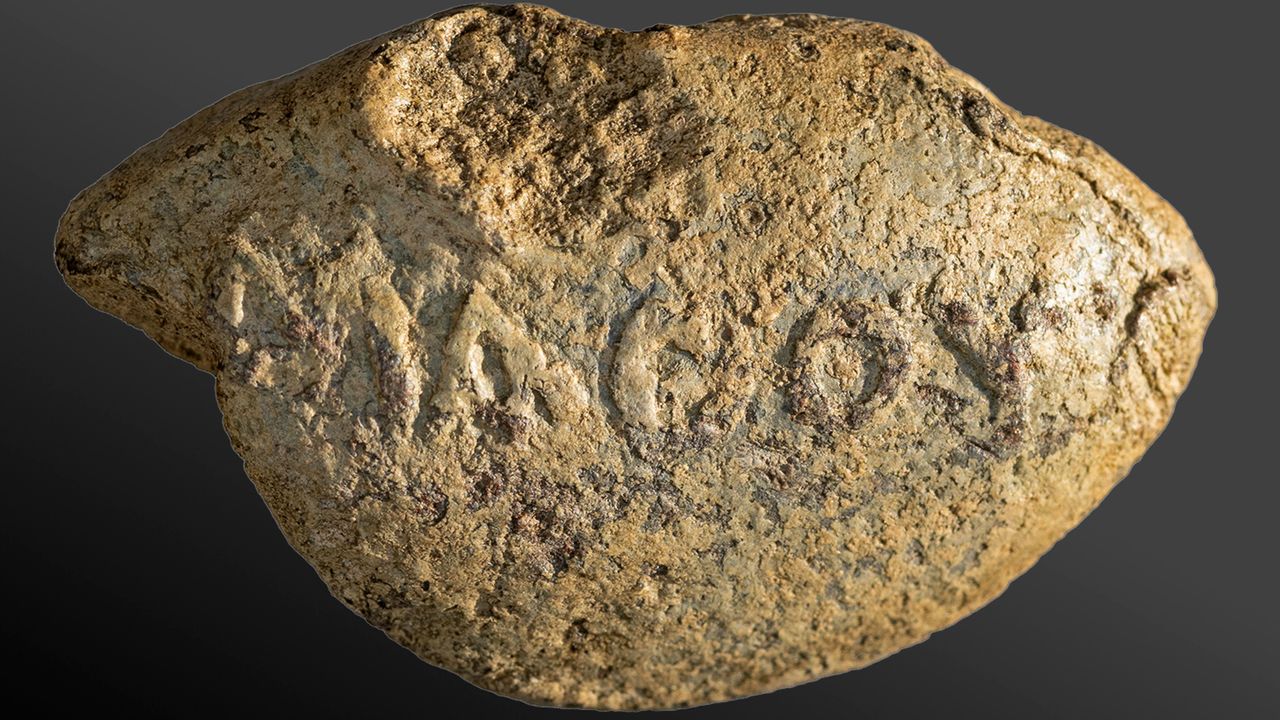
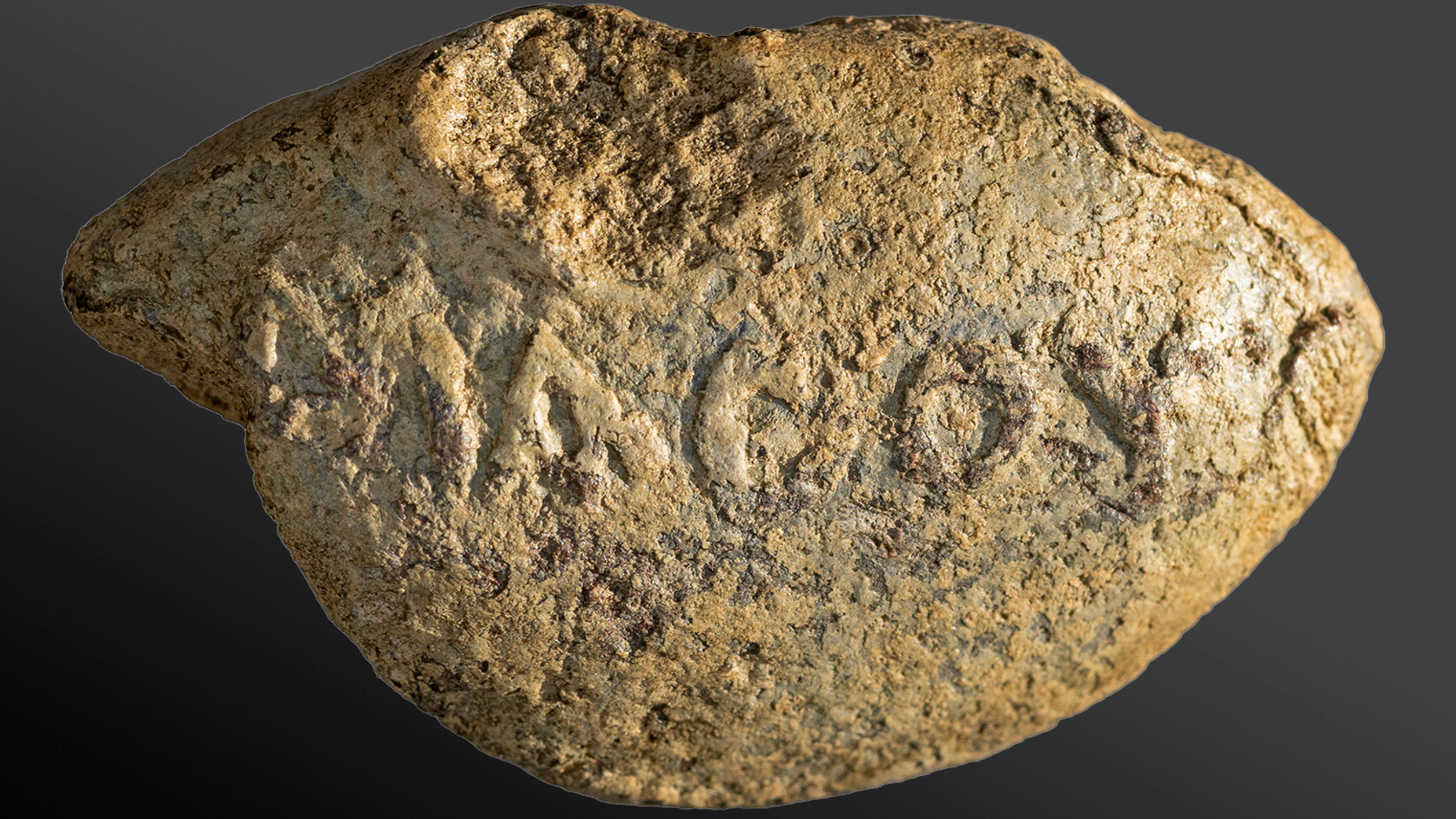
 The lead sling bullet is inscribed with Greek letters that form the word ΜΑΘΟΥ, which the researchers think is a command in ancient Greek to "learn." (Image credit: Michael Eisenberg/University of Haifa) Share this article 0 Join the conversation Follow us Add us as a preferred source on Google Newsletter Get the Live Science Newsletter
 Get the world’s most fascinating discoveries delivered straight to your inbox.
Become a Member in Seconds
Unlock instant access to exclusive member features.
Contact me with news and offers from other Future brands Receive email from us on behalf of our trusted partners or sponsors By submitting your information you agree to the Terms & Conditions and Privacy Policy and are aged 16 or over.You are now subscribed
Your newsletter sign-up was successful
Want to add more newsletters?
Join the club
Get full access to premium articles, exclusive features and a growing list of member rewards.
Explore An account already exists for this email address, please log in. Subscribe to our newsletterIsraeli archaeologists have unearthed a 2,000-year-old sling bullet inscribed with a cruel message: an ancient admonition telling enemies "Learn your lesson."
The sling bullet was found in the remains of the ancient city of Hippos (also known as Sussita). The molten lead for the ammunition had been poured into a mold emblazoned with the Greek letters for "learn."
"Sling lead bullets of this type are well known in archaeological research from many sites dating to the Hellenistic period, particularly from the second century BCE … but this is the first in the world to bear the inscription 'Learn,'" Michael Eisenberg, an archaeologist at the University of Haifa, said in a statement.
Article continues belowHe thinks the sling bullet, also called a sling stone, was used against attackers by the Greek-speaking defenders of Hippos, which was located about a mile east of the Sea of Galilee. Eisenberg and his colleagues reported the findings March 10 in the journal Palestine Exploration Quarterly.
"This represents local sarcastic humor on the part of the city's defenders, who wished to teach their enemies a lesson with a wink," he said.
Hippos was one of 10 ancient cities in a confederation known as the Decapolis. These cities were founded on the eastern edge of the Levant by the Macedonian successors of Alexander the Great and were later developed by the Romans as their eastern frontier against the Parthians, who lived in the ancient Near East and had descended from nomads in eastern Iran.
Ancient ammo
The sling bullet was found in 2025 during excavations of a necropolis in the ruins of Hippos, according to the statement. The archaeologists think a defender likely fired it from the city's walls, which overlooked a road there.
Sign up for the Live Science daily newsletter nowContact me with news and offers from other Future brandsReceive email from us on behalf of our trusted partners or sponsorsThe sling bullet was found amid the ruins of Hippos, an ancient Hellenistic city east of the Sea of Galilee. (Image credit: Michael Eisenberg/University of Haifa)
The lemon-shaped bullet is made of lead and is about 1.3 inches (3.2 centimeters) long. One side was destroyed in a powerful impact, and archaeologists estimate it originally weighed about 1.6 ounces (45 grams).
The statement noted that slings were cheap but extremely effective as artillery and that a skilled slinger could strike an enemy almost 1,000 feet (300 meters) away. In addition, sling bullets could be easily made from stone molds during a conflict.
Sling bullets were often inscribed with the names of gods, cities or military commanders, such as Julius Caesar, or with magical symbols, like tridents, lightning bolts or scorpions, which were said to imbue them with power, according to the study.
Hippos bullet
One side of the sling bullet from Hippos is inscribed with the Greek letters ΜΑΘΟΥ. The study authors have interpreted that inscription as a form of the Greek word "mathaíno," which means "learn," and they think the spelling indicates it was an imperative that meant something like "Learn your lesson."
Similar lead sling bullets with dark humor have been found in the region, with inscriptions that mean "catch" and "take a taste."
RELATED STORIES—Was medieval armor bulletproof?
The latest find is one of 69 lead sling bullets discovered at Hippos during 26 years of excavations, the study noted. Some are decorated with scorpions and thunderbolts, but this is the first with an inscription.
These sling bullets may have been used in any of several battles during the Hellenistic period at Hippos.
"The first was before the city's establishment, during the Ptolemaic rule, when a fortress stood atop the hill," the team wrote. "It was conquered during the Battle of Paneion c.199 BCE by the Seleucids, who subsequently established the polis of Hippos in this location."
Article SourcesEisenberg, M., Kowalewska, A., & Staab, G. (2026). Learn! – A New Type of Inscription on a Sling Bullet from Hippos of the Decapolis. Palestine Exploration Quarterly, 1–5. https://doi.org/10.1080/00310328.2026.2641294
Tom MetcalfeLive Science ContributorTom Metcalfe is a freelance journalist and regular Live Science contributor who is based in London in the United Kingdom. Tom writes mainly about science, space, archaeology, the Earth and the oceans. He has also written for the BBC, NBC News, National Geographic, Scientific American, Air & Space, and many others.
View MoreYou must confirm your public display name before commenting
Please logout and then login again, you will then be prompted to enter your display name.
Logout LATEST ARTICLES 1Drought paradox study reveals plants around Colorado River turn to groundwater when it gets too hot and dry, reducing flow into the already strained basin
- 2Rare 'daytime fireball' meteor creates powerful sonic boom as 7-ton space rock explodes above eastern US
- 3New AI image generator runs using 10 times fewer steps than today's best models — and it's coming to smartphones and laptops
- 4Enjoy 'Born to be Wild' and all your favorite nature documentaries on your travels with this best-ever ExpressVPN deal
- 57 best deep-sky targets to observe this galaxy season