 Image source, Getty ImagesImage caption,
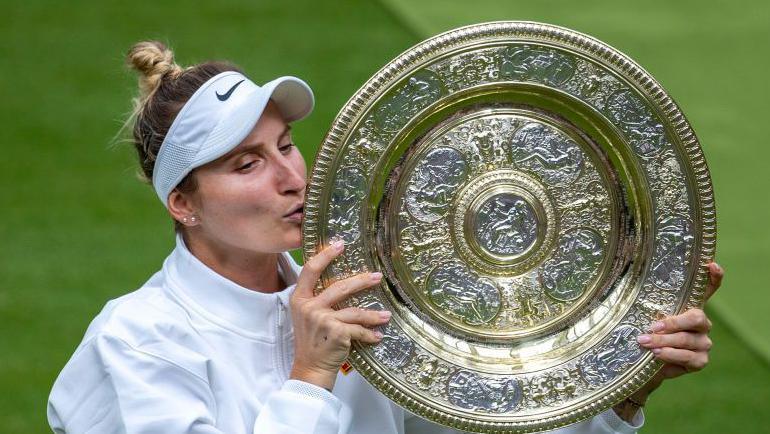
 Marketa Vondrousova beat Ons Jabeur in the 2023 Wimbledon final
ByJonathan JurejkoBBC Sport tennis news reporter- Published29 minutes ago
Recent Wimbledon champion Marketa Vondrousova receiving a four-year ban for refusing to take a doping test was a punishment which sent shockwaves through tennis.
The Czech, who became the first unseeded player to win the Wimbledon women's singles title in 2023, would not let a doping control officer into her Prague home to conduct the test in December 2025.
In June, it was announced the 27-year-old would be suspended for four years - the starting point for any player who refuses or evades a test.
On Friday, the independent tribunal which imposed the punishment released its full written report about the case - which it described as a "very unfortunate matter" but which offered "no compelling justification" for a shorter ban.
From how walking her dog undermined her case, to the lack of understanding players seem to have about doping rules, BBC Sport analyses some of the key findings.
An 8pm visit and panicked texts - what happened?
Vondrousova, who also reached the French Open final in 2019 and won the Tokyo 2020 Olympics silver medal, claimed she feared for her safety when the doping officer arrived at her flat at 8pm on 3 December.
She was alone in her apartment and told the officer via the intercom that she would not open the door.
The tribunal's report said Vondrousova called her agent to ask about doping protocol, and sent a text message to her boyfriend which said someone from doping control had arrived - using an expletive to describe them.
There is some dispute about what happened next, with the doping officer saying the pair had two exchanges over the intercom, but Vondrousova saying there was only one.
Both sides agree they met face-to-face about 10 minutes later when Vondrousova went outside to walk her Italian Greyhound dog.
That is when Vondrousova reiterated she would not take the test and signed a form which acknowledged her stance.
The International Tennis Integrity Agency (ITIA) - the body tasked with overseeing a clean and fair sport - said it had little option other than to seek a four-year suspension.
The tribunal agreed with the ITIA. It ruled she had provided "no compelling justification" for refusing a test.
On Friday, the tribunal said: "This is a very unfortunate manner in which the player made a decision in the heat of the moment to refuse doping control, in a state of stress and anxiety, with significant consequences."
Ex-Wimbledon champion Vondrousova given four-year ban
- Published22 June
Comparisons to Kvitova incident 'exaggerated'
One of the key parts of Vondrousova's mitigation centred around her safety concerns.
The former world number six said she felt scared when the officer approached her door "late at night" without, she claimed, properly identifying themselves or following protocol.
Vondrousova cited the horrific knife attack on her fellow Czech player Petra Kvitova - who was stabbed by an intruder at her home in 2016 - as a reason why she did not open the door.
However, the ITIA contested Vondorousova's case that she felt her safety was at risk, and the reasons why they said they disagreed included:
the area of Prague where she lives is "relatively crime-free"
the comparison with Kvitova's attack was an "exaggeration"
walking her dog was "entirely inconsistent with identifying a potential threat"
The ITIA also noted Vondrousova did not raise any concerns about her safety in the exchanges with her agent and her boyfriend.
In her defence to the tribunal, Vondrousova said another reason why she did not want to open the door was because she suffered from acute stress reaction and an anxiety disorder.
The tribunal acknowledged the situation would have led to anxiety, but said her wider arguments about safety and stress were not "exceptional circumstances".
Do players not know doping rules?
Vondrousova's case has been another example of how some players have revealed they do not know the doping rules.
After the incident in December, Vondrousova posted an Instagram story in which she accused the officer of not following rules because the call was outside her one-hour whereabouts slot.
The whereabouts rule means players must give a time and location for an hour where they can be tested every day of the year. They are also able to be tested outside this 60-minute slot.
"Unpredictable testing is an essential tool to protect clean sport," ITIA chief executive Karen Moorhouse said in June.
"The tribunal ultimately supported that principle. This case is an important reminder that players can be tested at any time, in any place, and that refusal comes with significant risk."
The tribunal's report noted how Vondrousova said she did not know she could be tested outside the one-hour slot, and claimed she had never been tested at home outside this window before.
She also said her agent did not know out-of-hours testing was possible.
The ITIA argued that "any lack of understanding" of the anti-doping rules by an experienced player like Vondrousova - who has taken 83 tests since 2018 - was "not credible".
Is tennis catching doping cheats or ruining careers?
- Published8 May 2024
Will Vondrousova appeal and what happens next?
Vondrousova plans to appeal against the decision and is expected to lodge her case with the Court of Arbitration for Sport (Cas) before the 11 August deadline, BBC Sport has been told.
She has not played since January as she dealt with the case, having dropped to 122nd in the world when her ban was announced in June.
If her appeal is not successful, she will not be able to play again until June 2030.
That means she will be almost 31 years old when free to return - if she wishes.
Whatever happens with the appeal process, Vondrousova's refusal to take the test has already cost her a considerable chunk of what should be the peak years of an impressive career.
It also acts as a serious warning to other players that missing a test will not be tolerated - a deterrent intended by the ITIA.