
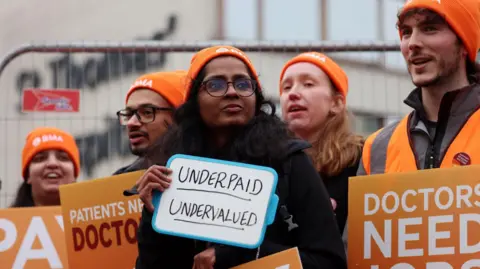
 EPAThe action will be the 15th strike in a three-year dispute between resident doctors and the government
 People should not put off seeking the care they need when a six-day strike by resident doctors in England begins on Tuesday, the NHS has said.
The 15th walkout in a dispute over pay and job opportunities comes at the end of the long bank holiday weekend and NHS managers say they fear a surge in demand could be "particularly challenging".
Officials said senior doctors and resident doctors not involved in the action will be working, and that patients should come forward as normal and attend appointments unless they are contacted.
The latest action by resident doctors - previously known as junior doctors - was called after talks to end the three-year long dispute broke down at the end of March.
Tens of thousands of doctors will strike between 07:00 BST on Tuesday until just before 07:00 on Monday 13 April.
Health Secretary Wes Streeting said the strikes were "disappointing" and that the focus was now on protecting patients and staff by minimising disruption to the health service.
He maintained that the NHS delivered almost 95% of planned activity during the resident doctor strikes in December.
The doctors' union, the British Medical Association (BMA), said the strikes "would bring disruption - despite NHS England's assurances that it can maintain the vast majority of services running for patients during times of industrial action".
Dr Jack Fletcher, chairman of the BMA's resident doctors committee, said: "Many senior doctors will be covering for us and whilst that of course benefits patients, we know they are also exhausted and as demoralised as we are."
Prof Ramani Moonesinghe, national clinical director for critical and perioperative care at NHS England, said there were "tried and tested systems for making sure that we can keep all of our health services safe over industrial action".
She told BBC Radio 4's Today programme: "The NHS is still open for business and there are still plenty of people there available to care for you.
"If you have a planned appointment - unless you have been specifically told that it has been postponed or cancelled - you should attend for that as you'd expect to.
"If you have an emergency or urgent condition, you should do exactly the things you'd normally do - so phone 111 or 999 if you need that sort of emergency care, attend A&E if you need emergency care or attend your GP or a local pharmacy if you have a less urgent condition."
Doctors lose new jobs package as strike to go ahead
Starmer gives doctors 48 hours to cancel strike or lose new jobs package
Why are resident doctors striking and how much are they paid?
Resident doctors make up nearly half the medics working in the NHS and two-thirds of them are BMA members.
After the strikes were announced, the government rescinded a key part of its offer to them by withdrawing 1,000 extra training places.
The Department of Health and Social Care said the plans were no longer "financially or operationally" possible but that the move would not impact the overall number of doctors in the NHS as the posts were going to be created from existing short-term roles.
Alongside the extra training posts, the government had also offered to cover some out-of-pocket expenses, such as exam fees, as well as ensuring faster pay progression through the five salary bands that span training. The pay points start at just below £39,000, and rise to nearly £74,000.
But the BMA ended the talks, saying the terms of the pay progression element had been "watered down" at the last minute.
It also coincided with the government accepting the recommendations of the independent pay review body that all doctors, including resident doctors, should get a 3.5% pay rise from this month.
While the pay rise means resident doctor pay has risen by a third over the past four years, the BMA argues it is still a fifth lower than it was in 2008 once inflation is taken into account.
The union uses a measure of inflation - RPI - that is higher than others. It says it does this because the government uses that measure of inflation when adding interest to student loans.
HealthDepartment of Health & Social CareNHS EnglandNHSBritish Medical Association (BMA)Strike action