First-year head coach Golesh says he is pleased with the Tigers' energy and buy-in as they begin to take form as a team while discussing how they are building their identity. (2:17)
College football coaches talk constantly about controlling what they can control. They know that, at the heart of this billion-dollar industry lies a very silly, very random game. The pointy ball, the transient and unreliable collections of 18- to 23-year-old men, the extreme physicality that produces lots of injuries ... coaches know that even if they recruit well, develop players well and deploy sturdy tactics, sometimes the breaks are simply going to go against them.
Take Clemson and Baylor, for instance. They ranked first and ninth, respectively, in returning production heading into 2025. Clemson had won 10 games and an ACC title the previous season, while Baylor had leaped from 3-9 to 8-5. The Tigers were ranked in the preseason top five, while the Bears at least had sleeper Big 12 hopes. But after producing a combined plus-22 turnover margin in 2024 (with turnover luck at +17.8, as we'll define below), they combined for a minus-11 in 2025, a 33-turnover shift in the wrong direction. They went a combined 12-13.
Take Arkansas and Florida State. They had very different 2024 campaigns -- Arkansas climbed from 4-8 to 7-6, while FSU plummeted to 2-10 -- but, in 2025, both had hopes of engineering solid bowl campaigns for their embattled head coaches. Instead, they went a combined 0-10 in one-score finishes, failing to either generate or benefit from the bounces they needed. The Hogs fired head coach Sam Pittman, while FSU's Mike Norvell is on his last strike.
Take Syracuse and Colorado, two fallen programs that had found reason for optimism in 2024. The Orange and Buffaloes won a combined 19 games in 2024, but they were forced to start 92 different players on offense and defense in 2025, with only 13 starting 11 or 12 games. Constant injuries and endless shuffling produced a pair of 3-9 campaigns.
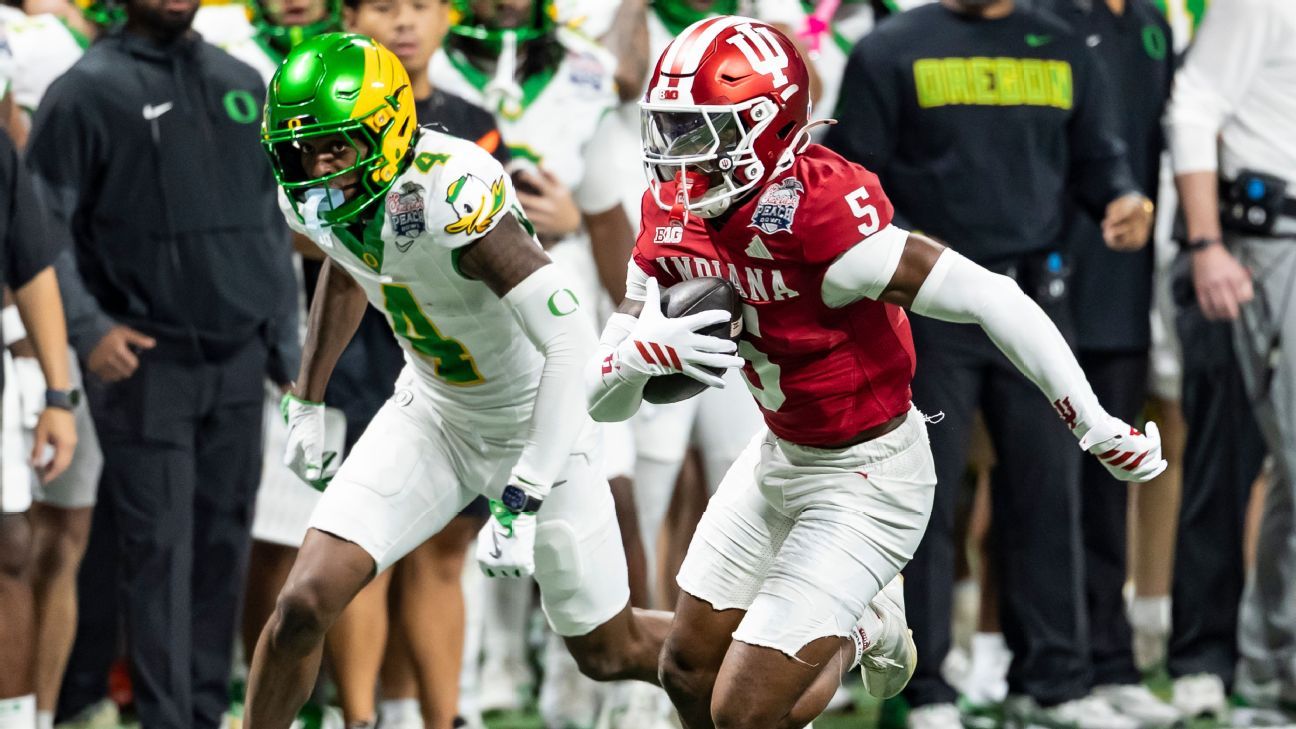
Take Indiana. Coach Curt Cignetti might be a wizard. A year after his Hoosiers got a solid number of breaks while charging to 11-2, they got even more of them during 2025's national title run. They were in the top 10 in turnover luck, close-game fortune and lineup stability, as you'll see below. Maybe he has cracked the code and figured out how to make the game far more controllable? Maybe a season of atrocious luck awaits in Bloomington? We'll find out.
Be it turnovers, close-game fortune or injuries, let's talk about the teams that were dealt the best and worst hands last fall.
Over a long enough period of time, a team will recover about 50% of the fumbles that occur in its games.
Over a long enough period of time, a team will produce a ratio of about one interception to every four pass breakups.
Through some combination of risk tolerance (say, defensive backs who take extra chances) and proper fundamentals (running backs properly leaving the ball unexposed), a team can have a bit of an impact on its turnover margin. But once a ball is fumbled or deflected, randomness takes over. And the teams that benefit the most from randomness in a given season tend to find comeuppance from the turnover gods the next season.
Based on the two truths above, we can determine what amounts to an expected turnover margin based on what would have happened if a team had recovered 50% of all fumbles, and both it and its opponents had produced the proper INT-to-PBU ratio. Compare a team's actual turnover margin to its expected margin, and voilà, we have turnover luck. It's a pretty powerful predictor.
In 2024, 14 teams had turnover luck of plus-5.5 or more (meaning, their turnover margin was at least 5.5 turnovers better than it should have been). That luck reversed for 12 of them in 2025, and these 14 teams' average turnover margin dropped by 7.1 turnovers in 2025. James Madison's turnover margin went from plus-20 in 2024 to plus-1 (which makes their 12-2 run even more impressive). Clemson's went from plus-16 to plus-2. Baylor's went from plus-6 to minus-13. Boston College went from plus-9 to minus-9.
The same thing happened in reverse: 22 teams had turnover luck of minus-5.0 or worse in 2024, and luck reversed for 20 of them in 2025. Average change in turnover margin: plus-9.6. Temple went from minus-9 to plus-11. Central Michigan went from minus-17 to plus-5. Southern Miss went from minus-19 to plus-14!
I'm giving Maryland fans pretty conflicting vibes this week. The Terrapins rank second in returning production, which provides some level of hope, but the fact that they went 4-8 last season despite some of the best turnover luck in the country certainly hints at a lower bar. The same goes for teams like Kansas State and LSU, which suffered disappointing campaigns despite some happy bounces.
On the flipside, you have Texas A&M. While most of the teams at the bottom of this list were disappointing in 2025 -- North Carolina faceplanted in Bill Belichick's first season, Arkansas went a dire 2-10, et cetera -- Mike Elko's Aggies had the third-worst turnover luck in the country and still made their first College Football Playoff. Of course, most of that luck came at the end of the season, as a thrilling 11-0 start turned into a disappointing 11-2 finish. In their last four games, a run that featured their wild comeback against South Carolina and losses to Texas and Miami, they had an expected turnover margin of minus-2.3 and an actual turnover margin of minus-9, including a minus-2 in the 10-3 defeat to Miami. With even neutral luck, the end of their season might have looked a lot different.
One of my favorite tools in my statistical toolbox is postgame win expectancy. The idea is to take all of a game's key, predictive stats -- all the things that end up feeding into my SP+ rankings -- and basically toss them into the air and say, "With these stats, you could have expected to win this game X% of the time."
Postgame win expectancy tells us a lot about the predictive power of certain key results from a given season. Oklahoma's vital 23-21 win over Alabama in November, for instance, punched the Sooners' CFP ticket but featured just 4.9% postgame win expectancy; two of Miami's three CFP wins, meanwhile, were a bit on the fortunate side -- their win over Ole Miss was a toss-up (47.9% postgame win expectancy), and the win over Ohio State (30.0%) suggests the Hurricanes probably wouldn't have won a best-of-seven series.
(None of this is to say these wins or teams were illegitimate. Having seasons determined by funky breaks and strange results is part of the fun of college football!)
Adding up each team's postgame win expectancies is a nice way of seeing how many games they could have expected to win on average. I call this a team's second-order win total. And when a team's actual win total skews a bit too far from its second-order win total, the odds of a reversal the next season are pretty high.
In 2024, there were 13 teams that finished with win totals at least 1.5 games above their second-order win totals. They went from a combined 120-50 that season to 93-72, a drop of 2.1 wins per team, in 2025. Iowa State and Missouri slipped from a combined 21-6 to 16-9. Sam Houston and Syracuse plummeted from a combined 20-6 to 5-19.
There were also 15 teams that finished at least 1.5 wins short of their 2024 second-order win totals. Predictably, they mostly charged forward in 2025, going from 86-104 to 104-91, a rise of 1.2 wins per team. Miami and Ole Miss both suffered key close losses that kept them out of CFP bids in 2024 but improved from a combined 20-6 to 26-5 with deep CFP runs in 2025. Fresno State and Washington, meanwhile, each jumped from 6-7 to 9-4 last fall thanks in part to a second-order win reversal.
Finishing as a second-order wins outlier doesn't guarantee a reversal the next season, of course. Texas Tech was on the fortunate end in 2024, going 6-1 in one-score games and 8-5 overall; the Red Raiders still charged to 12-2 in 2025, improving so much overall that they no longer needed close-game luck. Meanwhile, Auburn's 5-7 record in 2024 was 2.8 wins away from its second-order win total, the worst difference in the country. The Tigers proceeded to go 5-7 again in 2025, 0-6 in one-score finishes. Auburn never really adheres to math and probability.
The list of 2025 outliers starts with a couple of conference champs.
Duke and Kennesaw State each overachieved pretty dramatically while winning the ACC and Conference USA, respectively, and despite extreme misfortune in the loss to Oklahoma, Alabama's second-order win total of 9.4 doesn't really paint a playoff-worthy picture. But the most noteworthy team in the table above has to be the last one. Arkansas lost four games with a postgame win expectancy of at least 62% in 2025 and finished 2-10 with losses by scores of 23-22, 32-31, 34-31, 45-42, 38-35 and 41-35. Heading into the final game of the season, the Hogs were 2-9 with a positive scoring margin! Even by college football's standards of dumb randomness, that's pretty impressive. And it probably hints at a much better performance, in the win column, in 2026.
Injuries are hard to define in college football -- coaches are frequently canny in the information they do and do not provide, and with so many teams in FBS, it's impossible to derive accurate data regarding how many games were missed because of injury.
What I found last season, however, is that we can glean quite a bit from starting lineups. Teams with lineups that barely changed throughout the season were probably pretty happy with their overall results, while teams with ever-changing lineups likely succumbed to lots of losses. By looking at the ratio of (a) the number of players who either started every game or started all but one for a given team to (b) the number of players who started only one or two games, likely as a stopgap, we can derive quite a bit of information. Sure, coaches on bad teams are more likely to experiment with their lineups, injuries or no injuries. But if your lineup was a little too stable last season, it probably won't be in 2026. (Unless you're Curt Cignetti and you've eliminated all randomness, of course.)
Using the ratio of (a) to (b) above, 20 teams produced a ratio of 2.0 or better in 2024. They went from 172-92 that year to 162-103 last fall. That's not as big a shift, obviously -- Indiana, Kennesaw State and Virginia managed to keep their lineups relatively stable and surge in 2025 regardless (in part due to the close-game fortune we saw above). But Penn State, Sam Houston, Army, Memphis and Kansas State were among the teams that saw their lineups shaken up far more in 2025, and they all fell short of their preseason goals.
Meanwhile, eight teams finished with a ratio of 0.50 or worse in 2024. They went from a combined 31-56 to 49-39 in 2025, an average improvement of 2.3 wins per team. Sure, teams like Florida and Middle Tennessee couldn't really take advantage of more stable lineups, but Oklahoma, North Texas and Utah were all at the bottom of the lineup stability list in 2024 and charged from a combined 17-21 to 33-7 last fall. And somehow Kent State leaped from 0-12 to 5-7 despite remaining near the bottom of the lineup stability table.
The top 20 teams above had a combined win percentage of 0.711. The bottom 16 were at 0.297. That likely isn't a coincidence.
Again, bad teams are more likely to have shuffled lineups in general, but it's probably noteworthy that among the 24 teams with a 0.75 ratio or worse, only six won at least eight games (Boise State, Iowa State, Jacksonville State, Louisiana Tech, Missouri and New Mexico), and among the 43 teams with a ratio under 1.0, only Texas won 10 or more games.
There are plenty of teams that ranked high in one of the tables above and low in another. And there are teams like Indiana, which managed to somehow rank in the top 10 in each table. We'll see if Cignetti has solved the sport or (far more likely) there's some harsh regression-to-the-mean in Indiana's future. But there is some hope, at least for six teams.
The six teams below ranked 90th or worse in all three categories above and rank at least in the top 100 in returning production this fall. They fell from a combined 44-31 in 2024 to 22-51 in 2025, and it appears they had quite a bit of poor fortune dragging them down along the way. That will likely reverse itself to some degree in 2026.
Boston College. I really liked what Bill O'Brien did in his debut season at BC in 2024, but the Eagles plummeted from 7-6 to 2-10 last fall. He had no quarterback and no luck. There's no guarantee that the former will be fixed in 2026 -- the most likely starting QB is either Division II transfer Mason McKenzie (Saginaw Valley State) or redshirt freshman transfer Grayson Wilson (Arkansas) -- but more stability and a couple more bounces will help.
Colorado. By my count, Deion Sanders brought in transfers who combined for 182 starts in 2025, the third-highest tally of any team (behind two other disappointing Big 12 teams, West Virginia and Oklahoma State). He might have given new offensive coordinator Brennan Marion what he needs for a solid offensive turnaround in 2026, and if fortune flips as well, the Buffaloes could surprise.
Liberty. After going 21-5 in his first two seasons, Jamey Chadwell's Flames crumpled to 4-8 last fall. The offense is undergoing a massive facelift, with a new coordinator (Newland Isaac) and 17 new transfers, but a little bit of luck and stability would go a long way, too.
UL Monroe. After a promising 5-7 debut in 2024, Bryant Vincent's second season was a 3-9 disaster. ULM fell right back into the 130s in SP+, and the Warhawks finished on an eight-game losing streak as the lineup dissolved. This is always a hard job, but it was a little harder than normal in 2025.
Missouri. The Tigers are easily the best team on this list, and they fell only from 10-3 to 8-5 last fall despite ranking 95th in turnover luck, 102nd in second-order win difference and 111th in lineup stability. New quarterback Austin Simmons' development will determine the Tigers' fate in the crowded SEC, but simply neutral luck will help, too.
Oregon State. Never mind ranking 90th or worse in these three categories -- the Beavers were 117th or worse in each while falling to 2-10. They rank only 94th in returning production, and the transition under new coach JaMarcus Shephard is a massive one, but no team in the country more thoroughly deserves a few decent breaks this coming fall.