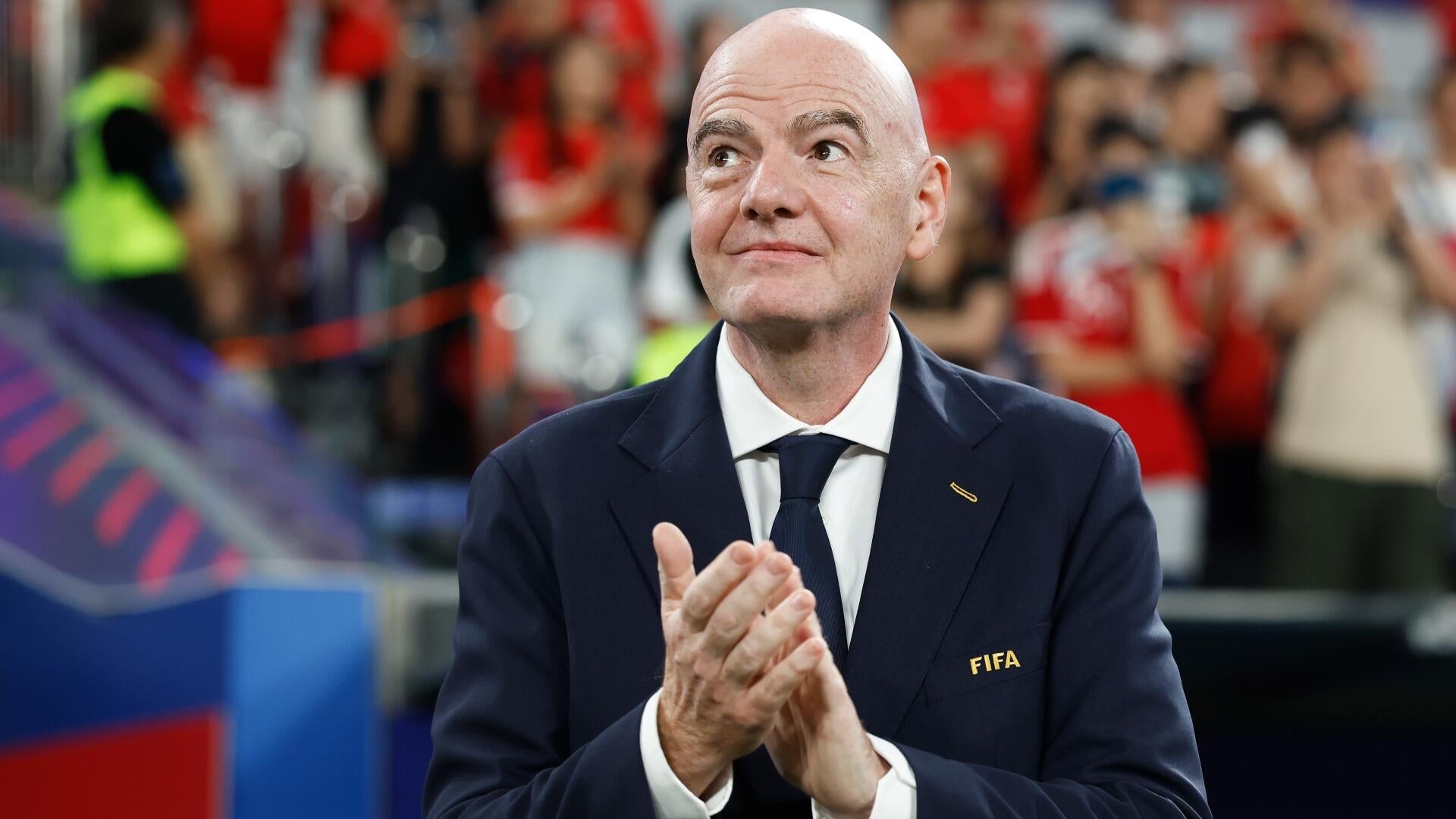
FIFA president Gianni Infantino apologized to members of the FIFA Council in a meeting on Thursday in Zurich, the first gathering of the organization's main decision-making body since Infantino announced and then scrapped a controversial plan to privatize the World Cup.
The specifics of Infantino's apology were not made public but FIFA said that the Council was updated on the legal background behind FIFA Forward Enterprise (FFE), which was a proposed subsidiary that controlled the commercial rights to the men's and women's World Cups and Club World Cups. FFE was valued at around $20 billion and minority stakes were to be sold to private investors headlined by Thrive Eternal, the investment firm of venture capitalist Joshua Kushner, the brother of U.S. president Donald Trump's son-in-law, Jared. The plan received criticism from the moment it became public knowledge in a report from the Times of London in July and was abandoned within a matter of days, though a legal battle over the proposal is now underway in the U.S. and the incident continues to loom large as Infantino seeks re-election.
Infantino fielded questions from Council members about FFE on Thursday and asked them to submit more queries for a subsequent meeting, the session ultimately drawing mixed reviews from those in the room. Ahmed Yahya, the president of Mauritania's federation, said he believes Infantino is the "right president" and that the majority of FIFA's member associations (MAs) feel the same way but others held back on endorsements. German Football Association president Bernd Neuendorf insisted he had no confidence in Infantino, while England's chairwoman Debbie Hewitt said Infantino was not forthcoming enough in his answers on Thursday.
"One of the disappointing things is that we didn't get answers to anything that we had specifically requested, for example, getting the papers from FFE," Hewitt said. "I asked the question, 'Why not?' and we were asked to submit those questions in writing. I think the man has to answer those questions and if he doesn't answer those questions now, he's not fit to be FIFA president and that was what was shared in the meeting. I've repeatedly asked for the papers to be shared. I haven't received them and still in spite of the request today, I haven't received them."
Infantino attempted to address some of the concerns around FFE, including agreeing to set up a working group to review governance procedures. FIFA also proposed an increase to the funds it usually distributes to the 211 MAs, who could now pocket $25 million over the next four-year cycle should the plan get the green light. This was in response to criticism from UEFA, Concacaf and the AFC that FIFA should use its existing reserves to further fund soccer projects around the world rather than FFE, which was unpopularly billed as a means to increase available resources for MAs.
The scrutiny on the FIFA president does not end there. He continues to face criticism for FIFA's handling of Folarin Balogun's red card suspension during the World Cup, in which the governing body cited a rarely used rule to lift his one-match ban for the U.S. men's national team's round of 16 defeat to Belgium. Infantino has been unable to shake the allegation that political pressure led to the decision, particularly after Trump said he called Infantino asking him to review FIFA's longstanding rules.
FIFA's legal team will now review the disciplinary procedures following the Balogun affair and are set to present their findings at the Council's next meeting in December. Infantino's detractors continue to cite the incident as an example of the president's shortcomings in recent months, including the awarding of the inaugural FIFA Peace Prize to Trump at last year's World Cup draw in Washington, D.C. It is unclear if the Peace Prize will be awarded again this year, since FIFA's Social Responsibility Committee will assess the award before the Council makes a decision on it in December.
The choices regarding the Peace Prize and Balogun's suspension were taken outside of FIFA's usual governance procedures, which is why Council members continue to ask for more information on how those decisions were reached.
"It is the rationale for why FFE happened in the way that it did, the Balogun case, the Peace Prize," Hewitt said. "The responses to those questions, which I still don't have answers to, will determine from my personal point of view whether or not Gianni is the right candidate. That will be the point at which or not we can say that any individual that was involved in FFE can or cannot be trusted because until we see what actually happened it's very difficult to say behavior needs or not to change … Those papers coming to Council are a crucial next part of us feeling comfortable as to what, if any, criminal proceedings need to take place."
Hewitt believed there was "some contrition" in Infantino's apology but said the president did not offer enough information to change her stance on his re-election.
"From my position, nothing has shifted," she said. "I've no new information that makes me feel any differently, other than we do have a president who is apologetic."
Infantino is seeking his fourth and final term in March's election, which will take place during the FIFA Congress in Rabat, Morocco. Ex-Switzerland international Ramon Vega is his only opponent thus far though prospective candidates have until Nov. 18 to submit their interest.
Add CBS Sports on Google Join the Conversation comments