 Rich CiminiApr 12, 2026, 06:15 AM ETClose
- Rich Cimini is a staff writer who covers the New York Jets and the NFL at ESPN. Rich has covered the Jets for over 30 years, joining ESPN in 2010. Rich also hosts the Flight Deck podcast. He previously was a beat writer for the New York Daily News and is a graduate of Syracuse University.

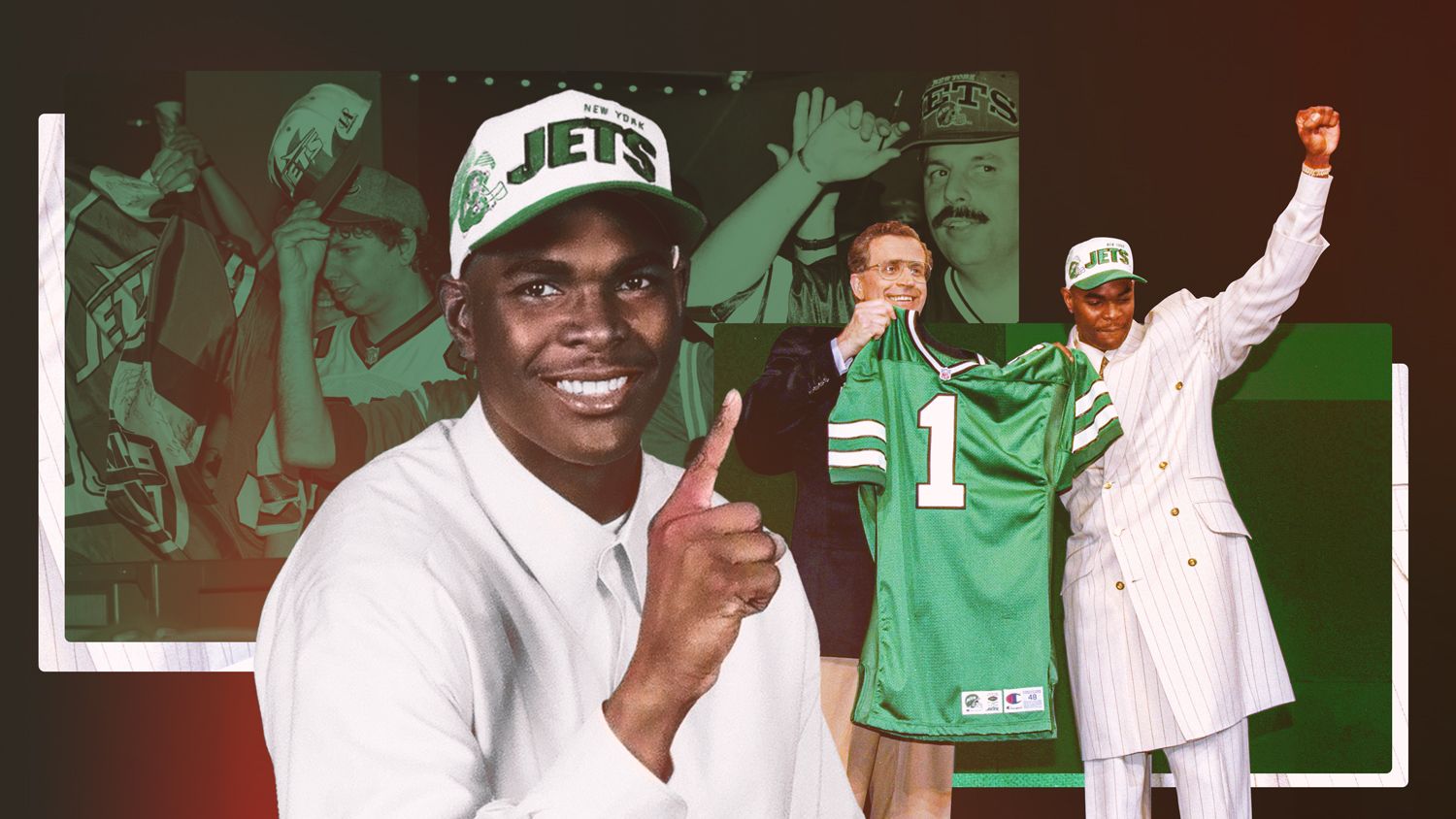
ON THE MORNING of the 1996 NFL draft, the New York Jets dispatched a front office official to a Manhattan hotel for an eleventh-hour meeting with Keyshawn Johnson and his agent. With the draft set to begin at noon a few blocks away at Madison Square Garden, the Jets' objective was to leverage their position, hoping to convince the former USC star to sign a contract before they were on the clock with the No. 1 pick.
Johnson was standing on a stool in his hotel room, modeling his custom-made beige suit for his personal tailor as agent Jerome Stanley and the Jets' Pat Kirwan haggled over the contract. Johnson deemed the offer below market -- this was 15 years before the NFL's rookie wage scale went into effect -- and told the Jets through Stanley, "Don't draft me!" He fired off a few expletives as well.
They did draft him, of course -- a decision that resonates to this day.
Thirty years later, Johnson remains an outlier -- the last wide receiver to be selected with the top pick in the draft. While the position has grown in stature and value -- the salary of the highest-paid receiver has increased by more than 600% since 1996 -- it hasn't loosened the quarterback stranglehold on the top spot.
Keyshawn Johnson remains the last wide receiver to be picked first overall in the NFL Draft.pic.twitter.com/M69bP2gux1
It took a perfect storm, so to speak, for the Jets to make such an unconventional move. It was a historically poor quarterback draft, so there was no temptation to go in that direction. They longed for a charismatic star, and Johnson, one of the most recognizable names in college football, was a spotlight-loving athlete from Los Angeles.
"I think [the Jets] were looking for somebody to change the identity of the organization, bringing a snap, crackle, pop -- a pizzazz. But also playmaking ability," Johnson told ESPN, reflecting on the experience.
Johnson's time in New York was eventful. There was the draft-day staredown with team officials, the acrimonious contract dispute that followed and the bitter divorce when he was traded to the Tampa Bay Buccaneers in 2000. But on the field, he produced at a high level -- the second-most receiving yards in a four-year span (4,108) in Jets history.
He and Irving Fryar (New England Patriots, 1984) are the only two wide receivers chosen first overall in the common-draft era (since 1967). According to experts, it might never happen again.
IT'S NOT UNCOMMON for a receiver to be picked in the top 10. In fact, it has happened 43 times in the last 30 drafts, starting with Johnson and Terry Glenn (seventh, Patriots) in 1996. Move closer to the tippy top, though, and the air becomes rarefied.
Johnson went No. 1. Only three have been picked at No. 2 -- Charles Rogers (Detroit Lions, 2003), Calvin Johnson (Lions, 2007) and Travis Hunter (Jacksonville Jaguars, 2025), who doubled as a cornerback in his rookie season.
"It's not a surprise to me just because of what the draft has become," ESPN draft analyst Matt Miller said. "It's quarterback over pass rusher, and maybe an occasional left tackle -- the three most important positions in football.
"That's what's going first overall, even if that's not where the value is."
The numbers confirm it: In the common-draft era, 29 quarterbacks have been chosen No. 1 overall, followed by defensive linemen (15), running backs (seven), offensive tackles (four), wide receivers (two) and linebackers (two). Oh, and the last running back picked first overall? Ki-Jana Carter, one year before Johnson in 1995.
Because of supply and demand, teams overdraft quarterbacks, letting desperation cloud their evaluations. In 2007, Calvin Johnson was widely regarded as the best overall prospect, but the Oakland Raiders owned the No. 1 pick and owner Al Davis was smitten with JaMarcus Russell's powerful arm.
Russell, a colossal disappointment, was out of the league in four years. Johnson was inducted into the Pro Football Hall of Fame in 2021.
"There's an example of the quarterback getting the bump over the wide receiver even though the quarterback didn't have as high a grade," ESPN draft analyst Mel Kiper Jr. said. "At the end of the day, [it's] quarterbacks and pass rushers."
The receiver position has evolved over the past 30 years. The passing game explosion, from the NFL to the high school level, has yielded a new generation of highly skilled pass catchers. They benefit from 7-on-7 summer leagues and wide-open college offenses. Likewise, the NFL has shifted away from base personnel, using three- and four-wide packages.
"Now they're a dime a dozen, and I don't think you feel near the stress to have to take one at the very top of the draft," said former Cleveland Browns general manager and longtime executive Phil Savage, now a consultant in the Los Angeles Rams' personnel department. "We still see some go in the top 10, but for the most part, you can find receivers through the whole draft now.
"There's been a proliferation as the game has changed," Savage added. "I don't know that we'll ever see a wide receiver go No. 1 again because it's harder to find a tackle, a defensive end and a quarterback than a wide receiver."
In Keyshawn Johnson's rookie year (1996), the highest-paid receiver was the incomparable Jerry Rice, who made $5.8 million per year, according to Over the Cap. The current highest paid is Jaxon Smith-Njigba, who recently signed an extension that pays him $42.2 million per year.
When Johnson received his draft call from the Jets, the first voice he heard belonged to octogenarian owner Leon Hess, who told him, "Well, son, I guess we've got to go to the bank. You're our guy."
Johnson wound up signing a six-year, $15 million contract, a rookie record at the time.
The upcoming draft will include anywhere from three to five receivers in the first round, according to talent evaluators. Quarterback Fernando Mendoza is the presumptive No. 1 pick, so Johnson's streak is safe for another year. It would be a surprise if a receiver cracks the top 5.
Next year should be interesting. Ohio State's Jeremiah Smith, one of the highest-rated receivers in recent memory, is eligible for the 2027 draft. In two seasons, he has produced mind-blowing numbers -- 2,558 receiving yards and 27 touchdowns. Scouts are awed by his physical tools. If there's a receiver worthy of the top pick, it's him.
"If it doesn't happen next year," Miller said, "I don't know if it will ever happen again."
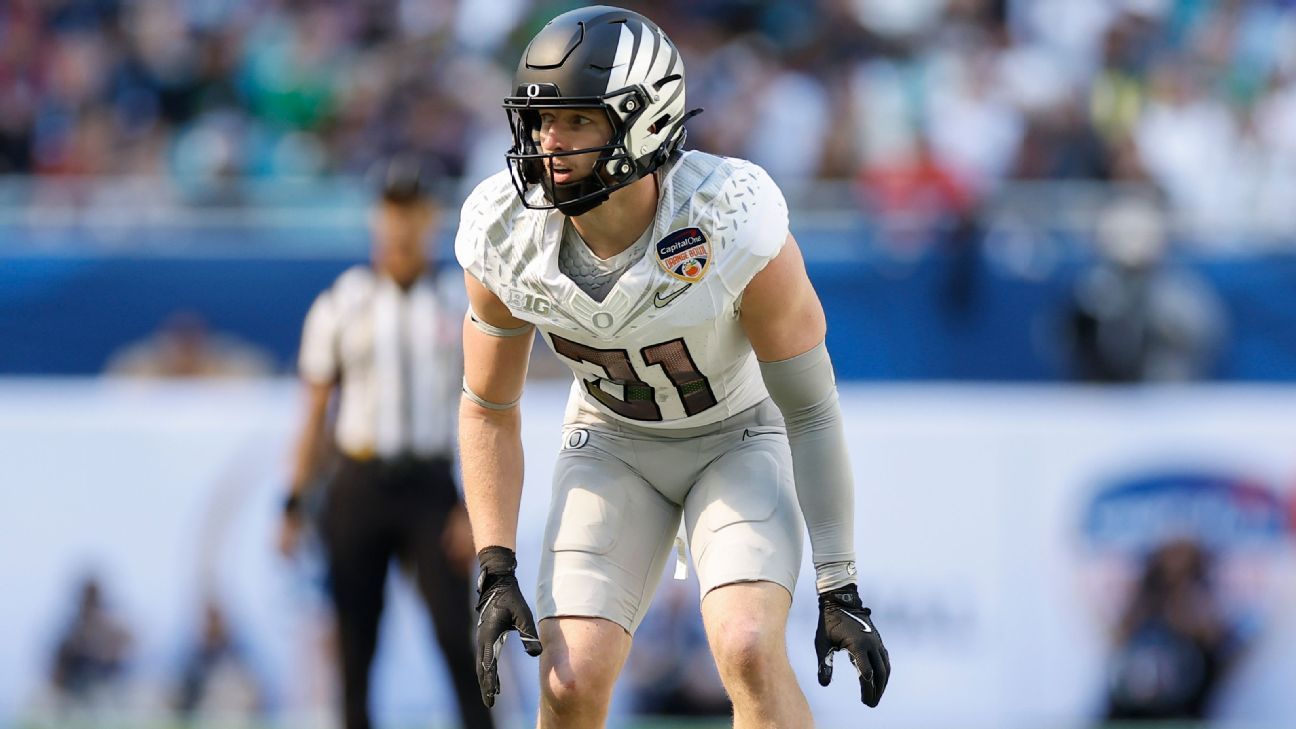
And it probably won't, because a handful of top quarterbacks, including Oregon's Dante Moore and Texas' Arch Manning, will be eligible. And we all know the NFL's unwritten rule: Quarterbacks trump everyone else.
Back in the day, Keyshawn didn't care much about norms or boundaries. He was a trend buster, someone who exuded competitive arrogance. He was determined to go No. 1 overall, no matter what people were saying about receivers.
Kiper said he received a phone call from Johnson in 1995, inquiring about his draft prospects. Kiper did some digging, contacting his friends in the league. He relayed his information to Johnson, telling him he'd probably be a first-round pick but probably not a high first-rounder.
Not good enough, Keyshawn told him. So he returned to USC for another year.
"Key wanted to be the top guy," Kiper said. "No matter what."
The Jets were coming off a three-win season with a second-year coach (Rich Kotite) who had previous ties to the organization -- eerily similar to the current situation with coach Aaron Glenn. Glenn played on that '96 team, along with recently hired offensive coordinator Frank Reich.
Kotite & Co. went into that offseason looking for a starting quarterback, opting for free agency because the draft was devoid of top prospects. In fact, the first quarterback wasn't chosen until the second round (No. 42 overall): Tony Banks, St. Louis Rams.
The 1996 draft is infamous for that reason; every draft since then has produced at least one first-round quarterback.
After signing former Pittsburgh Steelers starter Neil O'Donnell for $25 million over five years -- big money in those days -- the Jets had to make a decision with the top pick.
No team below them wanted to trade up, so the choice came down to Johnson and UCLA left tackle Jonathan Ogden, according to team officials. They had just lured Jumbo Elliott away from the New York Giants with a five-year, $15 million contract, so left tackle wasn't a need.
"Keyshawn was a star player; he was all the things we wanted," recalled Kirwan, the Jets' director of player administration at the time and now a SiriusXM host. "We had a lot of good, quiet players. We had spent a lot of money in free agency and we thought this young star is what we needed in New York. The Giants owned New York and we were trying to be relevant to that."
Three decades earlier, the Jets, an original AFL team, were armed with similar motivation when they drafted and outbid the rival NFL for the rights to Joe Namath. There was a show-business element to that decision, as then-owner Sonny Werblin -- an entertainment industry executive -- knew the importance of having star power in Gotham.
Like Namath, Johnson brought his star power to New York, making headlines with his brash personality and delivering on the field. He was an integral part of the team's turnaround in 1997, when Hall of Fame coach Bill Parcells arrived and led the Jets to within one game of the Super Bowl in the 1998 season.
"Shack Harris, along with Dick Haley, felt I was a difference-maker," said Johnson, crediting the Jets' top personnel men for drafting him. "I was a safe bet, as opposed to some of the other guys in the draft. A difference-maker and a safe bet. They bet and they won. We didn't win a championship, but everything started to turn."
It didn't happen overnight. Johnson's rookie year was a 1-15 disaster, providing plenty of juicy fodder for his explosive autobiography: "Just Give Me the Damn Ball." It was released in the spring of 1997, just as Parcells was settling into his new job.
In retrospect, Kirwan said Ogden might have been a better choice than Johnson.
"It's easy to look back in the rearview mirror and say we just should've taken Ogden," he said. "I get it, and I would readily admit that, but that's not to cast a negative light on Keyshawn. We wanted a star guy. We thought he was going to be one."
Ogden lasted until the fourth pick, chosen by the Baltimore Ravens after linebacker Kevin Hardy went second to the Jacksonville Jaguars and defensive end Simeon Rice went third to the Arizona Cardinals -- much to Baltimore's relief.
Savage, the Ravens' director of college scouting, said the Ravens were prepared to pivot to running back Lawrence Phillips. Ogden, one of the most decorated left tackles in history, went on to a Hall of Fame career. Phillips, picked sixth by the St. Louis Rams, was a major washout.
Johnson made the Pro Bowl in 1998 and 1999 and wanted a new contract with two years remaining on his rookie deal. He wound up being traded amid one of the most turbulent offseasons in team history.
In a span of three months, Parcells retired, heir apparent Bill Belichick walked away, Hess' estate sold the team to Woody Johnson, Al Groh was hired as coach and Johnson was traded to the Bucs for two first-round picks.
The dizzying series of events has haunted a generation of Jets fans, who wonder: What if?
"I would've never been traded away from the Jets if Belichick had become the head coach," Johnson said. "That, I strongly believe, and I know it based on talking to people and knowing that. Al Groh just decided to do something different."
Johnson said he never requested a trade, but that he was prepared to stage a long holdout to get his new deal, which he received from the Bucs -- eight years, $56 million. To this day, he remains puzzled by one thing.
"I never, ever talked to Woody Johnson. I never met the man," said Johnson, 53, a successful businessman in Los Angeles who has made his mark in the media space. "Think about it: If your star player -- the star player of the team -- is in a contract dispute and you're just buying the team, don't you think you would've reached out to him to say, 'Hey, how can we help fix this?' You would think that. Never, ever one peep."
Johnson won a Super Bowl with the Bucs, played 11 seasons on four different teams, finished with 814 catches (41st on the all-time list) and earned more than $45 million. He wishes he could've won a championship in New York, but he's content with his career.
He suspects another receiver someday will experience the thrill of being selected No. 1 overall. For now, he's one of only two people on this planet who can make that claim.
"It's like your college degree, a Super Bowl championship, a national championship -- all those sorts of things," Johnson said. "No one can ever take that away from you."