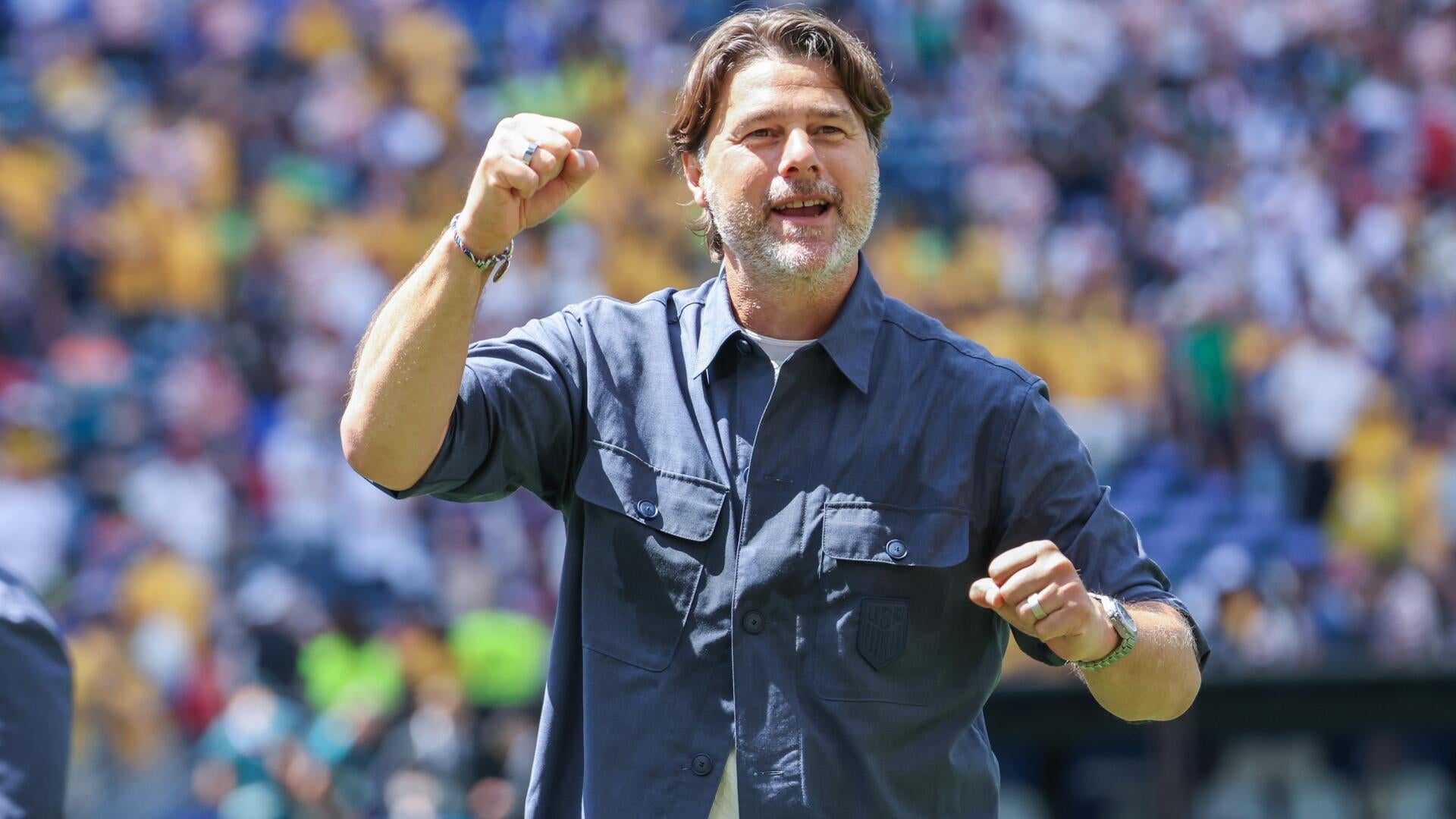
DANA POINT, Calif. – U.S. men's national team head coach Mauricio Pochettino was inside a makeshift but comfortable office at the team hotel on a picture-perfect Southern California evening. Behind him was a wall of inspirational quotes in his handwriting neatly written around a giant sign that reads, "Why Not Us?" the group's motto for this summer's World Cup. A softly-scented candle was lit, Colombia's clash with DR Congo was on a big screen, and a bowl of bright yellow lemons stood out in a room that was otherwise decked out in blue and red tones, a balcony overlooking Salt Creek Beach just before sunset within his gaze. Almost a month after the USMNT settled into their base for the early stretch of the World Cup, something had caught Pochettino's attention.
"It's crazy," he said about the surfers he can spot from his office every single day. "Five o'clock, they are there – in the morning, during the whole day and then perfecto, yes … It's 24 hours, people there doing surf[ing]. It's crazy. It's a little bit boring, no? They are waiting, waiting [for] the perfect wave but it never arrives."
Patience, though, has been a virtue for the USMNT's faithful since Pochettino assumed the helm in the fall of 2024. Trials and tribulations have defined the U.S. team's road to a World Cup on home soil, the perfect wave hard to spot for much of that stretch. Their perfect wave seems to have finally arrived, though, and not a moment too soon. The USMNT have had ambitious plans at a World Cup on home soil and so far, they have laid the foundation for just that – compelling wins against Paraguay and Australia to start Group D play means they have topped the group with a game to spare, an ability to live up to the hype at long last clear for most to see.
Two games in, the World Cup run has so far offered plenty of validation to Pochettino's methods. The players have spoken of a learning curve when it comes to the coach's tactical vision, a fluid attack-minded strategy coming together at just the right time. He admitted, though, there was an entirely separate learning curve he and his staff had to deal with.
Call It What You Want is your front-row seat as the USMNT takes center stage at the 2026 World Cup. The crew delivers live reactions, analysis, and debate before and after every game. Catch new episodes live on the Golazo America YouTube channel
"We were so naive when we signed our contract. I don't know if I can explain," he said on Tuesday. "We misjudged the situation. It was worse than we really believed because we were so excited, because we explained to the players from day one when we signed, we said it's the World Cup … It was with too much energy and then when we arrived here, we received a big bang, punch and we were knocked out for a while. We said, 'What the f—?'"
Pochettino often points out the difference between the player pool he met and the one he brought to the World Cup and it is not only that he introduced several new ones to the fold. He and his coaching staff experienced a dissonance between their own professional energy levels and the players, who he said had yet to snap into World Cup mode. A pair of Concacaf Nations League finals losses in March 2025 only amplified the work they needed to do.
"That punch, we expected," he said about the defeats to Panama and Canada. "That was more than [a] surprise [to] us. I think it was more of a plan to have this punch that was painful but necessary [for] the people to realize in which place we were, even for the players to recognize in this way, it's impossible. It's impossible to arrive in a good position to the World Cup."
It all began to click afterwards, slowly but surely. Their weeks-long journey to the Concacaf Gold Cup final a year ago was a turning point while subsequent friendlies allowed the USMNT to end 2025 on a five-game unbeaten run. It was in a meeting in November, sandwiched somewhere in between friendly wins against Paraguay and Uruguay, where Pochettino unintentionally broke out the team's World Cup motto – "Why not us?"
"I said, 'You are listening to me?'" he recounted. "I said, in 2002 when I was involved in the World Cup, South Korea was in the semifinals. Morocco was, also, in Qatar. Why not us? [We] can be that team that no one believed and get [to] that stage? … It was not that I prepared that. It was in this moment -- when I talk, I never prepare [for] the meetings. Of course, I prepare in my mental way but [in] the end, it's more intuition or feelings or emotion."
Even before the Group D finale, Pochettino was taking a victory lap of sorts. Many of his calculations turned out to be astute ones but the elite tactician has slipped into the vibes guy role and he continues to attribute any success he and his players enjoy to mentality and emotion, appropriate for someone who has a handwritten book photocopied into a book about him that ends with him arguing that soccer is "a context of emotions." As much as he needed to trust the talent pool, Pochettino admitted that the trust had to be reciprocal.
"Always, it's a process," he said. "You are going to check me, the players are seeing how we are in every single small situation and the player -- how I treat him, how I talk with the team, how I talk with the kit man, how I talk in the morning with the chef. If you say, 'Believe in me, I am a good guy,' but after I treat people in a wrong way -- they are so intelligent and [will] say, 'This guy thinks that we are stupid.' Also the problem was [to] prove [to] the players, all the players, 75 players and everything, that they can trust in us and they have our respect."
His decisions are often colored by his own experience at the World Cup as a player, his one and only trip before hanging up the cleats, though he admitted on Tuesday that the two trips were not created equal.
"I was so nervous when I was a player," he said. "I played in Japan against Nigeria with Argentina. I was so nervous. It was difficult to sleep the night before. It was so difficult but now it was the opposite. Before our first game, I feel so confident because I said, the players, they are going to perform. We were talking. We are so relaxed because when you feel that the energy is good, it's right, everything is perfect. They say, no doubt they are going to perform."
His conviction before the 4-1 win over Paraguay was correct, Pochettino now likely targeting a deeper run that most of his predecessors have missed out on, the U.S. team failing to reach the quarterfinals of the World Cup since 2002. It may have some people wondering if he will extend his current deal with U.S. Soccer, his contract up once the World Cup is over. U.S. Soccer CEO J.T. Batson gave him the sales pitch days before the USMNT's World Cup roster reveal in New York but Pochettino danced around the issue on Tuesday.
"I think it's good that It's now focused, focusing on the World Cup and then if we want to stay, we have months to talk or days, or weeks because it's four years until the next World Cup, no?" he said, his cards close to his chest.
There are things about the U.S., though, he has become enamored with. He brought a cowboy hat from the rodeo in Fort Worth, Texas to his office in the U.S. Soccer National Training Center in Georgia, a year before Sweden coach Graham Potter went viral for doing the same thing. Pochettino, though, has taken plenty from American culture.
"You go to, I don't know, someplace like Nashville and you go to a bar and if you are alone, you make friends so quick and it looks like you, in a few minutes, belong in that place and when you go around America, that for me was a massive surprise," he said.
The music tastes, meanwhile, have been eclectic – and appropriate as he is the newest Lainey Wilson fan, who he caught on Yellowstone, and as he works on learning the lyrics to "Take Me Home, Country Roads," the USMNT's unofficial World Cup anthem.
"I like country music now," he said. "We are very fond of country music. Also, Teddy Swims. I really love Teddy Swims. "Bad Dreams" … Ella Langley, but she was with the British guys."
He is also happy to clear up certain misconceptions about the nation as a whole.
"People say, 'Americans have no healthy food. Yes, you have healthy food but also you have the food," he said. "Chick-fil-A. It's amazing, no? Chick-fil-A, but you go to Whole Foods. You have organic, this, that. You have everything here. That country is massive and the people are so good. I think we learned a lot. I think we are much better people now, knowing that country and the culture of the people here."
Add CBS Sports on Google Join the Conversation comments