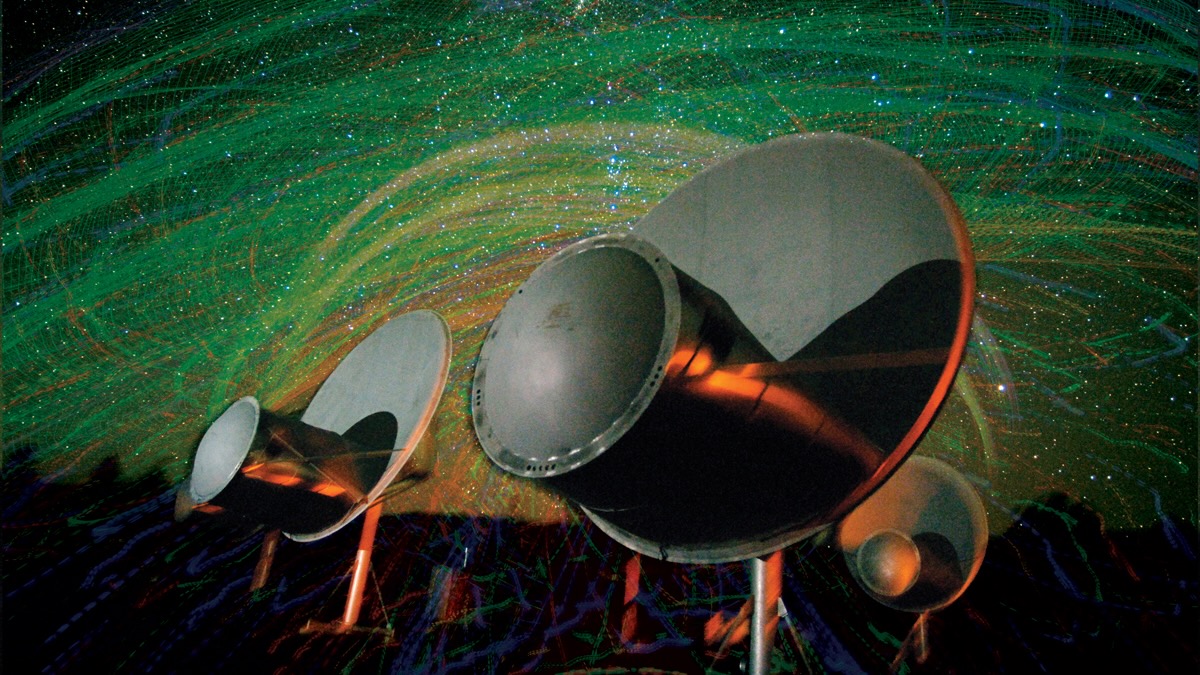
 Experts want to make sure a future alien detection is handled properly. (Image credit: Seth Shostak/SETI Institute) Share this article 0 Join the conversation Add us as a preferred source on Google Newsletter Subscribe to our newsletter
 The International Academy of Astronautics (IAA) has ratified protocols advising what an astronomer should do if they discover evidence for extraterrestrial intelligence in our modern global world of social media, AI deep fakes and misinformation.
Referred to as the "Declaration of Principles Concerning the Conduct of the Search for Extraterrestrial Intelligence (SETI)," the post-detection protocols cover everything from handling the evidence, and how the discovery should be communicated to the world to the challenge of what comes after the discovery. In a world where an AI hoax could easily be promulgated across social media, or in which conspiracy theorists would likely attack a real discovery, the protocols are intended to encourage best practice and safeguard astronomers when the media spotlight falls on them.
And despite how this summer's Steven Spielberg blockbuster, "Disclosure Day," presents the discovery of extraterrestrial life as a grand conspiracy to be disclosed, transparency is a top priority in the Declaration of Principles.
"There is no secret file on aliens," Michael Garrett, who is the Sir Bernard Lovell Chair of Astrophysics at the University of Manchester, told Space.com.
Garrett also chairs the IAA's Permanent SETI Committee and is the lead author of the updated Declaration, along with anthropologist Kathryn Denning of York University in Toronto, Arizona law expert Leslie Tennen and science-communication expert Carol Oliver from the University of New South Wales in Sydney.
"If we ever find a credible signal, the public will know; it won’t be hidden away in some government vault," continued Garrett. "The new protocols commit us to openness — every dataset, every line of analysis code, every step of the verification process will be made public once a discovery is confirmed. The challenge is not secrecy but ensuring that we're telling the public something that's true. As Carl Sagan would say, 'extraordinary claims require extraordinary evidence.'"
Given the large-scale astronomical surveys currently in operation, such as the one taking place at the Vera C. Rubin Observatory in Chile, or which are coming online soon, such as the Square Kilometer Array, it is very possible the astronomer who discovers evidence of extraterrestrial intelligence won't actually be a SETI astronomer.
"More than likely it's not going to be a SETI scientist who is going to make this discovery, it's going to be someone who's looking for something else in the astronomical data but who finds some kind of anomaly that doesn't quite add up," said Garrett.
In this case, they might not be familiar with the protocol of how to handle the discovery, Garrett suggests. They might not necessarily run to the newspapers, but they might declare their discovery on social media before their discovery can be independently verified — and while that could be very exciting, it could also be very daunting. How do they make sure their discovery is accurate and not a mistake? How do they announce this momentous finding to the world? How do they deal with the social media landscape that will judge and question them the minute their words hit the public eye? And what happens after the discovery has been made?
Hence, the eight protocols described in the Declaration of Principles. They have been written to guide the unwitting discoverer through this minefield.
How to handle an alien discovery
The first task in the Declaration of Principles is to verify the discovery is a real one, and not a misidentification.
No astronomer wants to be the boy who cried wolf and declare they've discovered aliens only to have to retract the discovery. Not only would this embarrass them, it would ultimately mislead the public and erode trust. So, verification is the only stage in which the proper protocol is to be circumspect, rather than go straight to the newspapers.
This certainly seems to be easier said than done. "We’ve seen that keeping these discoveries secret, even in a small group, is quite difficult," said Garrett. "The first gravitational-wave discovery leaked before it was published; even BLC-1 [a candidate SETI signal that turned out to be terrestrial radio interference] ended up in The Guardian before it was in Nature, so it’s quite hard to keep control of these things."
Verification could be as simple as having another, independent observatory confirm the detection and the details be peer-reviewed.
Once that is done, then the protocols state that the news be made public, either by the astronomers who made the discovery, or by an institution they are connected to — and that they liaise fully with the media. The findings also have to be reported in detail to the rest of the scientific community and the Secretary General of the United Nations.
Some technical aspects then need to be taken care of, such as protecting the radio frequency on which the discovery was found from terrestrial interference (if it is a radio signal that's been discovered, of course), plus continued monitoring of the signal and careful archiving of evidence, if only to avoid people in the future claiming it to be a hoax.
However, the discovery of extraterrestrial intelligence will open up a can of worms, especially in regards to how society and governments will react, which will depend on the type of alien discovery that has been made — direct contact through a radio signal or a probe in the solar system would probably elicit a much stronger reaction than the discovery of an inscrutable Dyson swarm a thousand light-years away. To better understand how society might react requires the input of academics and experts from many disciplines beyond astronomy.
"I think astronomers need to keep to what we do well, which is look for the evidence," said Garrett. "But then it becomes a societal question; once we’ve made that discovery, what do we do afterwards? I don't think scientists are better placed than anyone else to be able to decide what that should be."
What happens after we finally find aliens?
There are already several inter-disciplinary groups considering the societal implications of an extraterrestrial discovery, including the SETI Post-Detection Hub at the University of St. Andrews in Scotland and the IAA's SETI Permanent Committee, which originally introduced the first version of the Declaration of Principles back in the late 1980s under the stewardship of Michael Michaud. The protocols state that the IAA will maintain a post-detection sub-committee drawing international representation from the scientific, legal, ethics, social science, humanities and communications professions. Their job will be to help advise the public, the scientific community, governments and the United Nations on how to deal with any societal implications, should they ask for that advice.
What the Declaration does not recommend is sending messages to aliens in reply, at least not without international agreement through the U.N.
Messaging Extraterrestrial Intelligence, known as METI, has long been a thorny subject leading to acrimonious debates. While the protocols do not forbid METI (nor do they have any legal standing to forbid anything), they do state that SETI practitioners should participate in international consultations debating the merits of sending a message to the aliens and that no reply should be sent until a decision has been made through the U.N. via various international organizations.
"I'm pretty sure that the IAA SETI committee would say, 'don't reply' and that METI isn't actually a very useful thing," said Garrett. "I've no doubt that is what this committee would decide."
Another thorny subject is UFOs, the focus of Spielberg's Disclosure Day. Garrett says the IAA committee actually discussed whether to include them in the Declaration or not. While most on the committee were against including them on the basis that claims of their existence are not scientifically rigorous, some, including controversial scientist Avi Loeb, argued that they should be.
In the end, Garrett took the decision to only include phenomena detected above the Kármán Line (the official boundary between Earth and space, 62 miles, or 100 kilometers, above the ground) in the protocols.
Not only is this in keeping with the IAA's astronautical remit, but it also recognizes the fact that "the expertise of the committee is in searching for the signatures of intelligence beyond Earth’s atmosphere," said Garrett.
So, while the Declaration does not cover claimed observations of objects appearing to be UFOs in Earth's atmosphere, it would include the detection of alien probes in our solar system, or spacecraft passing through.
"I think there's a subset of our community and committee who can contribute to UAP research," said Garrett. "If UAP research becomes really scientific in the future — which I haven't seen it do so far — but if it does then why not at least have a look at what’s in the protocols and see if it can also be applied to things that are a bit closer to home in terms of phenomena that we don’t understand?"
Would the discovery change our lives?
Ultimately, no one really knows how the discovery of extraterrestrial intelligence will affect humanity. The implications range from there being a huge panic and crisis of confidence in society, as well as in political and religious institutions, to the largest shrug of the shoulders ever as people just get on with their everyday lives.
Garrett questions whether any international organization or institution is really ready to cope with the societal and scientific challenges of the discovery of extraterrestrial intelligence, especially if it is direct contact as opposed to finding a distant technosignature far beyond our solar system.
"Maybe no one can do that, but a professionalization in those kinds of areas would be really useful," he said. To that end, the protocols aim to encourage the development of best practice, so that we would at least have some well-studied guidelines to help us.
"We would really like to get to a place where we can point to a repository of best practice in a number of different areas — the whole range that this topic touches on, which is enormous," said Garrett. "This is why the protocols were originally set-up, and it’s why they have been re-drafted, because we think it is important that there’s a level of responsibility in the kind of things that we do."
The discovery of extraterrestrial intelligence could happen tomorrow, next week, next year, or never. When and if such a momentous discovery is made, however, rest assured that the real disclosure day would happen soon afterwards and that no one would be kept in the dark.
The revised protocols will be officially presented to the scientific community at the International Astronautical Congress in Antalya in Türkiye in October. In the meantime, they are available for anyone to read on the IAA website.
View MoreYou must confirm your public display name before commenting
Please logout and then login again, you will then be prompted to enter your display name.
Logout Keith CooperContributing writer
Keith Cooper is a freelance science journalist and editor in the United Kingdom, and has a degree in physics and astrophysics from the University of Manchester. He's the author of "The Contact Paradox: Challenging Our Assumptions in the Search for Extraterrestrial Intelligence" (Bloomsbury Sigma, 2020) and has written articles on astronomy, space, physics and astrobiology for a multitude of magazines and websites.