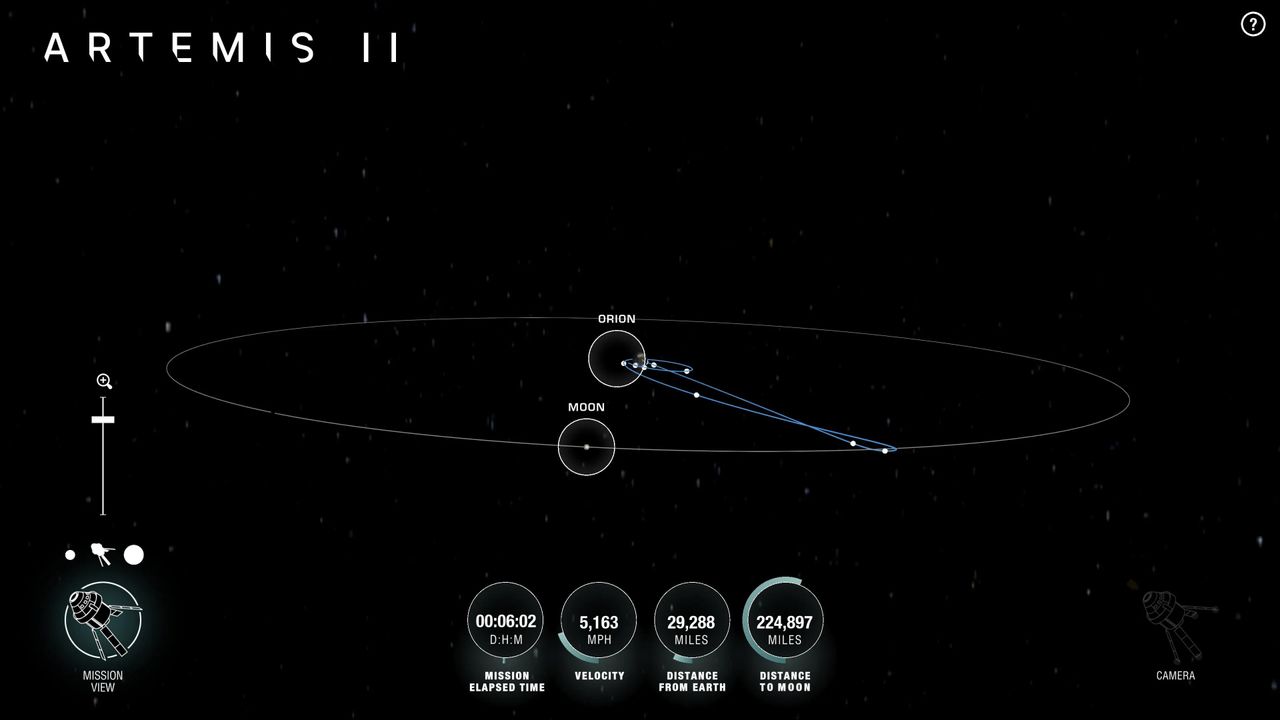
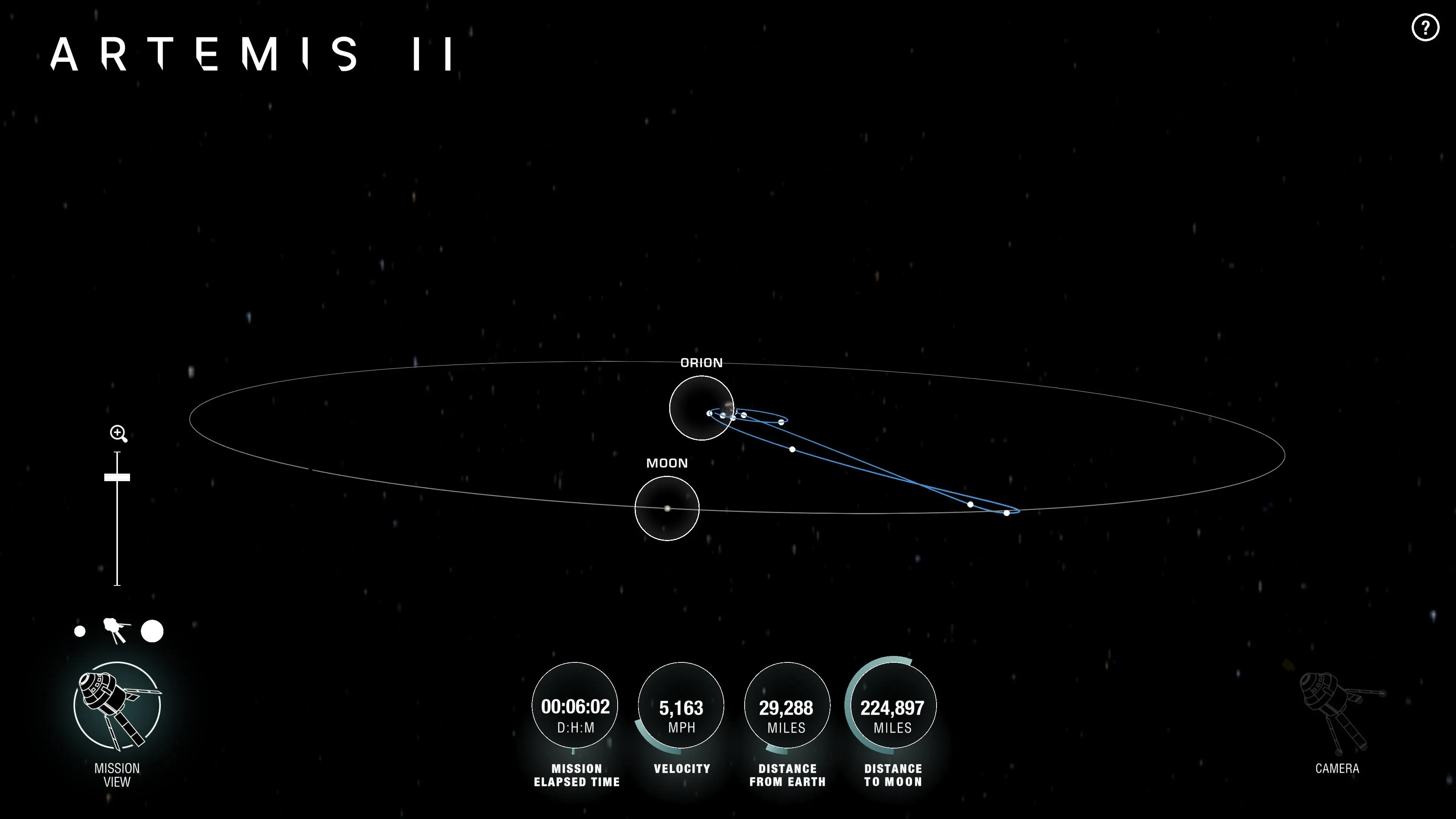
 Online, users can follow AROW to see where Orion and the Artemis 2 crew are in relation to the Earth and the Moon and follow Orion’s path during the mission. (Image credit: NASA) Share this article 0 Join the conversation Follow us Add us as a preferred source on Google Newsletter Get the Space.com Newsletter
 Breaking space news, the latest updates on rocket launches, skywatching events and more!
Contact me with news and offers from other Future brands Receive email from us on behalf of our trusted partners or sponsors By submitting your information you agree to the Terms & Conditions and Privacy Policy and are aged 16 or over.You are now subscribed
Your newsletter sign-up was successful
Want to add more newsletters?
An account already exists for this email address, please log in. Subscribe to our newsletterThe Artemis 2 astronauts are on their way to the moon, and you can track them every step of the way.
NASA's Artemis 2 mission launched April 1 from Kennedy Space Center in Florida, sending four astronauts on a 10-day trip around the moon in an Orion capsule. It's the first crewed mission to venture beyond low Earth orbit (LEO) since Apollo 17 in 1972.
"Using AROW, anyone with internet access can track where Orion and the crew are, including their distance from Earth, distance from the moon, mission duration and more," NASA officials said in a statement.
AROW will allow the public to "visualize data that is collected by sensors on Orion and then sent to the Mission Control Center at NASA's Johnson Space Center in Houston during its flight," agency officials added. "It will provide constant information using this real-time data beginning about one minute after liftoff through Orion’s atmospheric reentry to Earth at the end of the mission."
AROW will also provide background information about the moon and Apollo landing sites, according to the NASA statement. You can access it via NASA's website or by using the NASA app.
The app has a bonus feature: an augmented-reality tracker, which "will direct users where to move their phone to see where Orion currently is relative to their position on Earth."
Get the Space.com NewsletterContact me with news and offers from other Future brandsReceive email from us on behalf of our trusted partners or sponsors 
The four Artemis 2 astronauts are NASA's Reid Wiseman, Victor Glover and Christina Koch, and Jeremy Hansen of the Canadian Space Agency. Glover will be the first African-American to leave LEO; Koch and Hansen will be the first woman and the first non-American to do so, respectively.
Artemis 2 is a test flight designed to validate Orion's ability to support crewmembers in deep space. It's a key step in NASA's Artemis program, which aims to establish a long-term human presence on and around the moon in the coming years.
 Mike WallSpaceflight and Tech Editor
Michael Wall is the Spaceflight and Tech Editor for Space.com and joined the team in 2010. He primarily covers human and robotic spaceflight, military space, and exoplanets, but has been known to dabble in the space art beat. His book about the search for alien life, "Out There," was published on Nov. 13, 2018. Before becoming a science writer, Michael worked as a herpetologist and wildlife biologist. He has a Ph.D. in evolutionary biology from the University of Sydney, Australia, a bachelor's degree from the University of Arizona, and a graduate certificate in science writing from the University of California, Santa Cruz. To find out what his latest project is, you can follow Michael on Twitter.
View MoreYou must confirm your public display name before commenting
Please logout and then login again, you will then be prompted to enter your display name.
Logout MORE FROM SPACE... 1April's full Pink Moon dazzles as the first spring full moon of 2026 (photos)
- 2NASA just launched Artemis 2. What happens today could make or break the moon mission
- 3There was a bit of toilet trouble on NASA's Artemis 2 mission to the moon
- 4Why is the Artemis 2 rocket launch different from all other rocket launches?
- 5NASA launches 4 astronauts to the moon on historic Artemis 2 voyage, a lunar leap for the 21st century