
All you have to do is tell Gemini to make you a site using your sources.
By Mariella Moon Nov. 21, 2026 8:30 am EST Koshiro K/Shutterstock Add Engadget on Google: Preferred Source Google Discover
Google's tagline for Gemini Notebook is "understand anything," because it's meant to help you better understand difficult concepts by creating study guides and even podcasts. Before it was called the Gemini Notebook, it was known as Google NotebookLM, which the company presented as its "deep research tool."
To use the service, tap or click on Create notebook and then upload your sources for any particular topic. It accepts different types of sources, such as PDFs and images from your device or your Google Drive account. It also accepts links to websites, open source textbooks, books from the Play store and even copied text, such as your notes or emails. Gemini Notebook will then use those sources to create what you need, whether it's a study guide or a podcast featuring two AI hosts.
Gemini Notebook's latest feature can create a website you can interact with. Every website it makes has a unique design and comes with various elements, such as clickable sections, flash cards and quizzes that test whether you've learned anything from the information presented in it.
How to create an interactive site
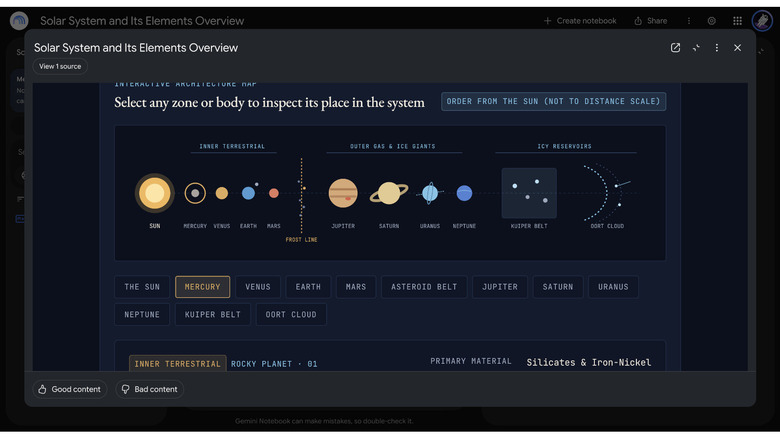 Screenshot by Mariella Moon (Gemini Notebook)
It's incredibly easy to create an interactive site with Gemini Notebook. At the moment, the feature is live on desktop and available for all users 18 years old and above. It is coming soon to the service's mobile app. But for now, you have to visit Gemini Notebook on the web and then hit New Notebook or Create notebook.
In the chat box within the new notebook's interface, type "make me a site" along with instructions on what you want the service to create for you. For the example above, I wrote: "Make a me site to help me understand the solar system and its elements. Explain them to me in simple sections with flash cards and create a quiz at the end." It will then draw information from your sources to make the website for you.
If you don't have any sources uploaded, it will ask you if you want to do a web search to find the information you need. It could be good enough if you want to learn about known concepts and don't need the website to reflect details and data only you have access to. Gemini will let you know if your interactive site is done. You'll then be able to access the site in the Studio panel on the right-hand side of your screen. Just click or tap on the tab to load the site.
In my case, Gemini created a colorful website, with illustrations of the solar system and clickable sections, as you can see in the image above. Clicking on Mercury, for instance, shows a card with information about the smallest planet in our Solar System. It made separate sections for the four inner terrestrial planets, including Earth, and for the gas and ice giants in the outer Solar System. There are more clickable sections for the asteroid belt, the Kuiper belt and Oort cloud.
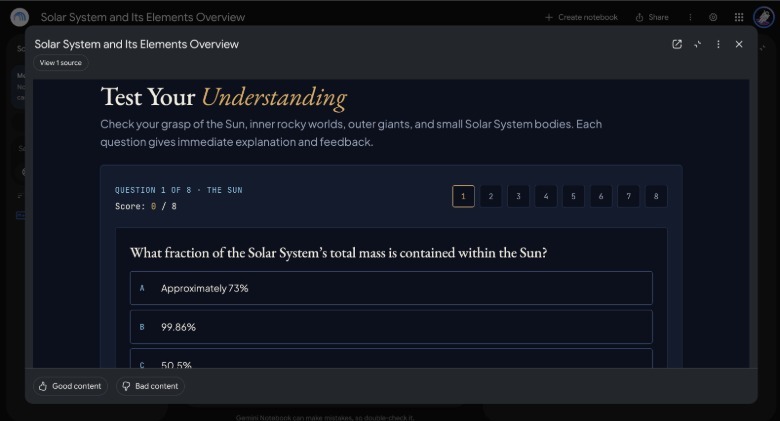 Screenshot by Mariella Moon (Google)
Maybe you read that last sentence and thought: "the? what?? cloud???" and rightly so! The Oort cloud is an entirely theoretical cluster of small, icy bodies past the Kuiper belt. Gemini presented it on this website as if it were extant and observed, describing it as "the home of long-period comets." The Kuiper belt was theorized decades before it was confirmed; that might end up being the case with the Oort cloud too. As with anything AI though, Gemini is not only capable of both hallucinating but of confidently misstating things too.
In addition to creating easy-to-digest interactive websites to help you learn or prepare for exams, you can also use the new feature for other purposes. Google says you can use it to build project trackers for your job or dashboards that give you an overview of your sales, complete with visual aids.