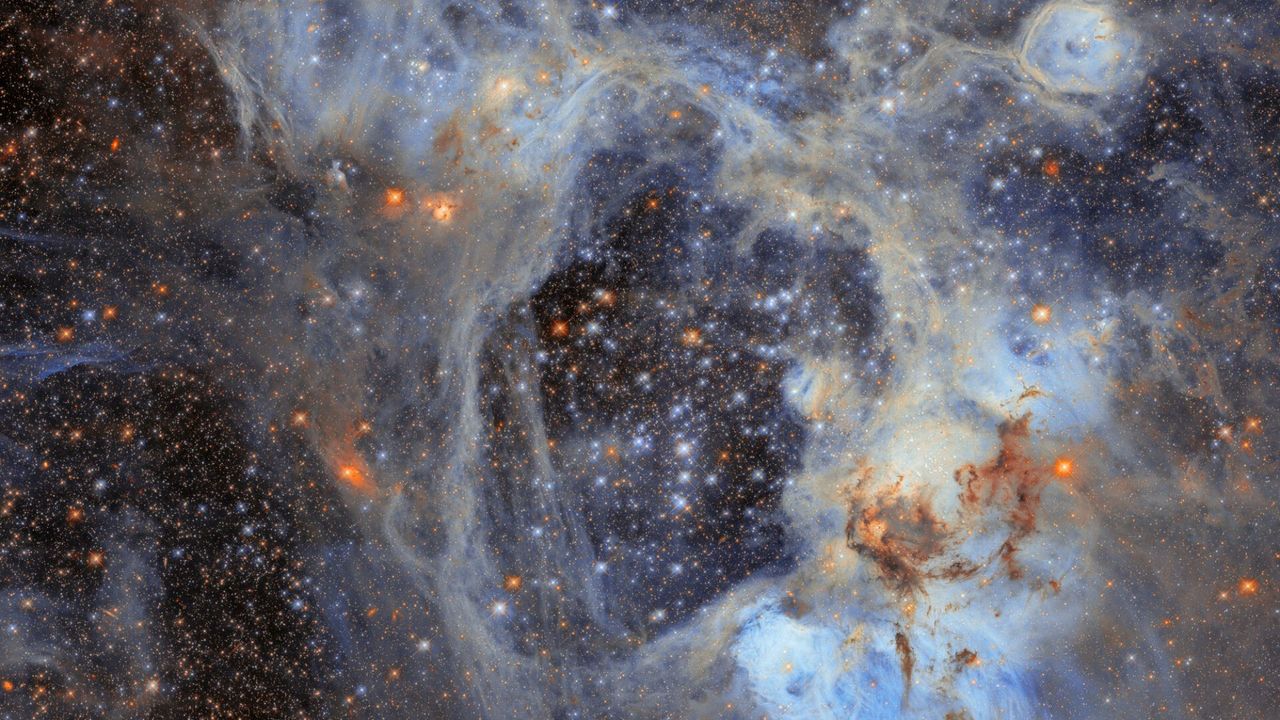
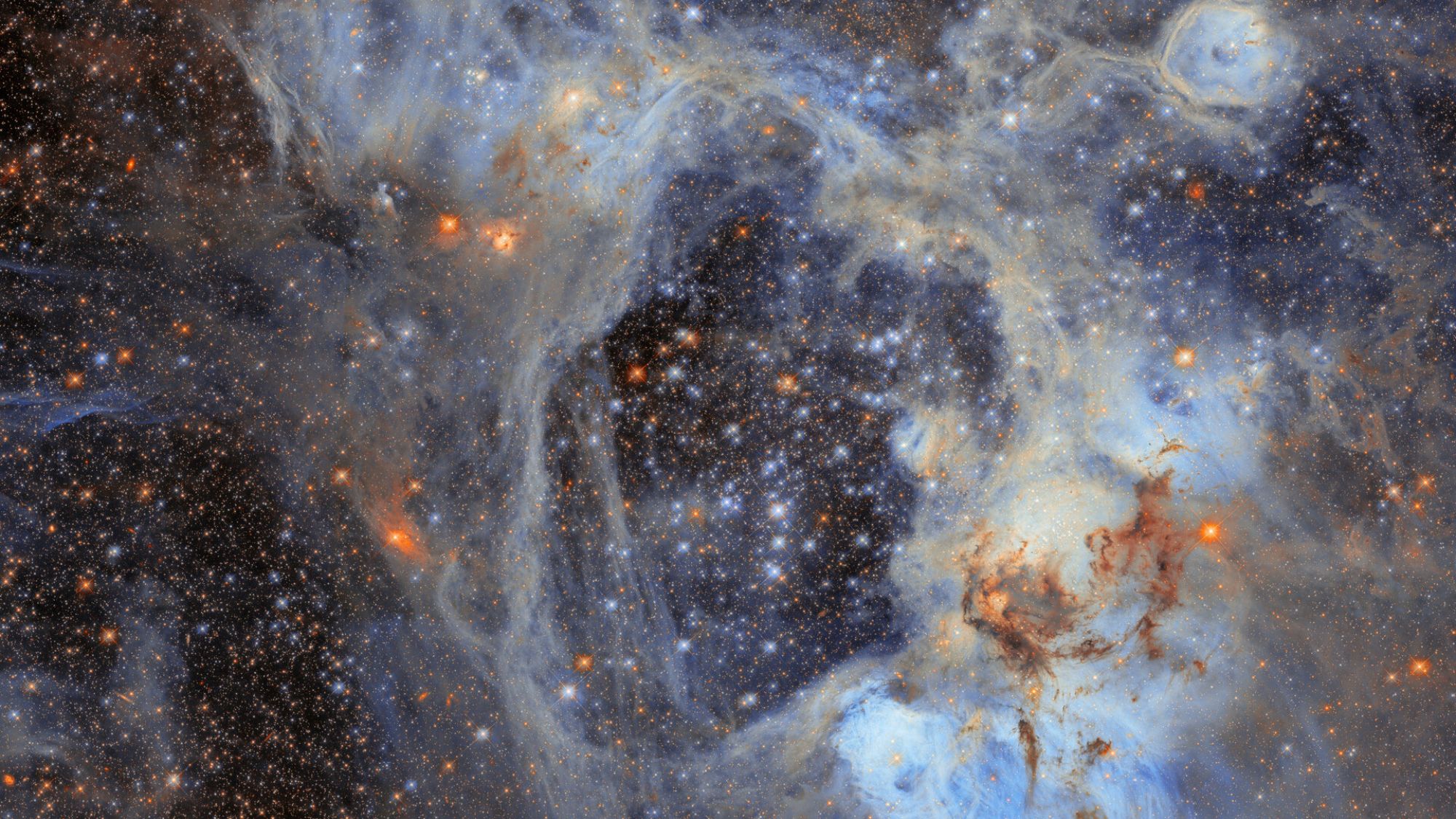
About 160,000 light-years away lies one of our Milky Way's little galactic neighbors: The Large Magellanic Cloud (LMC). And thanks to a new observing program, the Hubble Space Telescope has provided us with an intricate image of a nebula in the LMC. The surprising part? There's a giant void at the center. Scientists call it a "superbubble."
What is it?
What you're seeing in this image is a nebula within the LMC known as LHA 120-N44, or simply N44. It's located in the constellation of Dorado and, like a classic nebula, is the site of stars being born at a noticeably rapid rate.
But of course, what really can't be missed is the huge hole at the center of N44's dusty tendrils — this is the "superbubble," and its dimensions are staggering. NASA says it's about 210 by 140 light-years across — a truly unimaginable size, considering the distance between our sun and Pluto isn't even a single light-year.
One light-year, the distance light travels in a year, is about 6 trillion miles (9.7 trillion kilometers).
Why is it noteworthy?
The superbubble is a bit of a mystery, but one theory of why it exists is that stars at the center of the bubble could have undergone supernova explosions or have released stellar winds that swept away gas in the nebula. This could have resulted in a "void," as NASA calls it, surrounded by a gaseous shell. That would explain away the image we see pretty well, but there will likely be studies dedicated to refining that story.
Of note, in that shell around the superbubble, stars continue to form and show themselves as beautiful little specks across the watercolor-like landscape.
Something else interesting about this image is that N44 is what's known as an "emission nebula," meaning the gas you see has been energized by stars in the area. This enhances the luminescent quality of the portrait.
This is because the energization process, or ionization to be specific, generates ionized gas that ultimately must cool down. During that cooling, it goes from a higher energy state to a lower energy state and thus releases some energy. This energy loss causes N44 to glow brightly, creating the beautiful scene we see.
The reason scientists have used the Hubble Space Telescope to study N44 is this particular nebula offers good conditions to study star formation and evolution. As a matter of fact, Hubble managed to survey nearly half a million stars in and around the cluster, 30,000 of which are in the very early stages of their lives.
N44 has been a major topic of interest for quite some time. For instance, it made headlines in 2021 as well as in 2012 — both times due to Hubble's eye yet again — and observations with the Chandra X-ray Observatory led to a 2011 paper that discusses supernova shock waves and other phenomena shaping the nebula and its cavity.