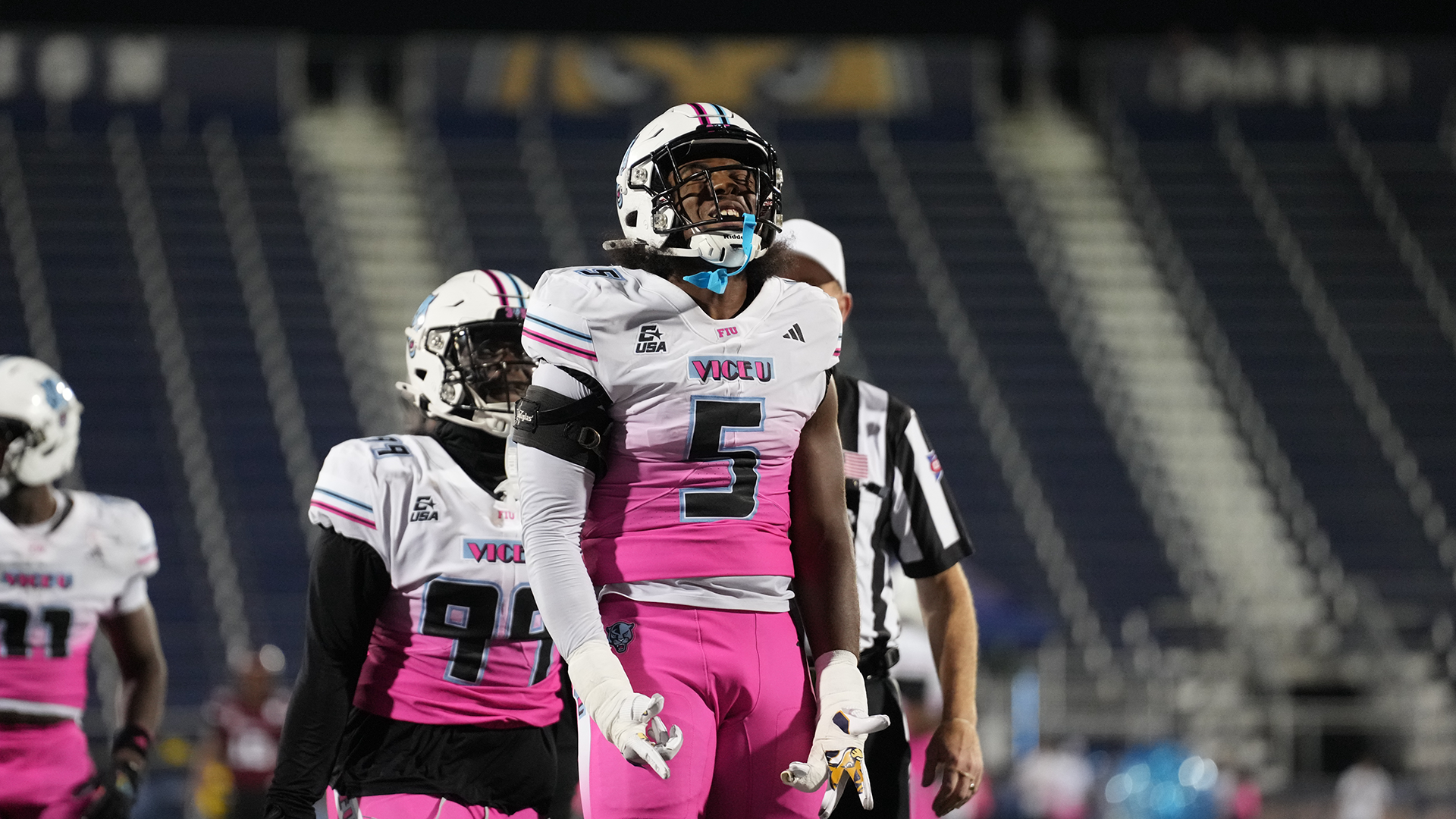
One of the best defenses in the Group of Six is a unit you don't hear much about nationally. Its coordinator, Jovan Dewitt, even calls them a "no-name, faceless defense." But the FIU Panthers have put together impressive performances this season while attempting to build on the momentum started in 2025.
The individual stats aren't eye-popping, but as a collective, FIU is ninth nationally in scoring defense, 12th in passing yards allowed per game, and 24th in yards per game allowed. Their 3-3 start has seen every opponent except for Jacksonville State score 20 points or fewer.
Now, as the faceless men look to the back half of their 2026 season, CBS Sports looks at how the unit was built and how it's powering FIU's success.
Bounceback transfers and how they're built
FIU has been a program of unrealized potential since Mario Cristobal was fired after one bad season in 2012. Cristobal went 7-6 with a conference title in 2010, then 8-5 in 2011, led by future pro receiver TY Hilton. Cristobal's journey led him to a national championship game appearance in South Florida -- but coaching the school a few miles away in Coral Gables.
FIU backslid and languished between being below average and one of the worst teams in FBS. Butch Davis, a different Miami coaching legend, came to wrest the program out of freefall and did for two seasons before leaving in a blaze of glory in 2021, publicly blasting school administration on the way out. That made way for Mike Macintyre, who took over in 2022 right as the NIL era became supercharged and just a few years after the transfer portal's inception.
His staff found an intriguing proposition for team building. Sure, perhaps they wouldn't be able to get a commitment from Deejay Holmes out of high school at powerhouse Pahokee High School. Holmes ended up signing with Ole Miss. But should he ever want to transfer home, they could be a landing spot. That's exactly what happened as Holmes found that Ole Miss wasn't the right place for him. He transferred back ahead of the 2026 season and has been FIU's anchor.
"Everyone at home can see me. They don't have to FaceTime me when I'm in Mississippi. You know, they can really see their baby boy now," Holmes said.
It's a blueprint many G6 programs in metro areas use, and it's part of how they can survive in this roster-building environment. FIU has multiple players who fit that mold.
Holmes and the defensive front power the position group and make it easier for the rest of the defense on the backend.
"I would say I'm more comfortable in getting depth in my drops because I don't really have to worry about the quarterback escaping the pocket and running for like 15 yards, like how I was last year," linebacker Josiah Stewart said. "I don't mean that in no shade, I'm just more comfortable in my job."
The 𝗠𝗘𝗡𝗔𝗖𝗘 from The Muck 🔥😤 pic.twitter.com/CLXmT229Eu
— FIU Football (@FIUFootball) October 8, 2026
Holmes leads the team in sacks, and he says his mentality is shaped by the Chucky doll he's often seen carrying into the stadium on game days.
"Growing up, I just always remember like that doll was a killer. He had a passion for it, you know. I'm a killer on the field. That's how I feel. I really feel like it's my killer season," Holmes said.
Modular defense in the portal era
FIU went 7-5 and became bowl eligible for the sixth time in the program's 23rd season, and first under head coach Willie Simmons, who kept Dewitt from MacIntyre's staff when he took over. Dewitt says Simmons is a hands-off, CEO-style coach and gave him a simple message: Be simple, and make sure the base defense lives with four down linemen.
Dewitt's had a winding journey. In 2019, while at Nebraska, he battled throat cancer, losing 100 pounds and confronting his own mortality more than any challenge an offense could pose. He still suffers from some neuropathy in his extremities, but otherwise he's healthy. Now he builds a defense built in what he calls a "modular fashion," understanding the challenges of being in the Group of Six.
"I think you have to really be smart or strategic in what you're trying to do and how you're trying to do it, because gone are the days where if you have a, like, we'll have players that we won't have next year for sure. Like, we have some really good players that will be gone in a year, so from that standpoint, I think you do have to be a little bit strategic in how you go about your process of teaching from the basic fundamentals all the way up to the, you know, the hardest red zone defense you want to think of," Dewitt said.
You can take different chunks and pieces from different places and make them all fit. And so, what we try to do is we try to keep some congruencies throughout from the front end to the back end, so that we're not confusing people. And there's a bunch of the same principles all over the place. We can make something that looks really, really different to an offense, but for us it's the same concept. Look at it this way: if each position only had to learn three different techniques, you could run about 25 or 27 different calls."
On the backend, it's often a blend where one half of the secondary plays one type of coverage, and the other plays another. Gary Patterson is perhaps most famous for this style of coverage. Dewitt says his players are so in tune with the system they know what the call is before it comes in from the sideline.
"We had a red zone period today, and I said, "What do you guys want? They're like, "Coach, you already know the call. I said, "You're right. Go ahead, run it."
He's got heady players like Stewart and safety Shamir Sterlin, who are young but so adept at making sure everyone's in the right place that Dewitt says they rarely miss assignments. Stewart patterns his game off of Hall of Famer Luke Kuechly, not just on the field but off it as well. Kuechly is renowned for how he studies film and calls the offenses' plays out before they run it. Stewart tries to do the same.
"Even today, I'm calling out like they're pistol, or FIB, and they run counter. I'm calling it out before it happens. I'm calling out draw, and all that extra stuff," Taylor said.
Every moment of downtime can be spent watching film. Taylor says he multitasks between Call of Duty Warzone and College Football 27 sessions, although he doesn't love the new passing mechanics. Go balls were easier in last year's version.
While Taylor is struggling with the concepts in a video game, in real life, it's what the Panthers are best at. Concepts being at the bedrock of the defense allow for them to adjust to surprises from offenses, versus rigid rules that are made to be broken. The offense has to improve for FIU to get where it wants to go, but the foundation the defense is building is a great start for the Panthers.
"They're not worried about stats," Dewitt said. "They just want to win games. They just want to play well enough to win games. So they're not worried about what the stat sheet says or where we rank. And they're just not concerned with that. They just want to play. Did we play well enough? We have standards, not goals. Did we play well enough to win the game? If we did, whatever the outcome, we can live with it. If we didn't, then we have a problem."
Add CBS Sports on Google Join the Conversation comments