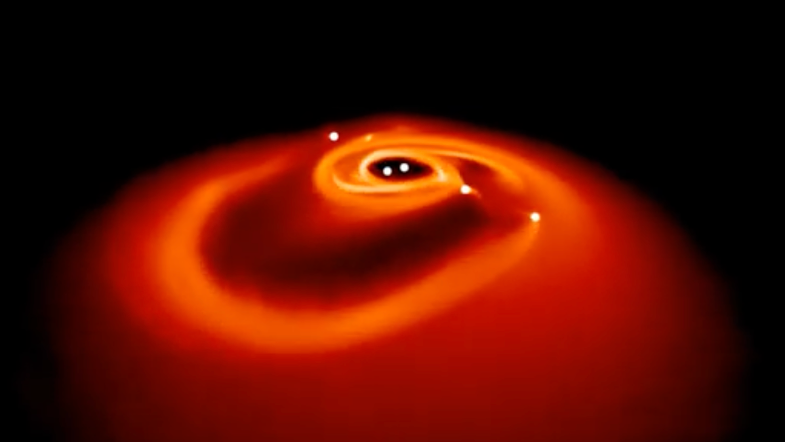
 Screenshot from a simulation of a protoplanetary disc around a binary star becoming gravitationally unstable and fragmenting to form planets. (Image credit: Teasdale et al.) Share this article 0 Join the conversation Add us as a preferred source on Google Newsletter Subscribe to our newsletter
 Planets may form more easily around pairs of stars than around single stars like the sun, according to new research.
Binary star systems, in which two stars orbit each other, are common throughout the Milky Way — and, in fact, even our sun may not have always been alone. For decades, astronomers believed such multi-star systems were hostile environments for planet formation, with competing gravitational forces stirring up surrounding material and preventing planets from taking shape.
"Close to a binary star it's simply too violent for planets to form," study lead author Matthew Teasdale of the University of Lancashire said in a statement. "But move farther out and the disk becomes an ideal environment for planet formation."
Using computer simulations, Teasdale and his team modeled the swirling disks of gas and dust that surround young binary stars — the birthplaces of planets — called protoplanetary disks. These simulations revealed that regions close to the two stars form a "forbidden zone," where intense gravitational forces create a turbulent environment too unstable for planets to emerge.
But beyond this boundary, the disk can become unstable enough to break apart under its own gravity, a process known as gravitational instability that can rapidly produce multiple young planets, particularly large gas giants similar to Jupiter, the study reports.
"What we're finding is that they can actually be extremely productive," Dimitris Stamatellos, an astrophysics professor at the University of Lancashire in the U.K. and a co-author of the new paper, said in the statement. "Once you get past the danger zone, planets can form quickly and in large numbers."
At the same time, the gravitational complexity of these systems can eject some worlds entirely, sending them drifting through interstellar space as so-called rogue planets, according to the new study.
The results suggest that real-life versions of the iconic twin-sun world Tatooine "may be far less rare than we once imagined," the statement read.
Planet formation around a binary star - YouTube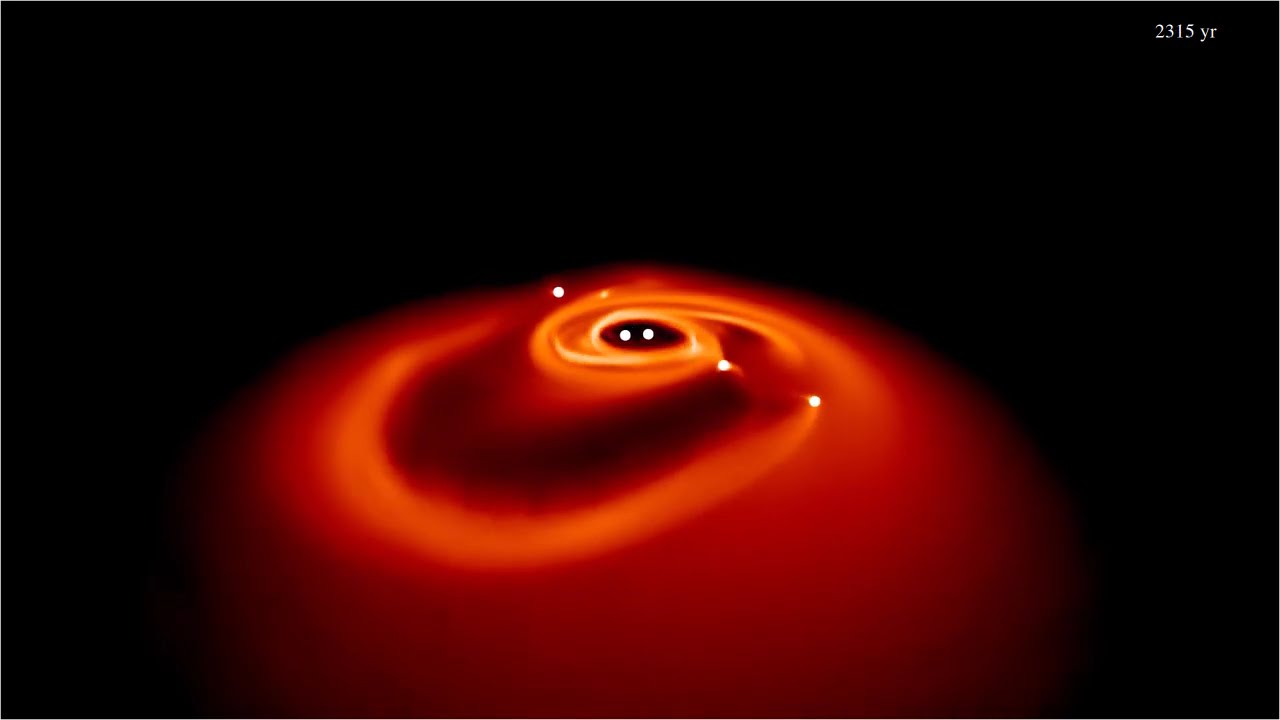 Watch On
 Astronomers have already discovered more than 50 planets that orbit two stars, known as circumbinary planets, including several on wide orbits far from their host stars. The findings could help explain how these worlds can form and survive despite the competing gravitational forces at play.
The findings also open new avenues for observation, the researchers say, with powerful instruments such as ALMA (short for Atacama Large Millimeter/submillimeter Array), the James Webb Space Telescope, and the upcoming Extremely Large Telescope that could help astronomers spot these planet-forming disks, and perhaps even witness them fragmenting to form new worlds.
This research is described in a paper published April 27 in the journal Monthly Notices of the Royal Astronomical Society.
View MoreYou must confirm your public display name before commenting
Please logout and then login again, you will then be prompted to enter your display name.
Logout Sharmila KuthunurContributing Writer
Sharmila Kuthunur is an independent space journalist based in Bengaluru, India. Her work has also appeared in Scientific American, Science, Astronomy and Live Science, among other publications. She holds a master's degree in journalism from Northeastern University in Boston.