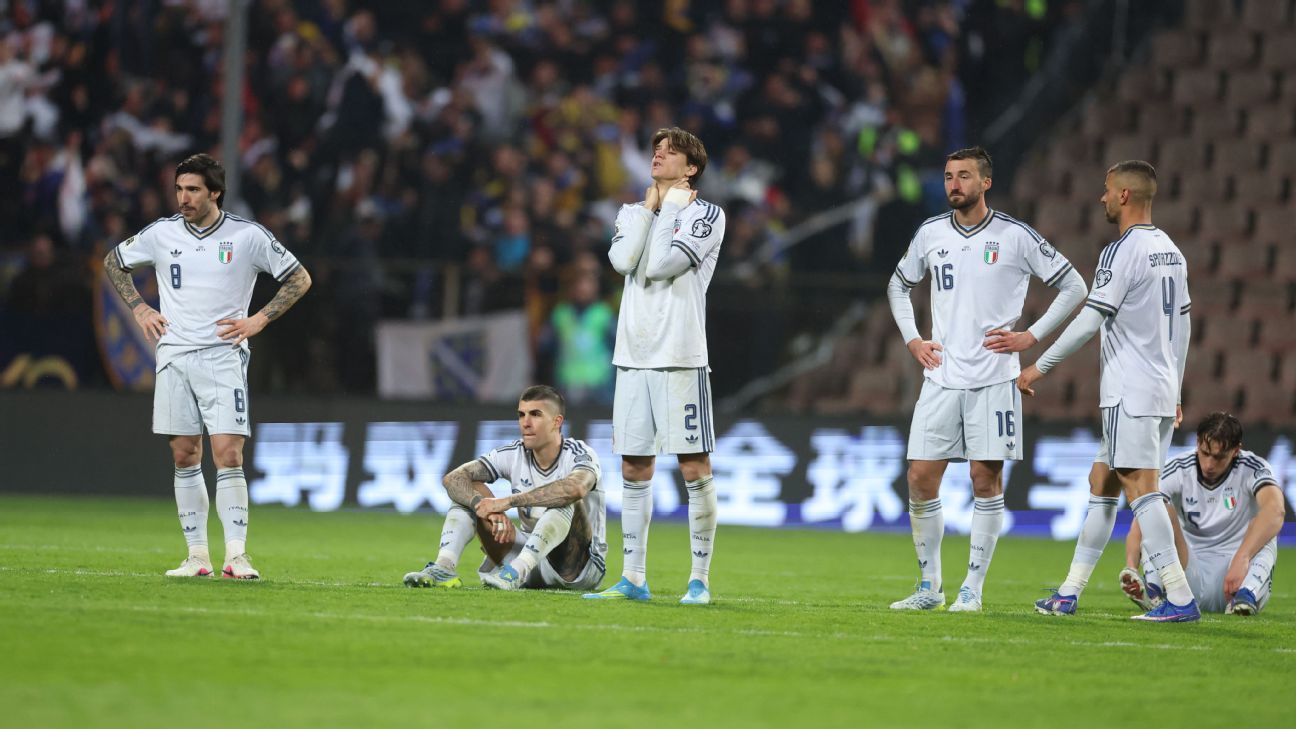
Gab Marcotti reacts to Italy failing to qualify for a third straight World Cup after losing to Bosnia and Herzegovina on penalties. (1:37)
I'd say, "This isn't funny anymore," but I cracked that one last time. And I used the one about "letting somebody else have a chance to win a World Cup, since we have four of them at home -- as many as England, Spain and France combined -- and we don't want to be greedy," back in 2018.
So where do you turn to now that Italy have failed to qualify for three straight World Cups, something no other World Cup winning nation has ever done? Especially at a time when the World Cup field was increased by 50%, from 32 to 48 teams?
I'm not sure, but I am sure about what you don't need after Tuesday's defeat on penalties against Bosnia and Herzegovina.
- Meet World Cup's debutants: Curacao, Uzbekistan, Cape Verde, Jordan - O'Hanlon: Ranking the 2026 World Cup field - Karlsen: One tactical note to know about all 48 World Cup teams
You don't need massive think pieces about the decline of Italian football and calls for root-and-branch reviews. No, it's not because Serie A today isn't as good as it was in the 1990s that Italy failed to qualify. Serie A was no better -- it was arguably worse -- when Italy reached the final of the Euros in 2012 and 2021, winning the latter.
You don't need Gennaro Gattuso, the Italy coach (for the time being, anyway) talking up his team's heart and effort and how they didn't deserve to go out. Nobody can fault their heart and effort, but guess what? Bosnia showed just as much, if not more. And they were coming off 120 minutes plus penalties against Wales away from home, with a 40-year-old up front. (You want to talk "heart" and "effort" today? Look up Edin Dzeko.)
Or Gattuso lamenting their missed chances and episodes. Sure, if Moise Kean buries his counterattack in the second half, or Fede Dimarco finishes with his weaker foot, or Francesco Pio Esposito's header sneaks past Nikola Vasilj, Italy qualify. Maybe they qualify if Tarik Muharemovic gets a yellow card instead of a red. And -- cruel irony! -- if Gianluigi Donnarumma hadn't gotten to Dzeko's finish, parrying it into the path of Haris Tabakovic for his goal, Italy would have advanced because the ball came off Dzeko's elbow. But so what? Donnarumma had to make 10 saves, several of them world-class. Bosnia took 30 shots and missed a bunch of opportunities too.
The fact is, it's not that deep. Italy may not be stacked with talent like France or Spain or England, but they had more than enough quality to qualify. They're 13th in the FIFA rankings, for goodness' sake. Nor is this an aging team (one starter, Matteo Politano, is over the age of 30) or a disinterested one (effort and application were not the issue).
The reality is that they made life mighty difficult for themselves at the start of the qualifying campaign, losing early on to Norway (thanks in part to some wretched decisions) which meant that, realistically, avoiding the playoffs was never really in their hands after that. Once you go into the one-and-done format, stuff can happen and moments attain outsized importance.
Alessandro Bastoni may be one of the best central defenders around, but his boneheaded red card after 41 minutes is a big reason Italy will be watching on TV this summer. At 11 vs. 11, you would have liked their chances not because they were playing well -- to that point, the Azzurri had managed just two shots on goal for an xG of 0.15 -- but because, with Italy 1-0 up at the time, there was a clear pathway.
Keep the ball, make Bosnia and Herzegovina chase you, tire them out, make your experience count. That's what Gattuso does moderately well: simple game plans, playing the percentages and lots of fire, brimstone and arm-waving on the sidelines.
A man down, however, it all went out the window. Italy went into deep prevent mode and invited the Bosnian pressure. And for the players and the tens of millions of Azzurri fans, the game turned into an 80-minute nightmare directed by Esmir Bajraktarevic and Kerim Alajbegovic. It was a simple plan from a simple coach in Gattuso who -- beyond sideline cheerleading -- offered very little value during his time in charge.
Which, lest we forget, wasn't long at all: Gattuso had no more than 15 sessions with his players in his 10 months at the helm. Though to be fair, you can't help but wonder if more time might have given him more opportunities to screw things up. There's no denying it: Gattuso didn't help himself.
When you have better players than the opposition, the best strategy generally is to make that talent count, taking the game to them. And as we saw, Gattuso didn't do that, possibly because he was spooked by the early lead they were gifted by the hosts, possibly because he was paralyzed by fear after the red card.
Are there structural problems that inhibit the growth of Italian football? Sure. You could cite too much emphasis on results and tactical nous over development and technical ability at the youth level. You could point to the fact that Serie A clubs are more reluctant to trust homegrown players than those in other leagues, creating a "blockage in the pipeline" to first-team football, or the fact that clubs do little or nothing to help the national side (witness Gattuso's inability to organize even a two-day training camp).
But they're not the reason Italy didn't qualify for the World Cup. Bad decisions and bad performances in qualifying left them with margins that were far slimmer than they should have been. Bosnia and Herzegovina's heart, grit and enthusiasm (and some missed penalties) did the rest.
Not that it lessens the hurt, in any way, shape or form, of course. When you've won four World Cups, believe me, it hurts even more.