Japan's groundbreaking mission to Mars is officially underway, headed to the Red Planet's mysterious moons Phobos and Deimos for a historic sample-return attempt.
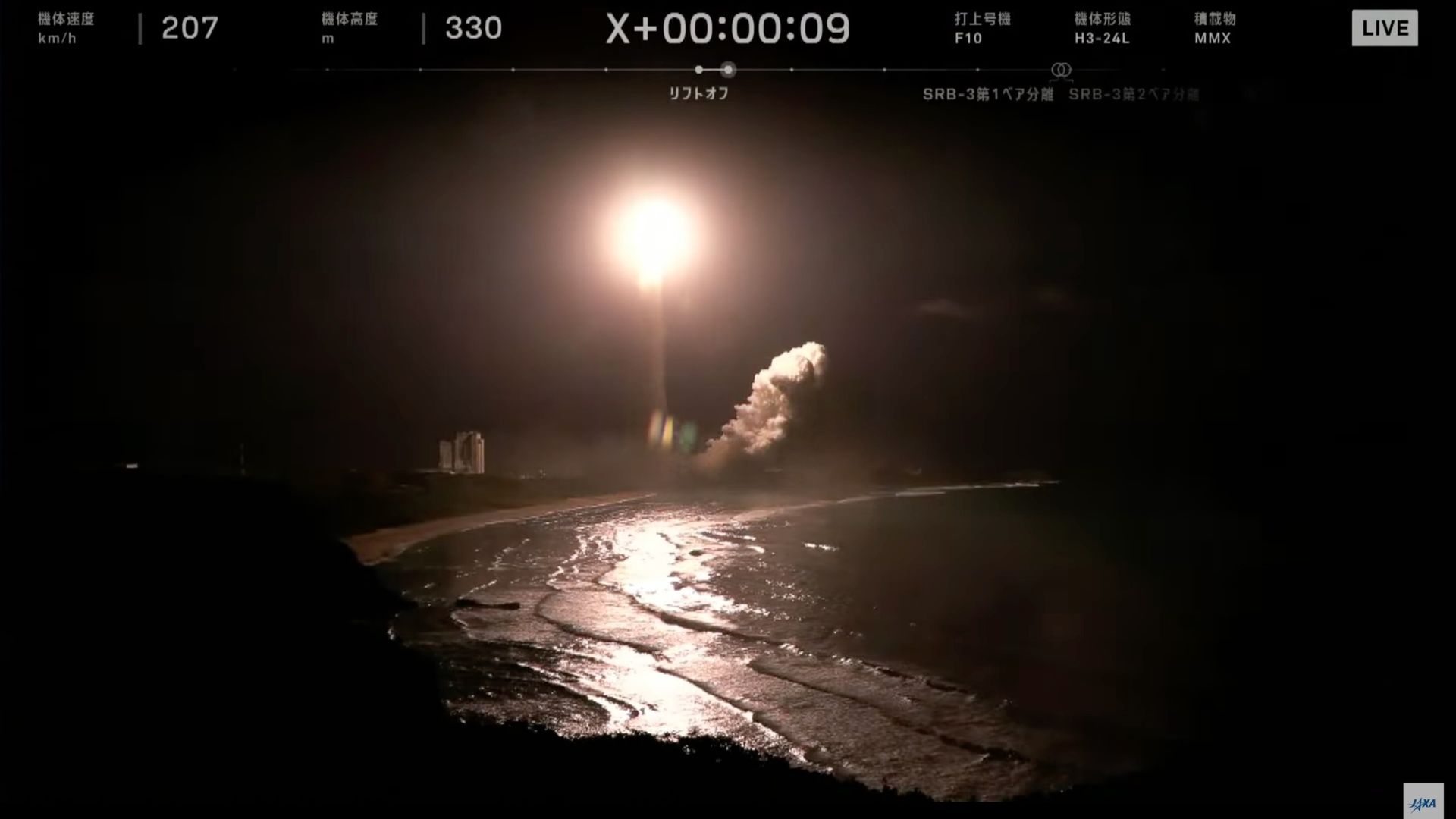
The Martian Moons eXploration (MMX) mission launched today (Oct. 19) from Tanegashima Space Center in Japan, riding an H3 rocket that lifted off from Pad-2 at Tanegashima's Yoshinobu Launch Complex at 3:41 p.m. EDT (1941 GMT; 4:41 a.m. local time in Japan on Oct. 20).
The JAXA (Japan Aerospace Exploration Agency)-led MMX mission is bound for Mars orbit, where it will study the planet's two moons, Phobos and Deimos. If everything goes according to plan, MMX will become the first spacecraft to land on and return samples from Phobos for study back on Earth, which scientists think could shed light on a decades-old mystery about the moons' origins and reveal clues about the formation of the early solar system.
It was the 10th liftoff of Japan's expendable, two-stage H3 rocket, which was jointly developed by JAXA and Mitsubishi Heavy Industries. After clearing its launch pad today, the 207-foot-tall (63 meters) launch vehicle flew a nominal trajectory through its ascent corridor over the Pacific Ocean, jettisoning its four solid boosters in pairs just before the flight clock reached two minutes. The rocket shed its payload fairings about one minute and 20 seconds later, exposing MMX to the vacuum of space for the first time.
H3's first stage is powered by two LE-9 rocket engines, channeling a mixture of liquid hydrogen and liquid oxygen to produce a combined thrust of 331,000 pounds (1,471 kN), according to Mitsubishi Heavy Industries. As the mission clock approached T+5 minutes, H3 executed its main engine cut off procedure and separated from the second stage, which ignited its engines for a 5.5-minute burn about 10 seconds later.
If all goes according to plan, the H3 upper stage will ignite its engine for a second time for a trans-Mars injection burn about one hour and four minutes after liftoff, a maneuver that will last roughly six minutes and 25 seconds. MMX will be released from the rocket's upper stage about one minute after the completion of that burn, while flying approximately 368 miles (592 kilometers) above central Africa.
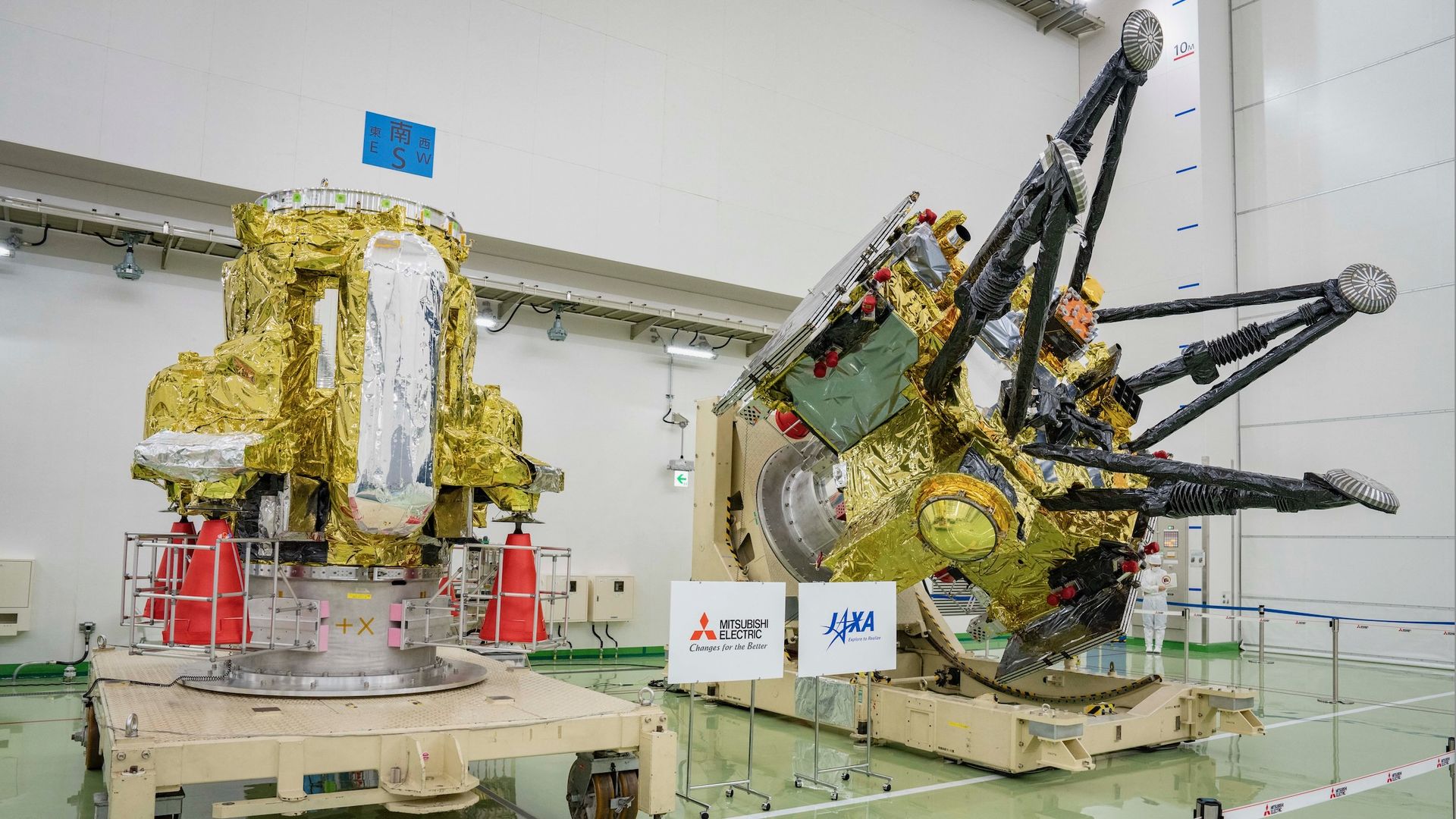
MMX will then be under its own power, and on trajectory for Mars. The interplanetary transit will last about 10 months, with the spacecraft scheduled to arrive at the Red Planet in August 2027. When it does, MMX's propulsion module will execute an orbital insertion burn to place itself in a quasi-satellite orbit (QSO) around Phobos, which places MMX within the space around the moon as both circle Mars.
MMX will spend about three years in the Martian system, devoting much of that time to studying the 14-mile-wide (22 km) Phobos with its science instruments. The spacecraft also carries the IDEFIX rover, a joint effort of the space agencies of France and Germany, which is scheduled to deploy to the surface of Phobos in late 2028 or early 2029.
After a mapping campaign to select suitable landing sites, MMX will perform two separate touchdowns on Phobos to collect and stow samples in the spacecraft's return capsule. Following its second landing and sample collection, MMX will briefly return to QSO with Phobos before transferring to a more elongated orbit around Mars that intersects with the planet's smaller moon, Deimos, which is just 8 miles (14 km) in diameter.
During the last several months of its time around Mars, MMX will perform a series of Deimos flybys before departing for Earth in November 2030. If all goes according to plan, the MMX sample-return capsule will land in Australia in 2031.
Scientists are counting on those samples, and other data collected during MMX's time around Mars, to answer a decades-old question surrounding the Martian moons' origins. Competing theories and conflicting evidence point to two possibilities for how Mars got its moons.
Their near-circular, equatorial orbits suggest a narrative similar to how Earth's moon is thought to have formed — as a result of a massive planetary impact between Mars and some other giant space rock, which broke off pieces of the planet that eventually coalesced to form the natural satellites that orbit there today.
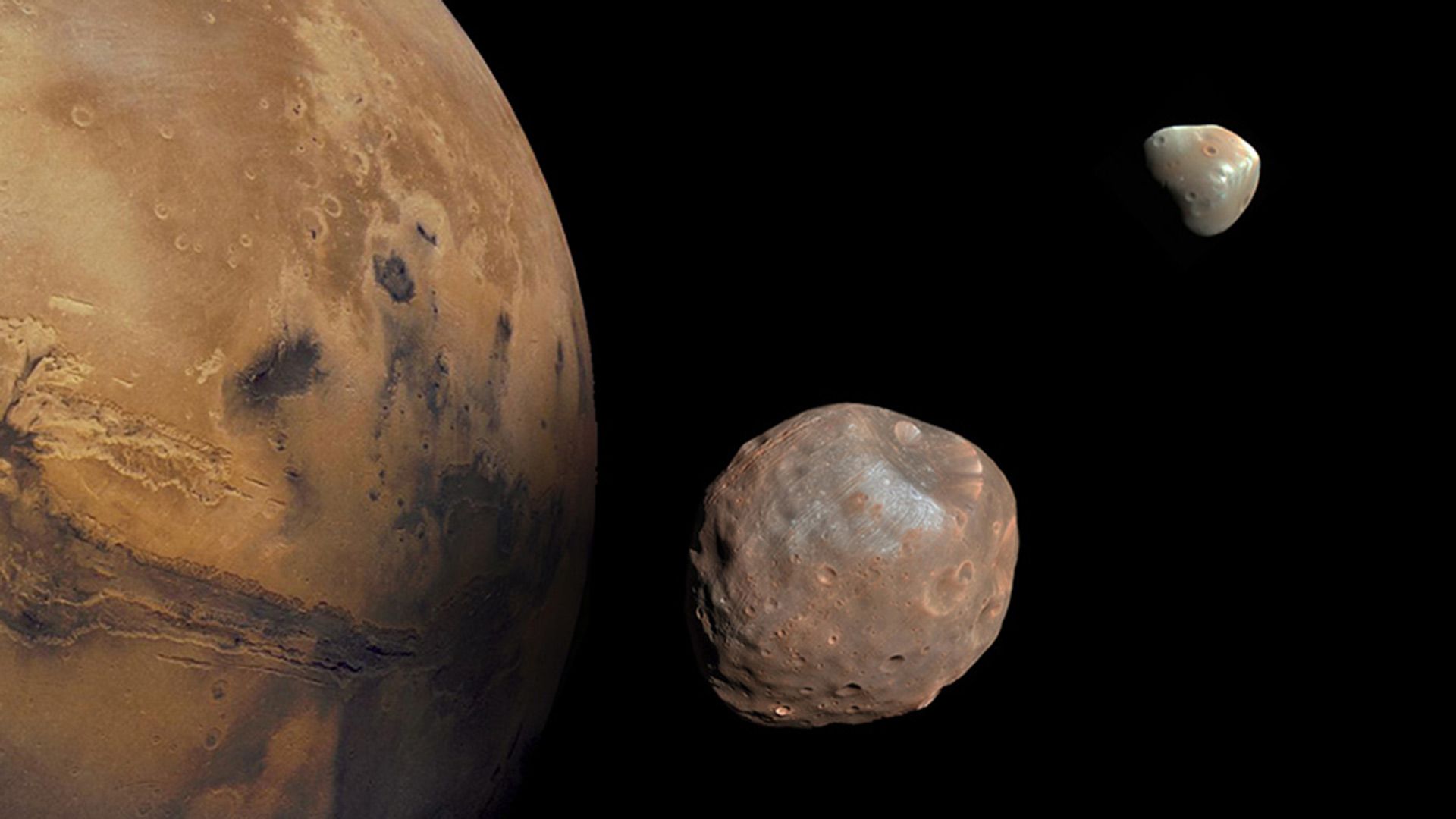
Neither Phobos nor Deimos is spherical, isntead; both are oblong and lumpy, like potatoes. That fact — along with their chemical composition, as far as we have been able to tell using telescopic spectroscopy — point to the possibility that Phobos and Deimos were asteroids from the early solar system that were captured by Mars' gravitational pull. Figuring out the moons' true origin story would provide key clues about Mars' geological past, the solar system's early history and the formation of the inner planets, mission team members have said.
Once the MMX samples are safely returned to Earth, scientists will study their composition and mineralogy, then compare such chemical fingerprints with those of Martian rocks and asteroid material. These analyses, combined with data collected by MMX during its mission, will help nail down the origin of Phobos — and by extension, Deimos. — by
While JAXA leads MMX, the mission is an international effort, with interagency partnerships between JAXA, NASA and the European Space Agency (ESA), as well as U.S. and European companies, which supplied a handful of the spacecraft's scientific hardware and communications equipment.
NASA's contributions to MMX include the Mars-moon Exploration with Gamma rays and Neutrons (MEGANE, pronounced "meh-gah-nay") device, which is a gamma-ray and neutron spectrometer built by the Johns Hopkins Applied Physics Laboratory (APL); a Honeybee Robotics-built pneumatic sampler; and communications support using the agency's Deep Space Network.
NASA has also invested approximately $87 million through the end of the mission, which includes funding for United States scientists and astromaterials experts on the MMX team. The agency is getting something concrete for such contributions: At least 15% of the planned 10-gram (0.35 ounces) returned Phobos sample will be reserved for NASA's study. Those materials will be transferred and maintained at the agency's Johnson Space Center in Houston for analysis and long-term preservation.
MMX is not the first Phobos sample-return project to take flight, by the way. That distinction goes to Russia's Phobos-Grunt ("Phobos-Soil") mission, which launched in November 2011 but failed to get out of Earth orbit due to a rocket glitch. The 14.5-ton spacecraft eventually crashed back to Earth over the Pacific Ocean in January 2012.