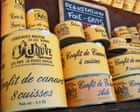
 Foie gras for sale in France. EU member states are not allowed to ban one another’s products on animal welfare grounds. Photograph: Pauline Cutler/AlamyFoie gras for sale in France. EU member states are not allowed to ban one another’s products on animal welfare grounds. Photograph: Pauline Cutler/AlamyLabour to back down on foie gras and fur bans to ease EU trade deal
Exclusive: Animal welfare charities ‘bitterly disappointed’ that Labour plans to backtrack on manifesto commitments
The government is to break a manifesto commitment to ban foie gras imports, and has declined to stop fur imports, after the EU made these red lines in its discussions for a trade deal.
Animal welfare charities say they are “bitterly disappointed” that ministers are failing to use powers granted by Brexit to restrict the import of these “cruel” items.
Sources close to the discussions between the UK and EU said the UK was ready to drop the foie gras import ban, as there were other sticking points of higher priority, such as precision breeding of crops. Ministers say that is more likely to boost the economy than banning imports of foie gras and fur.
The government left a foie gras ban out of its recently launched animal welfare plan. It also released its response to a consultation on a fur ban at the end of last month. Despite 97% of respondents saying it was wrong for animals to be killed for the sake of their fur, and that the vast majority of those surveyed wanted a ban, ministers did not commit to import restrictions, and are instead setting up a working group to look into the fur industry.
Fur farming has been banned since 2000, and the production of foie gras in the UK has been outlawed since 2006. However, both are still imported, mostly from EU countries, and sold in shops and restaurants in the UK.
Before the election, the then shadow environment secretary, Steve Reed, said Labour would “ban the commercial import of foie gras, where ducks and geese are aggressively force-fed”.
Foie gras is made by force-feeding ducks and geese grain through a funnel or tube that has been thrust down the bird’s neck – a process known as gavage that swells the animal’s liver to many times its normal size. The livers are then harvested.
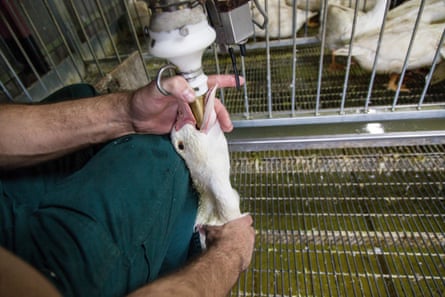 A duck being force-fed for foie gras in south-west France. Photograph: Andia/Universal Images Group/Getty Images
EU member states are not allowed to ban one another’s products on animal welfare grounds. Since the UK left the EU, it has had the freedom to restrict imports of EU products, but so far has not done so. Now, under a trade agreement expected to be firmed up in the autumn, the UK will once again need an exemption from EU law to ban these products.
David Bowles, head of public affairs at the RSPCA, said: “Every animal deserves a life free from suffering. We are bitterly disappointed that the government has failed to ban the sale and import of fur, and we welcome the setting up of the round table to consider next steps. While any steps to reduce the import of fur are a positive move, stronger action is still needed to stop the fur trade in the UK, particularly at a time when Europe appears to be moving towards licensing of fur farms.”
Alexis Gauthier, restaurateur at Gauthier in Soho, London, said the government should ban foie gras, describing it as an “atrocious product”. He said: “Throwing this crucial animal welfare pledge under a bus and blaming the EU would be just another demonstration of this government’s rudderless policy, toothless negotiations and apparent lack of integrity or compassion.”
Gauthier used to be one of the UK’s top importers of foie gras but he became a vegan after the campaign group Peta protested outside his restaurant for serving the product. He now serves “faux gras” made of mushrooms, lentils, walnuts and cognac, and says the concoction has emulated the buttery taste sought by foie gras fans.
Fur farms have been criticised for cruelty as the animals are often confined in small spaces.
Claire Bass, director of campaigns at Humane World For Animals UK, said: “The previous Labour government banned fur farming in the UK more than 20 years ago. Allowing the UK market to outsource fur from the bloody and brutal farming practices abroad should have no place in our trade landscape with the EU or anywhere else.”
Bowles added: “The UK government must keep its commitment to end the import of this cruel product. High animal welfare standards should not be compromised in the pursuit of trade agreements, so we urge ministers to provide clarity and deliver on this commitment without further delay.”
Some restaurants still sell foie gras in the UK, though many shops have removed it from sale, including the king’s grocer, Fortnum and Mason, which took it off shelves in 2021.
Boris Johnson’s Conservative government had plans to ban fur and foie gras imports, using “Brexit freedoms”, but shelved them after an outcry from Tory MPs who did not want their favourite fashions and delicacies banned.
A spokesperson for the Department for Environment Food and Rural Affairs said: “We are proud to have some of the highest animal welfare standards in the world, which has seen fur farming banned across the UK for 20 years.
“We welcome the publication of our expert Animal Welfare Committee’s report on the responsible sourcing of fur. This delivers a key commitment made in the government’s world-leading animal welfare strategy.”.
Alexis Gauthier’s vegan faux gras recipe
Ingredients
1 shallot, peeled and diced 4 tbsp olive oil 4 cloves garlic, peeled and thinly sliced 2 tsp chopped rosemary 2 tsp chopped thyme 2 tsp chopped sage 24 button mushrooms, roughly sliced 2 tbsp cognac 2 tbsp soy sauce 400g cooked lentils 150g toasted walnuts 2 tbsp beetroot puree Black pepper, to taste
Method
In a heavy pan, saute the shallot in two tablespoonfuls of the olive oil until translucent. Add the garlic, chopped herbs, and mushrooms. Add the cognac and turn up the heat.
Add the soy sauce, reduce the heat, and cook over low heat for six minutes. Remove the pan from heat and let cool.
In a food processor, process the mushroom mixture, the remaining olive oil, the lentils, walnuts, beetroot puree and black pepper until almost smooth. Add an optional extra splash of cognac.
Place in a small glass jar and refrigerate for a few hours before serving. Serve alongside toasted slices of sourdough or other bread.
Explore more on these topicsShareReuse this content