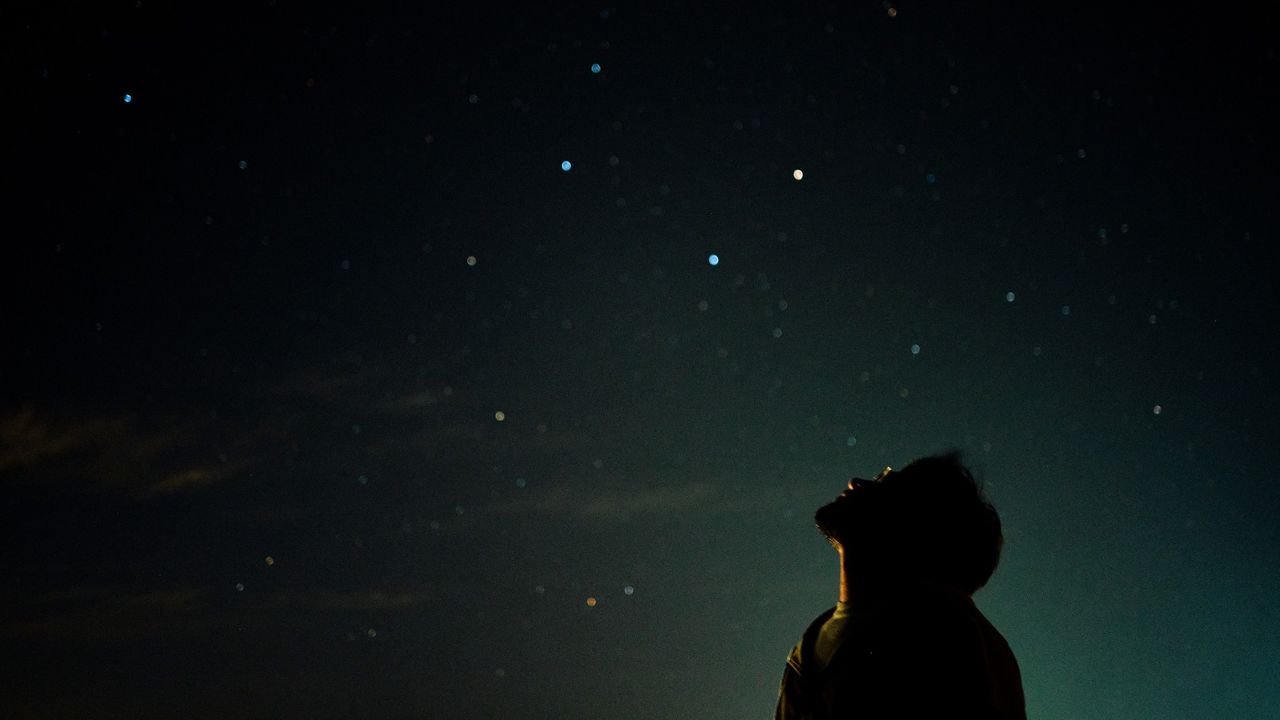
 Stargazing is best done by star-hopping, not apps. (Image credit: Mariyariya via Getty Images) Jump to:
 - How to go star-hopping
- 1. Find Polaris from the Big Dipper
- 2. 'Arc to Arcturus, spike to Spica.'
- 3. Find Leo from the Big Dipper
- 4. The Spring Triangle
- 5. The Spring Diamond
- Stargazer's corner: May 8-14, 2026
- Constellation of the week: Boötes
- My latest stargazing obsession
"Look, there's the Southern Cross!" I turned, expecting an outstretched arm and a finger pointing low to the horizon. Instead, she was pointing at her phone. Her friend hurried over, not to look up, but to look down — both of them staring at a glowing screen while, just beyond them, Crux was visible in the night sky.
I wanted to interrupt them, to redirect their attention by a few degrees. Just lift your eyes! It's right there!
You don't need to try to recognize everything in the night sky at once.
Beginners often miss this and try to match the entire sky to a chart on a phone. It doesn't work because the sky is too big. To know it, you have to navigate it, starting with something obvious and moving to something less so, building a chain and, in time, a mental map. The night sky will reveal itself to you slowly if you let it, and it will be with you the rest of your life.
Sure, if you get stuck when stargazing, use an app. The point isn't to avoid technology entirely, but to avoid becoming dependent on it.
Why May is perfect for star-hopping
Early May is ideal for going app-free. This weekend, the moon fades toward last quarter, opening up darker skies with each passing night. This is the monthly observing window — when moonlight no longer overwhelms the fainter stars and the sky begins to reveal itself again.
The key to star-hopping in May is the most recognizable shape in the Northern Hemisphere's night sky — the Big Dipper/Plough. In May, its familiar seven bright stars are high overhead after dark, providing quick and easy reference for navigating everything else, with direct lines — literally — to Polaris, the North Star, and the great spring constellations of Leo, Virgo and Boötes, each anchored by a bright star that's easy to recognize.
How to go star-hopping
Instead of using an app, try these shortcuts — star-hops that teach you how the sky fits together, turning the sky into something you can move through instinctively.
Here are the ones to try this May.
1. Find Polaris from the Big Dipper
Start with the two stars at the edge of the Big Dipper's bowl — the "Pointer Stars," called Dubhe (pronounced DOO-bay) and Merak. Draw a straight line through them and extend it about five times their separation. You'll land on Polaris, below. It's not the brightest star, but it's the most important — marking true north and anchoring the entire northern sky. Once you've found Polaris, draw a line straight down to the horizon — that's due north.
How to find Polaris from the Big Dipper and go "Arc to Arcturus, spike to Spica." (Image credit: Starry Night/Jamie Carter - Canva)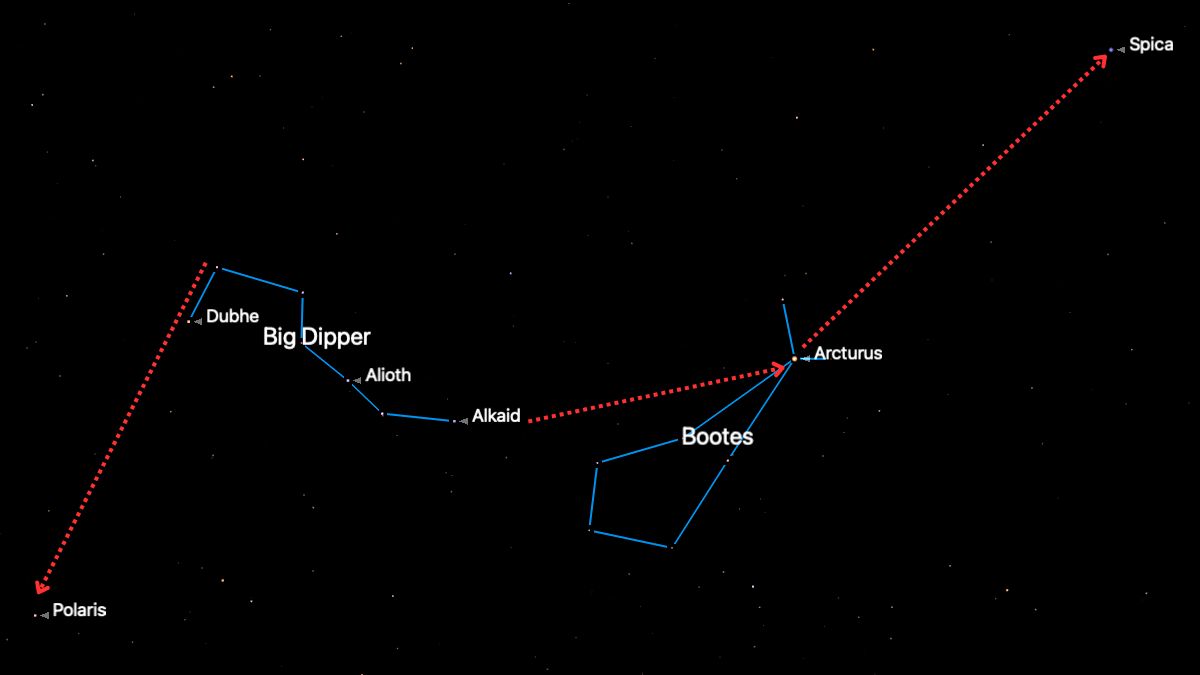
2. 'Arc to Arcturus, spike to Spica.'
Follow the curve of the Big Dipper's handle in a smooth arc, and you'll arrive at Arcturus. Now take a spike to the next bright star — Spica (pronounced SPY-kuh). It's one of the most efficient navigational moves in spring stargazing.
3. Find Leo from the Big Dipper
How to star-hop to Leo and find the Sickle. (Image credit: Starry Night/Jamie Carter - Canva)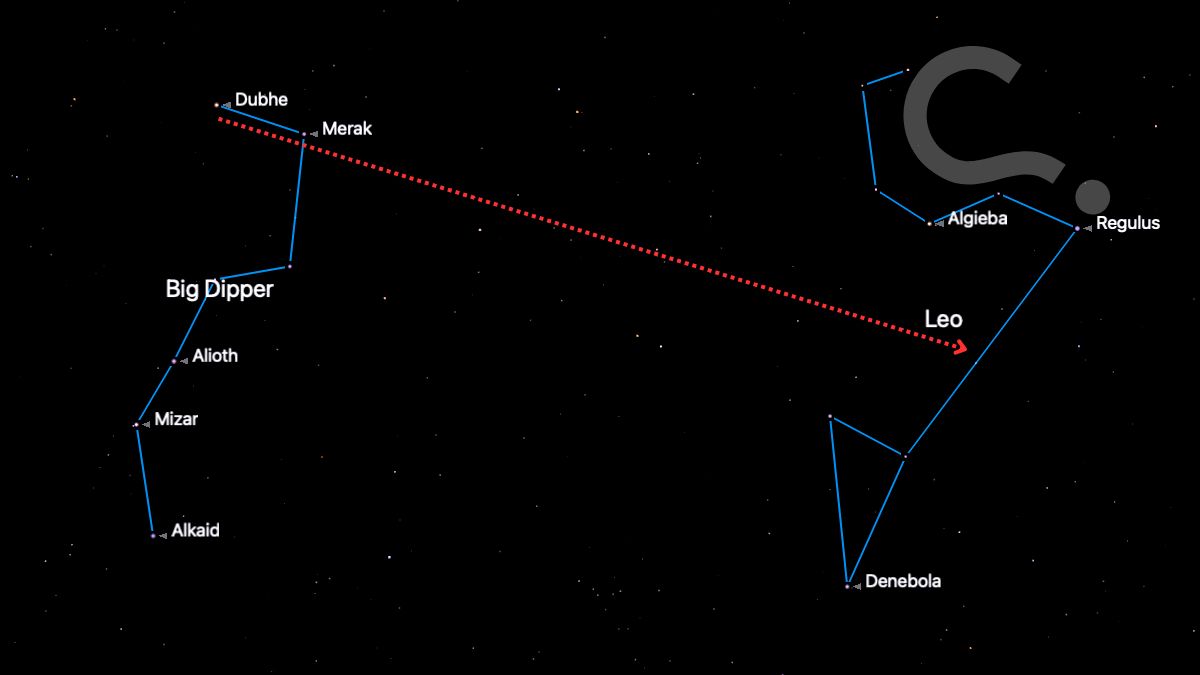
Use the bowl of the Big Dipper as a guide. Draw an imaginary line from Dubhe and Merak — those two stars furthest from the handle — down toward the southern sky, and you'll arrive at Leo. Once you've located Regulus — Leo's brightest star — look for that distinctive backward question mark, called the Sickle of Leo (the lion's head), then trace the body eastward into a faint triangle. It's one of the easiest constellations to recognize once you've locked onto the "Heart of the Lion."
4. The Spring Triangle
There's a Winter Triangle and a Summer Triangle, so why not a Spring Triangle? Join Arcturus, Spica and Regulus, and you've created the Spring Triangle — a vast, unofficial asterism that anchors the entire southern sky in May. If you want to make it more equilateral, use the fainter star Denebola, at the back of the constellation of Leo, instead of Regulus.
The Spring Triangle and Spring Diamond. (Image credit: Starry Night/Jamie Carter - Canva)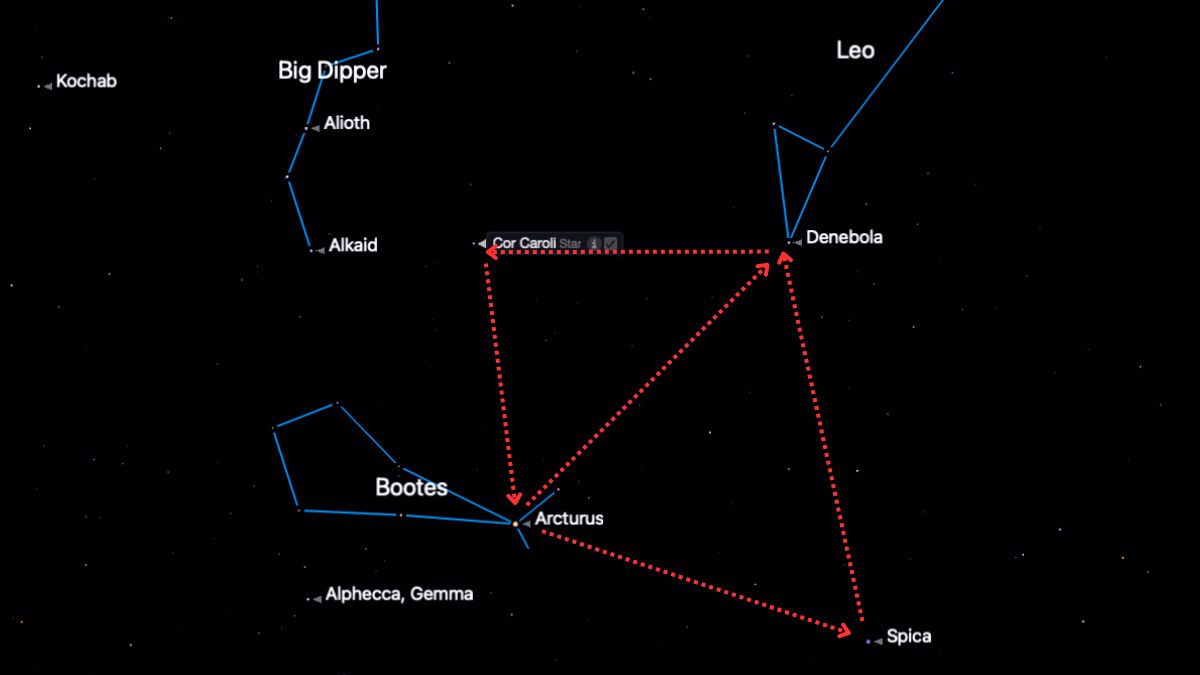
5. The Spring Diamond
From Arcturus, look north toward the end of the Big Dipper's handle. About a third of the way along sits Cor Caroli, a dimmer star, but still the brightest in the tiny constellation Canes Venatici in an otherwise fairly empty part of the sky. Together with Arcturus, Spica and Denebola, Cor Caroli helps create the Spring Diamond asterism. Cor Caroli means Heart of Charles, thought to have been named in the 17th century for England's King Charles I.
Stargazer's corner: May 8-14, 2026
The moon is now waning and rising later each night, which means darker skies are back in the early evening. A highlight this May is Venus, which is climbing into the post-sunset night sky in the west. Later in the week, if you're out before dawn (a really early start!), the waning crescent moon reappears low in the east. However, the best way to use this week is to practice a star-hop or two, keeping sessions short and focused. Master one of them, repeat it, then stop. Repetition and familiarity are the keys to success in stargazing.
Constellation of the week: Boötes
The Boötes constellation is an anchor of May's night sky (Image credit: E. Slawik/NOIRLab/NSF/AURA/M. Zamani/Outline and background added in Canva Pro.)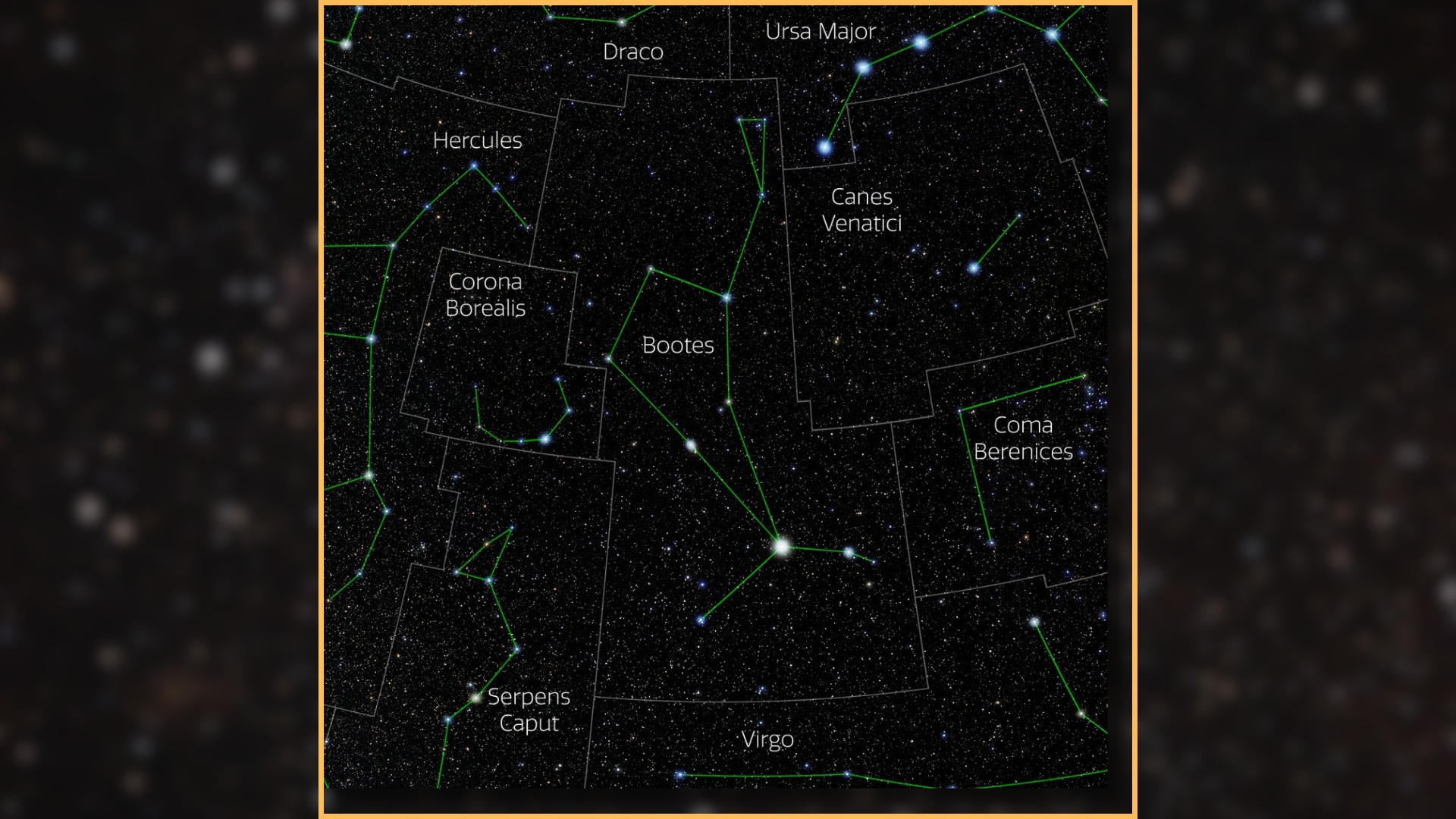
Having followed the "Arc to Arcturus" from the Big Dipper, you're familiar with how to find the brightest star in the constellation Boötes — one of the oldest in the night sky. The rest of the constellation is said to form a loose kite pattern around Arcturus, stretching into darker regions of the sky. However, I always see Boötes as a champagne or cocktail glass. Maybe that says something more about me than the stars? More traditionally, Boötes is a herdsman or a plowman. An Arab legend saw Boötes as a herdsman to the Pole Star, while ancient Egyptians saw it as a Hippopotamus. Its anchor, Arcturus, is 37 light-years distant and a red giant star — its color leading Chinese astronomers to see it as a horn of a giant dragon.
My latest stargazing obsession
It's so easy to make excuses not to protect your night vision. You tell yourself you're only going outside for a few minutes or that checking an app on your phone for a few seconds won't make any difference. It will. Turn on a bright phone screen, and white light will flood your eyes, effectively rendering you star-blind. So if you think you may use a stargazing app while you're star-hopping, remember the golden rule before you go outside: dim your phone's brightness and put the app into red light mode, which is kinder to the rod cells in your eyes. Only then can you navigate the night sky with your night vision intact.
Editor's note: If you want to enhance your star-hopping game, take a look at our best binoculars guide.
View MoreYou must confirm your public display name before commenting
Please logout and then login again, you will then be prompted to enter your display name.
Logout Jamie CarterContributing Writer
Jamie is an experienced science and travel journalist, stargazer and eclipse chaser who writes about exploring the night sky, solar and lunar eclipses, the Northern Lights, moon-gazing, astro-travel, astronomy and space exploration. He is the editor of WhenIsTheNextEclipse.com, author of A Stargazing Program For Beginners, co-author of The Eclipse Effect, and a senior contributor at Forbes.