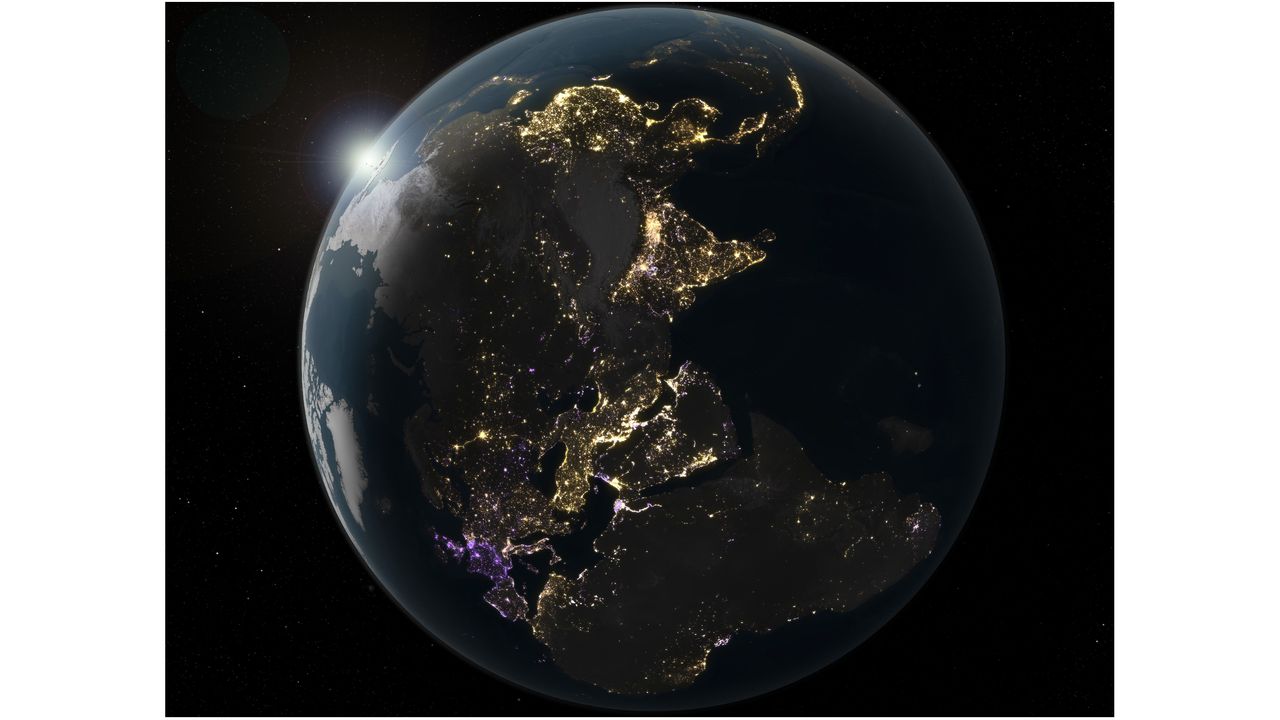
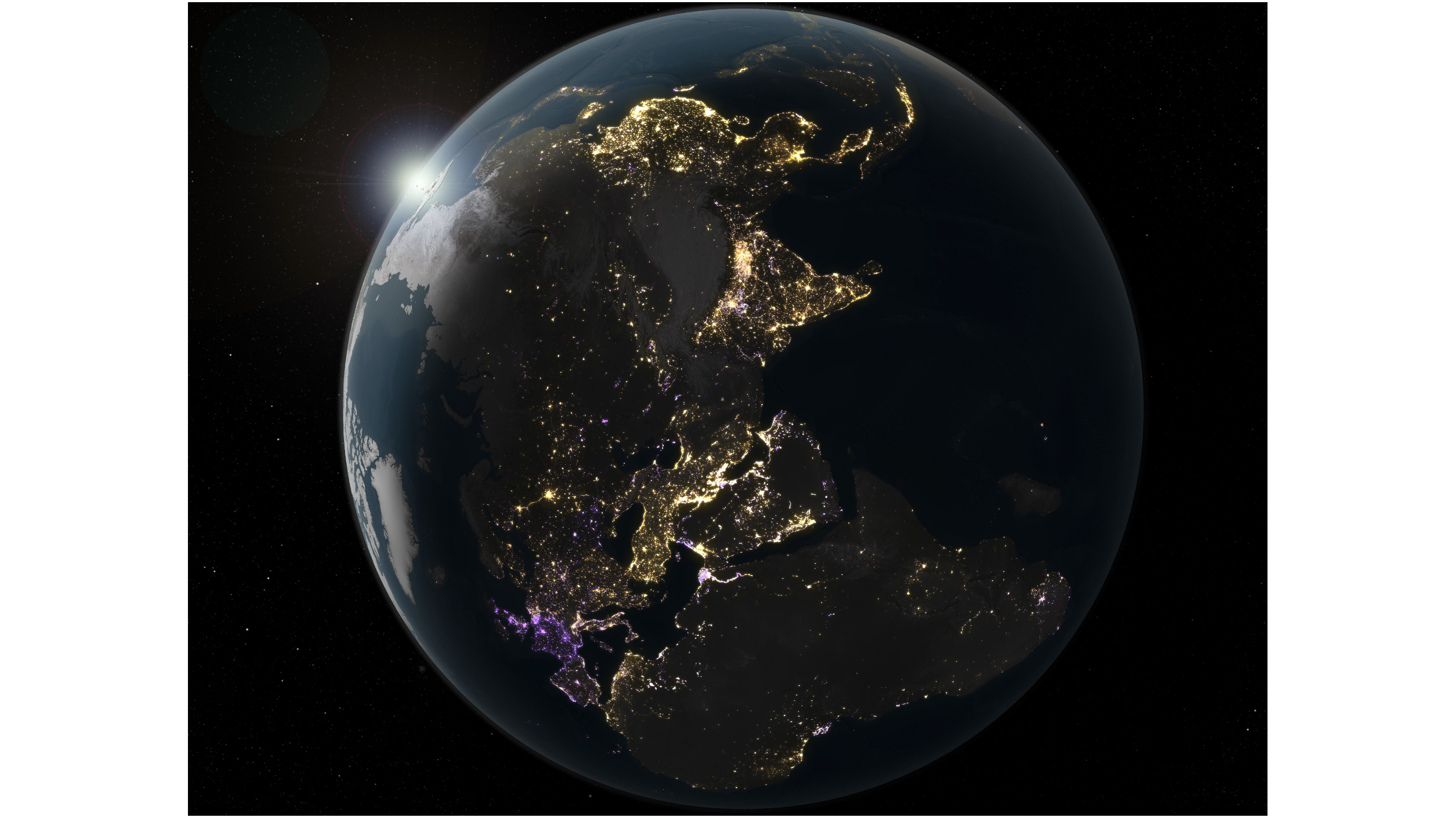
 A nighttime view of Earth, based on images from Earth-monitoring satellites. (Image credit: Michala Garrison/NASA Earth Observatory) Share this article 0 Join the conversation Follow us Add us as a preferred source on Google Newsletter Get the Space.com Newsletter
 Breaking space news, the latest updates on rocket launches, skywatching events and more!
Contact me with news and offers from other Future brands Receive email from us on behalf of our trusted partners or sponsors By submitting your information you agree to the Terms & Conditions and Privacy Policy and are aged 16 or over.You are now subscribed
Your newsletter sign-up was successful
Want to add more newsletters?
An account already exists for this email address, please log in. Subscribe to our newsletterArtificial lights at night brightened up planet Earth by 16% between 2014 and 2022, a new study using satellite images has revealed.
But some areas, including those struck by war and natural disasters, or those in countries with effective light pollution and energy-saving policies in place, are bucking the trend.
From space, Earth at night is a magnificent sight — a darkened sphere lined and dotted by blueish and golden lights revealing outlines of countries and continents. It has not always looked like that. For our ancestors, that twinkling ball would have been completely dark. Artificial lights at night reveal the progress of civilization as new settlements spring up and electric grids expand, bringing the comforts of modern life. But constant artificial light has also become a problem, affecting sleep quality, disrupting plant and animal biorhythms and obstructing our views of the cosmos.
The new study, by an international team of researchers. found that Earth is getting brighter overall. But there are caveats: In many areas, lights have actually been extinguished by war and natural disasters, or dimmed by effective energy-saving policies. In fact, Zhe Zhu, the study's lead author, said that, despite the overall brightening visible in the satellite images, the world's dimming areas are actually increasing in size at an accelerating pace.
"We found that the Earth is not gradually brightening, it is flickering," said Zhu, an associate professor of remote sensing at the University of Connecticut. "The brightening is mostly driven by developing countries like India, China and parts of Africa. But we also see the areas of dimming increasing every year. Some of that is due to sudden events like wars and natural disasters, but we also see a huge area of dimming in Europe, where they put policies in place. The U.S. is still mostly increasing."
A dramatic decline in night-time artificial light was observed, for example, in Ukraine following the Russian invasion, which began in February 2022. France, a developed western European country, dimmed by a staggering 33% thanks to new policies.
Zhe said the study is the first to reveal the trends in artificial light use with a level of temporal detail that distinguishes individual events and regional trends. The researchers could thus see in the data the rollouts of the COVID pandemic lockdowns across the world and monitor phases of armed conflicts.
Get the Space.com NewsletterContact me with news and offers from other Future brandsReceive email from us on behalf of our trusted partners or sponsors"You can see almost in real time when there is a war happening," said Zhe. "In Palestine, you could see many dips — ups and downs — every time the war flares up. You can also see disasters, such as major hurricane impacts in Puerto Rico, which basically wipe out electricity for a long time."
The researchers used data from NASA's Black Marble tool, which uses special algorithms to process measurements from the Visible Infrared Imaging Radiometer Suite (VIIRS). The VIIRS instrument flies on both the Suomi National Polar-orbiting Partnership (NPP) satellite, a joint effort of NASA and the U.S. National Oceanic and Atmospheric Administration, and its predecessor, NOAA-20. VIIRS captures a wide range of light signatures, from ultraviolet to infrared light, revealing the nighttime glow of the planet.
The algorithms, Zhu explained, filter out unwanted noise such as moonlight reflections, auroral light, the shadowing by clouds and vegetation, and even differences caused by the viewing angle of the satellite during different passes.
The brightness increases reported in this study, however, may be somewhat skewed, as the satellite sensors feeding the NASA Black Marble tool are not sensitive to the blue-tinged light emitted by most traditional LED lights, which dominate the lighting technology of today, Zhe said.
A 2023 study, based on more than 50,000 observer reports from all over the world, concluded that the perceived night sky brightness in inhabited locations worldwide had been increasing at a mind-boggling rate of nearly 10% per year in the past decade. This brightness increase is effectively erasing stars from the night sky, forcing skywatchers and professional astronomers to retreat into ever more remote locations. The incessant glow, which prevents true darkness from setting in even in the dead of night, also has profound effects on human, plant and animal health, disrupting sleep and natural growth cycles.
"Human vision at night is most sensitive towards shorter wavelength (blue) light and has little sensitivity to near infrared light, but the VIIRS has no sensitivity to light below 500 nm (i.e. blue light), and can easily see infrared light from high-pressure sodium lamps," Christopher Kyba, a professor of night-time light remote sensing at Ruhr University Bochum in Germany and one of the co-authors of the paper, told Space.com in an email. "So, when a city converts a street from high-pressure sodium to white LED, then a person would say it got brighter, but the satellite would say it got darker."
Kyba also led the 2023 observer study.
Zhe says the brightening isn't just a doom-and-gloom signal for skywatchers. In many areas, especially underdeveloped regions of Africa and Asia, the lights mean improved economic prosperity.
"From the economic perspective, brightening can be a good thing," he said. "It means more activity, people having access to power where they previously didn't have it."
The study was published in the journal Nature on Wednesday (April 8).
 Tereza PultarovaContributing Writer
Tereza is a London-based science and technology journalist, aspiring fiction writer and amateur gymnast. She worked as a reporter at the Engineering and Technology magazine, freelanced for a range of publications including Live Science, Space.com, Professional Engineering, Via Satellite and Space News and served as a maternity cover science editor at the European Space Agency.
View MoreYou must confirm your public display name before commenting
Please logout and then login again, you will then be prompted to enter your display name.
Logout MORE FROM SPACE... 1Artemis 2 mission sends 'Kerbal Space Program' player numbers soaring to the Mun
- 2All eyes on Orion’s heat shield: Artemis 2 astronauts will hit Earth's atmosphere at nearly 24,000 mph on April 10
- 3May full moon 2026: When, where and how to see the Flower Moon
- 4Large Hadron Collider gives scientists their best look yet at conditions right after the Big Bang
- 5'The Expanse: Osiris Reborn' has lots of 'Mass Effect' DNA, but its developers are teasing a far more grounded sci-fi RPG