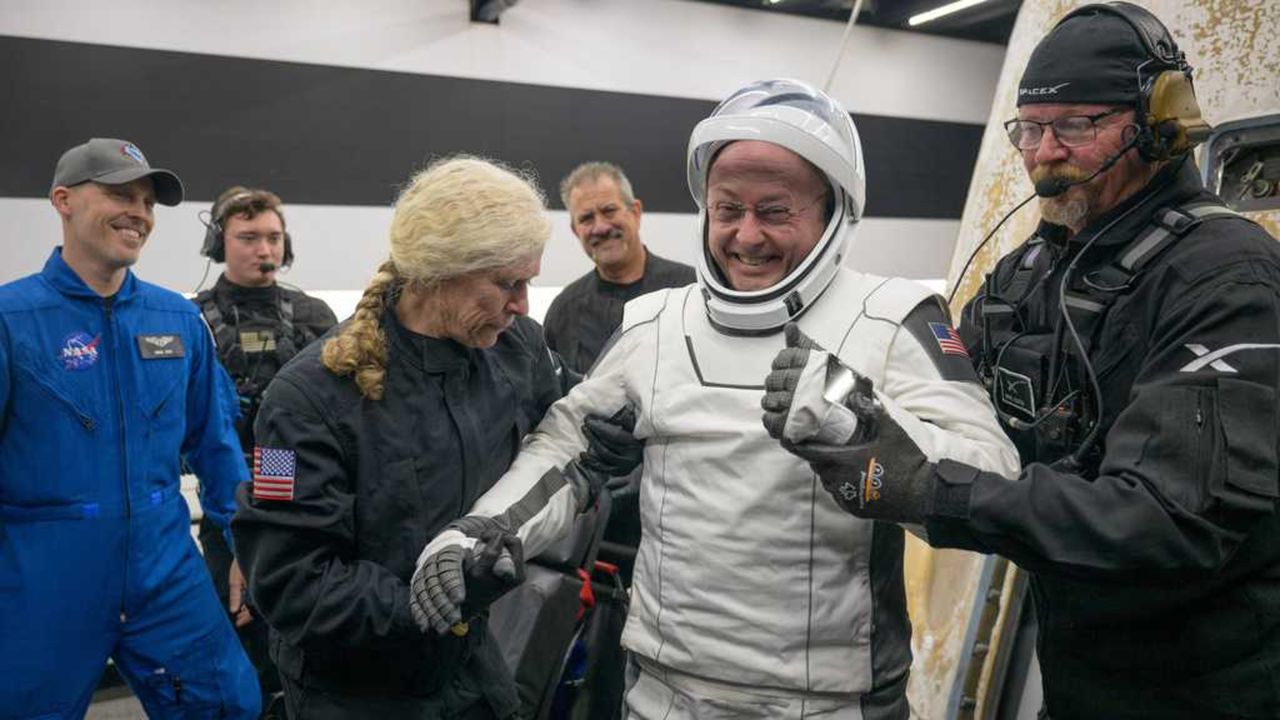
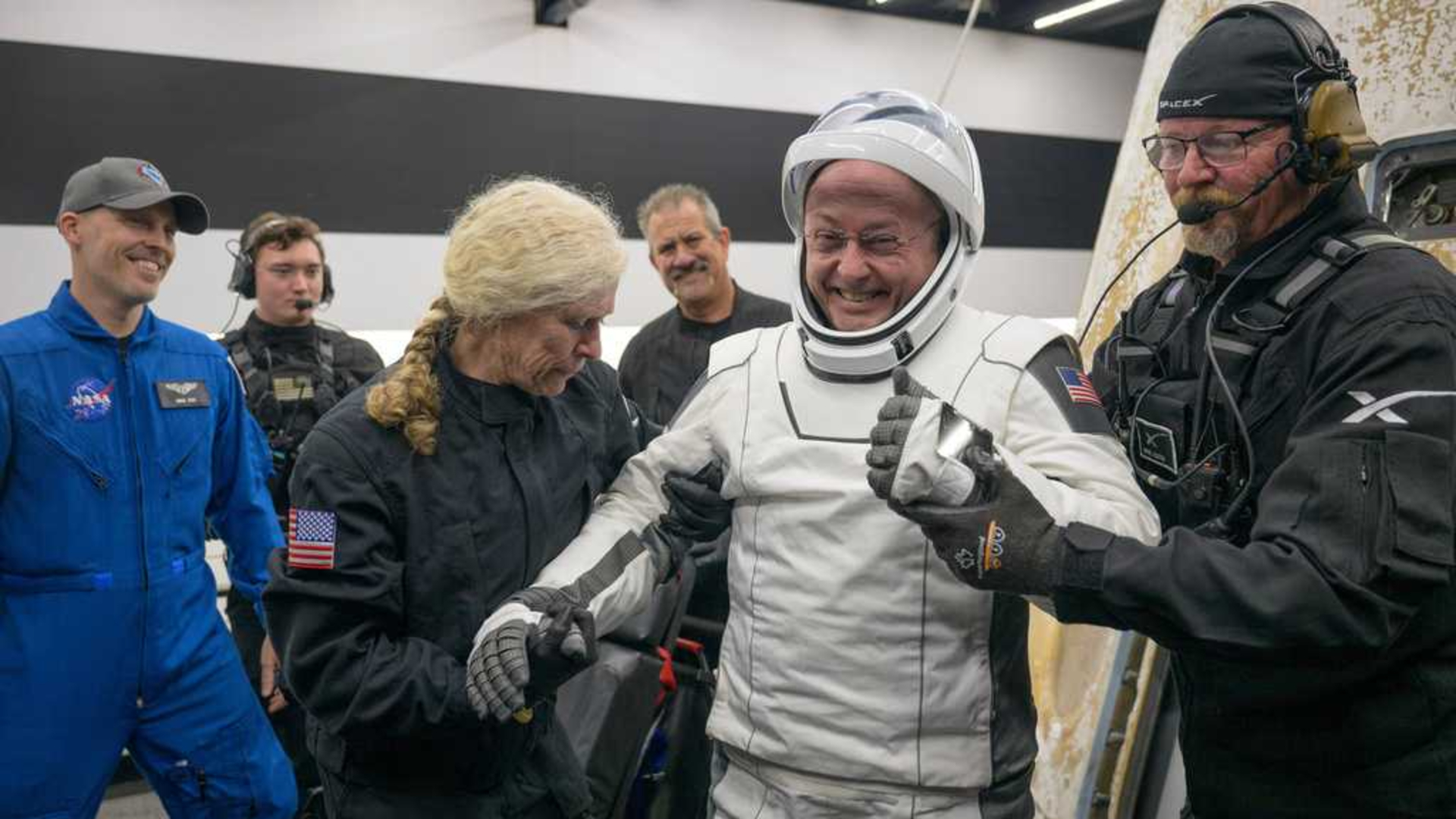
 NASA astronaut Michael Fincke is helped to his feet after returning to Earth from the ISS with other members of the SpaceX Crew-11. (Image credit: NASA/Bill Ingalls) Share this article 0 Join the conversation Follow us Add us as a preferred source on Google Newsletter Sign up for the Live Science daily newsletter now
 Get the world’s most fascinating discoveries delivered straight to your inbox.
Become a Member in Seconds
Unlock instant access to exclusive member features.
Contact me with news and offers from other Future brands Receive email from us on behalf of our trusted partners or sponsors By submitting your information you agree to the Terms & Conditions and Privacy Policy and are aged 16 or over.You are now subscribed
Your newsletter sign-up was successful
Want to add more newsletters?
Join the club
Get full access to premium articles, exclusive features and a growing list of member rewards.
Explore An account already exists for this email address, please log in. Subscribe to our newsletterAs NASA prepares to send four astronauts around the moon for the 10-day Artemis II mission, a veteran space flier's unexplained illness in orbit is spotlighting one of the biggest risks of deep-space travel: the need for medical systems in case of emergencies.
NASA astronaut Michael Fincke said a sudden episode aboard the International Space Station (ISS) in January left him unable to speak and forced NASA's first-ever medical evacuation from the orbiting laboratory. Doctors have ruled out a heart attack, Fincke told the Associated Press, but they still don't know what caused the medical issue.
NASA was able to get Fincke (along with the three other members of the crew) back to Earth relatively quickly from the ISS. But that may not be the case for the longer lunar missions the agency envisions under the Artemis program. As NASA works toward building a lasting human presence on and around the moon — including plans for a $20 billion lunar base — unexplained medical events like Fincke's may become harder to dismiss as one-off scares.
Article continues below"It was completely out of the blue. It was just amazingly quick," Fincke said, according to the Associated Press. "My crewmates definitely saw that I was in distress. It was all hands on deck within just a matter of seconds."
Fincke, the pilot on NASA's SpaceX Crew-11 mission to the ISS, flew alongside NASA astronaut Zena Cardman, Japan Aerospace Exploration Agency astronaut Kimiya Yui and Roscosmos cosmonaut Oleg Platonov. Crew-11 conducted research on astronaut health and other space-station science while helping to keep the orbital laboratory running.
RELATED STORIES—Astronauts will 'absolutely be test subjects': NASA's moon plans pose big questions — and big risks
The episode hit on Jan. 7, 2026, while Fincke was eating dinner after preparing for a spacewalk. He said he felt no pain, and the event lasted around 20 minutes. Seeing Finke's distress, his crewmates quickly called flight surgeons back on Earth.
Fincke was more than five months into the mission when the medical issue happened. NASA used the station's ultrasound machine during the emergency, he said, and the agency is now reviewing astronaut medical records to see if anything similar has happened in space.
Sign up for the Live Science daily newsletter nowContact me with news and offers from other Future brandsReceive email from us on behalf of our trusted partners or sponsorsThe incident shortened Crew-11's mission as NASA canceled the next day's spacewalk and brought Fincke and his three crewmates home early on Jan. 15.
For now, Fincke says he feels fine. Artemis II is nearing its scheduled April 2026 launch date, and Fincke was never scheduled for that mission — but the medical mystery highlights a key weakness that NASA must overcome before astronauts can safely live and work beyond Earth.
Think you know the history of moon landings? See how quickly you can name all 12 Apollo astronauts in our moon landing quiz!
 Kenna Hughes-CastleberryContent Manager, Live Science
Kenna Hughes-Castleberry is the Content Manager at Live Science. Formerly, she was the Content Manager at Space.com and before that the Science Communicator at JILA, a physics research institute. Kenna is also a book author, with her upcoming book 'Octopus X' scheduled for release in spring of 2027. Her beats include physics, health, environmental science, technology, AI, animal intelligence, corvids, and cephalopods.
View MoreYou must confirm your public display name before commenting
Please logout and then login again, you will then be prompted to enter your display name.
Logout LATEST ARTICLES 1Our fossil fuel economy is a house of cards and Trump's war in Iran is about to topple it. The need for a clean energy transition has never been clearer.
- 2Here's the stargazing gear you need for April 2026 — don't miss the Lyrids, two comets and the full moon
- 3DNA shed by every living thing is lurking in the environment — and it could tell us how Earth is changing in real time
- 4Lençóis Maranhenses: Brazil's dune-filled expanse that sits at the intersection of 3 biomes
- 5Synesthesia isn't just in your mind. The body reacts as if the colors were real.