
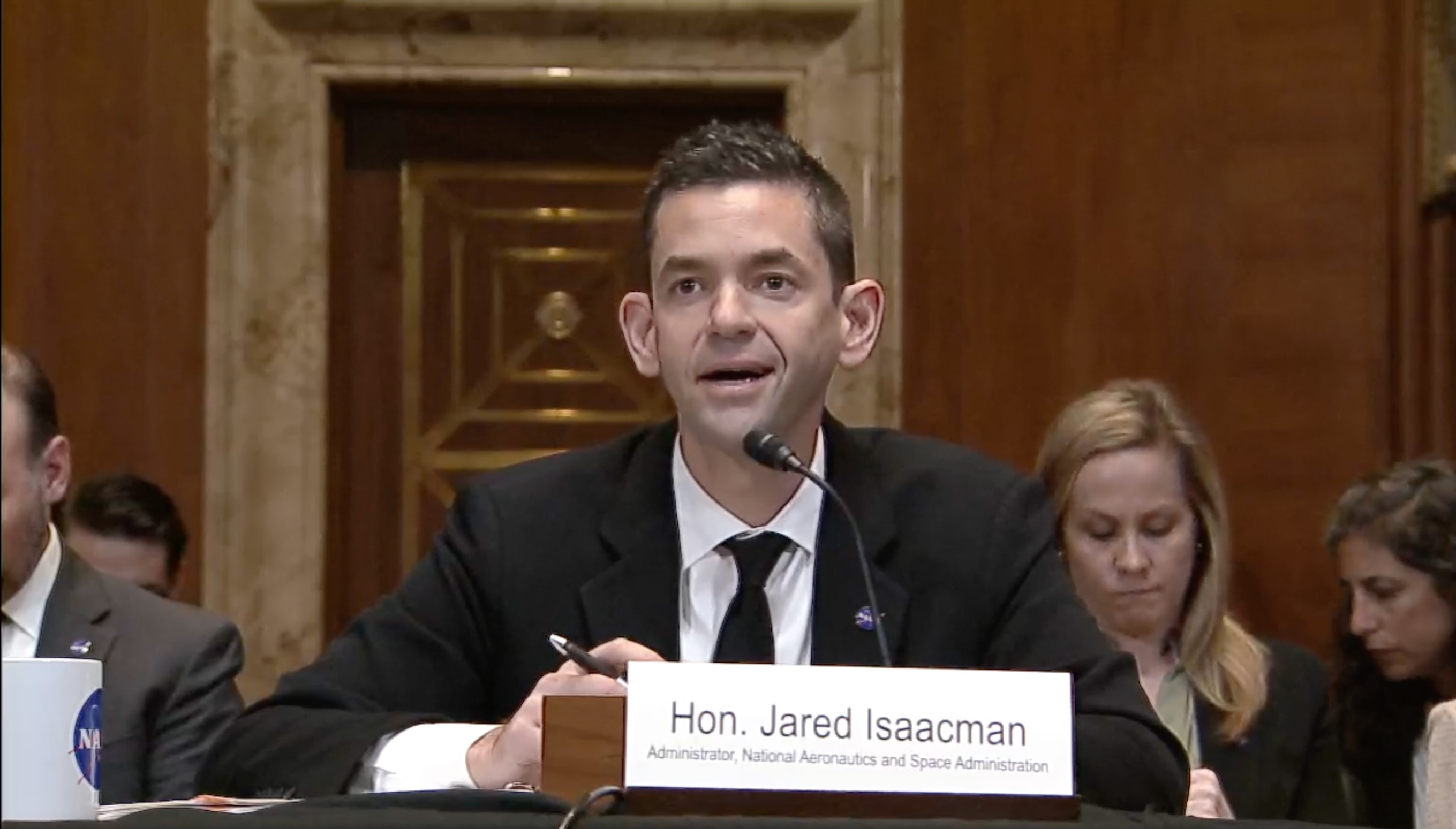
 NASA Administrator Jared Isaacman testifies during a hearing held by the House Appropriations Subcommittee on Commerce, Justice, Science, and Related Agencies to review NASA's Fiscal Year 2027 budget request, Monday, April 27, 2026, at the Rayburn House Office Building in Washington. (Image credit: NASA/Joel Kowsky) Share this article 0 Join the conversation Add us as a preferred source on Google Newsletter Subscribe to our newsletter
 NASA chief Jared Isaacman wants to restore Pluto to its former glory.
In 2006, the International Astronomical Union (IAU) stripped Pluto of its planethood, reclassifying the icy world as a "dwarf planet." The decision was controversial, and not just because it forced schoolchildren around the world to learn a new mnemonic for our solar system's major denizens.
The IAU defined a planet according to three newly pronounced criteria: It has to orbit the sun, be massive enough to be spherical, and clear its orbit of debris. Pluto fell short on the third count, according to the IAU, as it shares space in the distant Kuiper Belt with many other dwarf planets. But Earth shares orbital space with lots of asteroids, as does Jupiter, Pluto-planet advocates note. So why was Pluto singled out?
We now know that such Pluto defenders include Isaacman, a billionaire private astronaut and tech entrepreneur who became NASA chief this past December.
Isaacman testified about the White House's 2027 NASA budget request today (April 28) before the U.S. Senate Committee on Appropriations. At the very end of the hearing, Republican Sen. Jerry Moran asked the NASA administrator his thoughts on Pluto, noting that Tombaugh hailed from Moran's home state of Kansas.
"Senator, I am very much in the camp of 'make Pluto a planet again,'" Isaacman replied.
"And I would say, we are doing some papers right now on, I think, a position that we would love to escalate through the scientific community to revisit this discussion and ensure that Clyde Tombaugh gets the credit he received once and rightfully deserves to receive again," the NASA chief added.
As those words indicate, all NASA (or any Pluto advocates) can do on the matter is escalate the discussion. The ultimate decision on Pluto's status lies with the IAU, a global society of professional astronomers that defines celestial objects and assigns official names to them and their surface features.
A significant escalation occurred in July 2015, when NASA's New Horizons spacecraft returned the first-ever up-close imagery of Pluto. Those photos revealed a stunningly diverse world with towering mountains, vast nitrogen-ice glaciers and other jaw-dropping features, including a now-famous heart-shaped landform that mission scientists dubbed Tombaugh Regio.
New Horizons' historic flyby wasn't enough to get Pluto its planethood back. Will things be different now that NASA's chief is pulling so openly for the farflung world? We'll have to wait and see.
View MoreYou must confirm your public display name before commenting
Please logout and then login again, you will then be prompted to enter your display name.
Logout Mike WallSpaceflight and Tech Editor
Michael Wall is the Spaceflight and Tech Editor for Space.com and joined the team in 2010. He primarily covers human and robotic spaceflight, military space, and exoplanets, but has been known to dabble in the space art beat. His book about the search for alien life, "Out There," was published on Nov. 13, 2018. Before becoming a science writer, Michael worked as a herpetologist and wildlife biologist. He has a Ph.D. in evolutionary biology from the University of Sydney, Australia, a bachelor's degree from the University of Arizona, and a graduate certificate in science writing from the University of California, Santa Cruz. To find out what his latest project is, you can follow Michael on Twitter.