
 NASA/Reid WisemanThe Earth as seen from the Artemis II mission's Orion space capsule
Nasa has named the four astronauts for its Artemis III mission, due to launch in 2027.
They will not land on the Moon, but will fly to low Earth orbit where they will dock with prototype lunar landers in a rehearsal for the landing to come.
The 2028 Artemis IV mission is scheduled to put American astronauts on the Moon for the first time since 1972.
What will the Artemis III mission do?
Artemis III will launch on Nasa's Space Launch System (SLS) rocket from the Kennedy Space Centre in Florida. The launch date has not yet been confirmed.
The four astronauts will travel inside the Orion capsule, the same vehicle used during the Artemis II mission in April 2026.
Unlike in that mission, Orion will not loop around the Moon during Artemis III. Instead, it will remain in low Earth orbit, around 290 miles above the planet - roughly the distance from Manchester to Edinburgh, and 40 miles higher than the International Space Station (ISS).
That is where it will rendezvous and dock with the prototype lunar landers, called pathfinders. At least one crew member is expected to climb inside a lander to test the hatches, life-support connections and the new Axiom spacesuits.
The Axiom suits are literally and figuratively cool, designed by the Italian fashion house Prada and built by Houston-based Axiom Space. Axiom has done the engineering - including, for the first time, a backup cooling loop in case the primary fails. Prada is responsible for the inner garment that is designed to distribute chilled water across the body during the eight-hour spacewalks on the Moon planned as part of the subsequent Artemis IV mission.
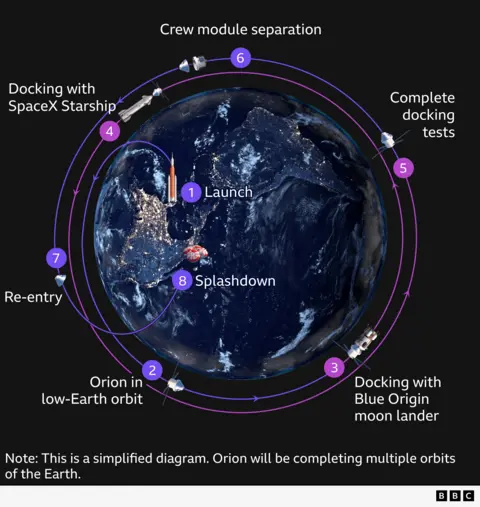
The Artemis III crew will be aboard Orion for slightly longer than the nine days spent there by the Artemis II team. Their return journey will test an upgraded heat shield during the capsule's fiery re-entry into the Earth's atmosphere.
The mission was originally conceived to be the first crewed lunar landing since Apollo 17 in 1972, but Nasa changed its plans in February 2026.
The reason was simple: the SpaceX Starship lander contracted to carry astronauts to the surface is not ready, and the in-orbit refuelling it depends on has never been demonstrated.
Rather than slip the schedule further, Nasa repurposed the mission as a crewed docking rehearsal — so that when the landers do fly, the techniques to dock with them and the suits to enter them will already have been tested with people on board.
In terms of the in-orbit refuelling, a March 2026 report from the US Government Accountability Office found that Elon Musk's SpaceX had made "limited progress" maturing the technology. The first refuelling demonstration is, optimistically, scheduled for late 2026.
Who are the Artemis III crew?
What are the Artemis IV and V missions to the Moon?
Artemis IV, targeted in 2028, is now planned to be the first crewed lunar landing of the modern era.
Astronauts are due to descend to the Moon's south polar region in a lander and remain on the surface for about a week. It is hoped that the frozen water located in permanently shadowed craters there could be used to develop drinking water, oxygen and rocket fuel during future missions
Artemis V, scheduled for later in 2028, would carry a second crew to the surface aboard the Blue Moon Mk2 lander, which is being developed by the Jeff Bezos-owned Blue Origin.
The overarching ambition behind Artemis is to establish a long-term human presence on the Moon. Nasa's Moon Base programme — unveiled in May 2026 by the agency's administrator, Jared Isaacman — sets out three phases:
- Before 2029: robotic landers and hopping drones will survey the south polar region and deliver scientific instruments
- From 2029 onwards: repeated crewed missions will expand the site
- By the mid-2030s: Nasa envisages "semi-permanent" habitats with astronauts living on the Moon for extended stays
A working base would allow sustained scientific research, the testing of technology bound for future Mars missions, and the eventual extraction of lunar resources. It would also keep the United States ahead of China in a renewed space race.
Many in the field doubt that Nasa's timetable can be met.
Experts are concerned about the slow pace of the development of Elon Musk's Starship lunar lander and the absence of any in-orbit refuelling tests.
But the biggest set back was on 28 May 2026, when Blue Origin's only launch pad at Cape Canaveral was seriously damaged after a rocket exploded during an engine test.
Rebuilding the New Glenn launch pad is expected to take many months. When SpaceX lost a pad in 2016 it took 15 months to rebuild it — and SpaceX had other pads to fall back on.
Blue Origin does not, which calls into question the company's ability to provide the Blue Moon Mk2 needed for Artemis V.
"It would not surprise me at all if China gets [to the moon] first," the Open University's Dr Simeon Barber told the BBC. The limiting step, he said, was the lander — the most challenging piece of the mission's technical architecture, and the one least under Nasa's direct control.
Nasa unveils next steps to build permanent Moon base
Exploding rocket casts doubts over Nasa's Moon plans
SpaceX's stock market blast-off could be Musk's biggest gamble yet
What happened during the Artemis II mission?
Watch the moment Artemis II blasts into space on historic missionArtemis II launched on 1 April 2026 from the Kennedy Space Centre.
Its crew of four - commander Reid Wiseman, pilot Victor Glover, mission specialist Christina Koch and Canadian Space Agency astronaut Jeremy Hansen - became the first humans to travel beyond low Earth orbit since 1972.
Over ten days, Orion flew around the far side of the Moon, passing within 4,000 miles of the lunar surface and reaching a maximum of 252,756 miles from Earth -further than any humans have ever travelled.
The capsule successfully splashed down off the coast of San Diego on 10 April 2026.
The mission tested Orion's life-support and communication systems and gave engineers their first detailed look at how the heat shield performs on a lunar return. The Artemis II flight was the essential proof that the hardware works with people on board.
But given the other technical challenges, that was the easy part.
Artemis crew returning to Earth with 'all the good stuff' from Moon discoveries
From blast off to splashdown: My days following Nasa's historic mission to the Moon
Artemis II mission was a triumph. Now comes the hard part
When was the last Moon mission?
The last human mission to the Moon was Apollo 17 in December 1972.
Astronauts Eugene Cernan and Harrison Schmitt spent three days on the surface in the Taurus-Littrow valley.
No human has set foot on the Moon in the half-century since.
In total, 24 American astronauts have travelled to the Moon and 12 have walked on its surface - all as part of the US Apollo space programme. Five of the 24 are still alive.
America first went in the 1960s, primarily to beat the Soviet Union to assert its geopolitical and technological dominance.
Once that goal was achieved, political enthusiasm and public interest ebbed, as did funding for further exploration.
First stop, the Moon. Next stop, Mars? Why Nasa's mission matters
Nasa Apollo missions: Stories of the last Moon men
Which other countries plan to send astronauts to the Moon?
 Getty ImagesChinese astronauts Zhu Yangzhu, Zhang Zhiyuan and Li Jiaying travelled to China's Tiangong space station on the country's Shenzhou-23 spacecraft in May 2026
China has announced a target to land astronauts on the Moon by 2030. It has tested its Mengzhou capsule and Lanyue lander, and is preparing a new heavy-lift rocket called the Long March 10.
India has set a target to put people on the moon by around 2040, following the successful landing of its Chandrayaan-3 mission near the lunar south pole in 2023.
Russia is part of a joint China-led lunar base project targeted for the mid-2030s, although sanctions, funding and technical problems make its contribution uncertain.
European and Japanese astronauts are also expected to fly on future Artemis missions, although there is no contractual guarantee of an international seat on Artemis III.