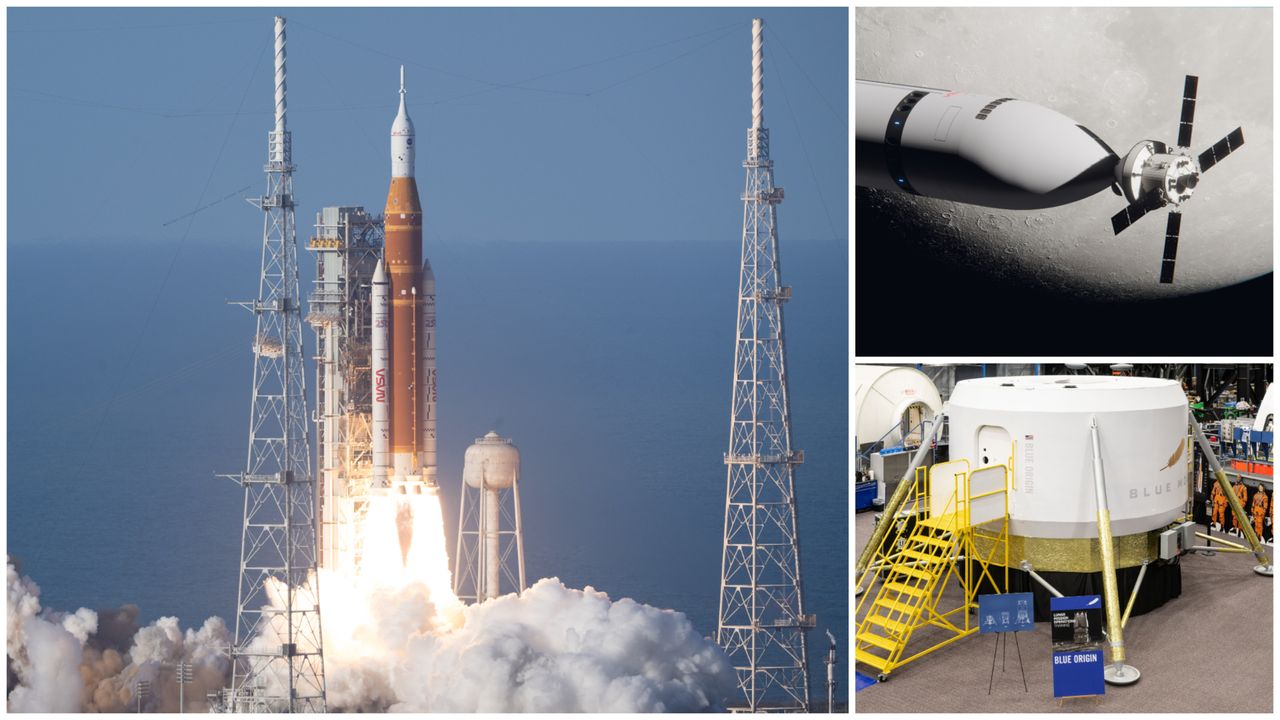
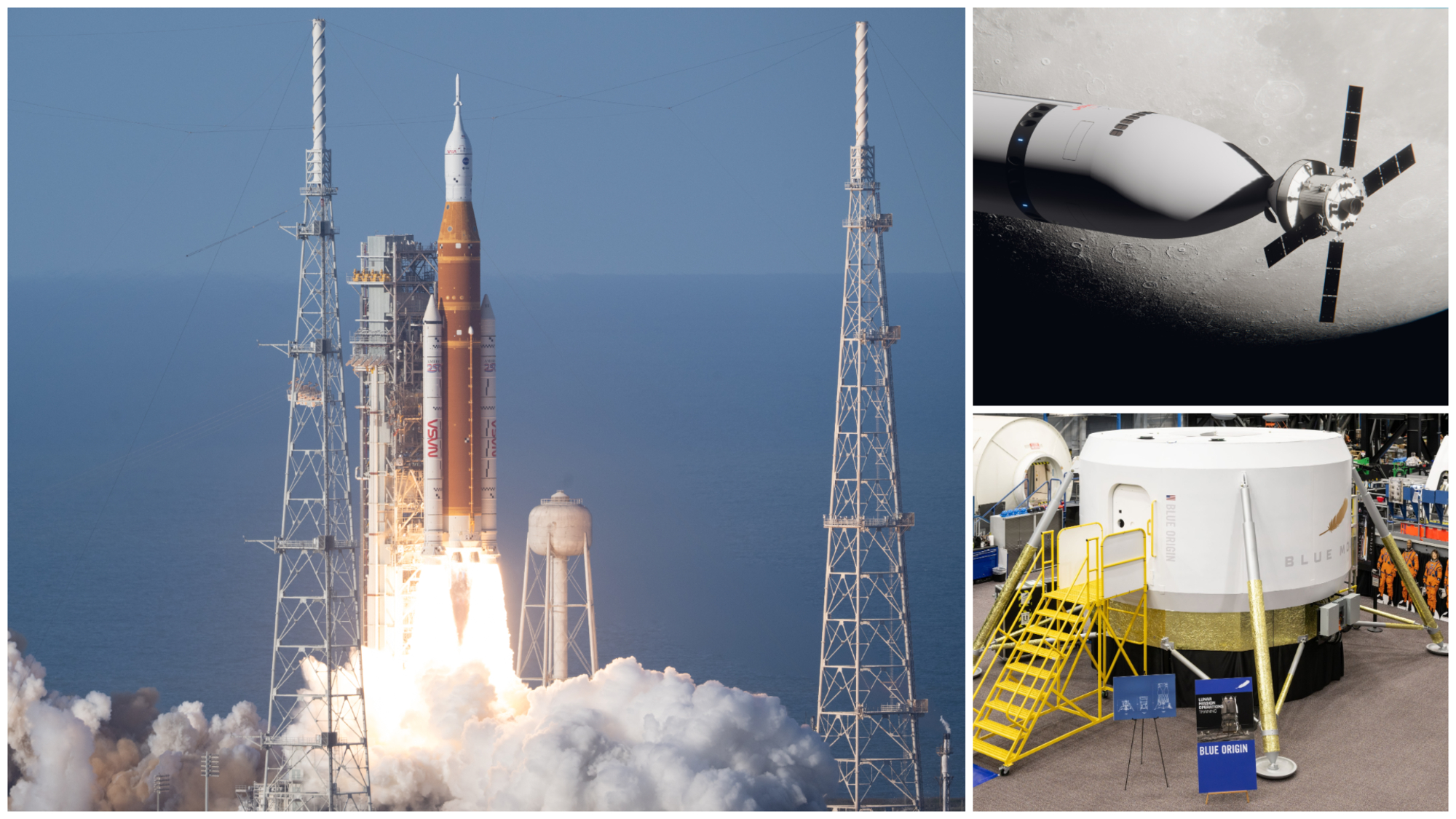
 NASA's Artemis 3 mission will include launches of the Space Launch System, SpaceX's Starship, Blue Origin's New Glenn, and include dockings with up to two moon landers. That's a lot of complexity for one test flight. (Image credit: NASA/Joel Kowsky (SLS launch)/NASA/SpaceX) Share this article 0 Join the conversation Add us as a preferred source on Google Newsletter Subscribe to our newsletter
 HOUSTON — When you get down to brass tacks, NASA's Artemis 3 mission in 2027 looks to be one of agency's most complicated missions ever — one that relies on not one but three giant rockets and a pair of private moon lander prototypes that haven't even been built yet.
If NASA's schedule holds, four Artemis 3 astronauts will launch aboard an Orion spacecraft sometime in the second half of next year. Once in Earth orbit, they'll test Orion's capability to fly and function with two Artemis moon lander designs. NASA introduced that crew on Tuesday (June 9) during a ceremony here at the Johnson Space Center that also included new details on how the Artemis 3 mission will work.
"Artemis 3 is an incredibly exciting, complicated, and highly coordinated multi-launch campaign," NASA Artemis program manager Jeremy Parsons said Tuesday. "It's going to happen in a short period of time with three of the world's most powerful rockets."
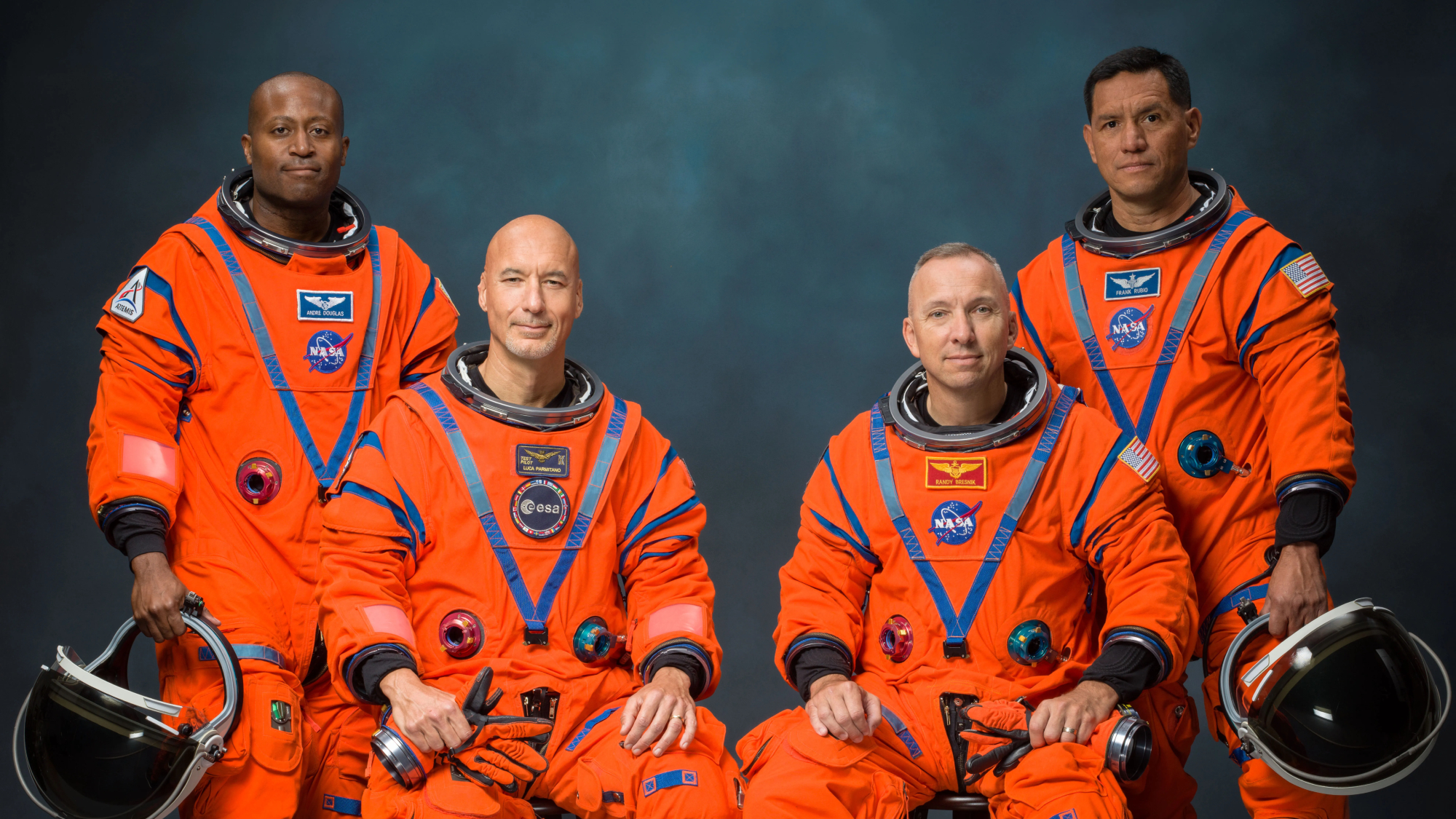
Artemis 3 will be commanded by NASA astronaut Randy Bresnik, with the European Space Agency's Luca Parmitano as pilot. Mission specialists Frank Rubio and Andre Douglas, both of NASA, round out the crew. They will fly Orion's longest crewed flight yet, and move NASA's Artemis program one step closer to returning astronauts to the surface of the moon by 2028.
Here's what we knew before Tuesday's mission update:
NASA planned to launch Orion to orbit to rendezvous and dock with at least one of the commercial lunar lander vehicles contracted for Artemis. SpaceX's Starship, and Blue Origin's Blue Moon lander have each faced development delays, with explosive accidents for both companies occurring within the last year. The agency had previously suggested Orion would fly with whichever lander was ready when the time came to launch the mission, even if that meant leaving one behind.
Now, NASA administrator Jared Isaacman says both landers will fly with Orion on Artemis 3.
"Additional powerful rockets will launch to place the Blue Origin and SpaceX Starship landers into orbit throughout the duration of the Artemis 3 mission," he said during Tuesday's ceremony. Isaacman said NAS will coordinate Artemis 3 with launches of SpaceX's massive Starship rocket and Blue Origin's New Glenn rocket that will launch their respective landers after NASA's Space Launch System (SLS) launches Orion.
"We're not going to launch if we don't feel like we can get enough out of it in order to ensure a follow-on lunar landing is successful," Isaacman said to members of the media afterward. NASA plans to land astronauts on the moon on Artemis 4, sometime in 2028.
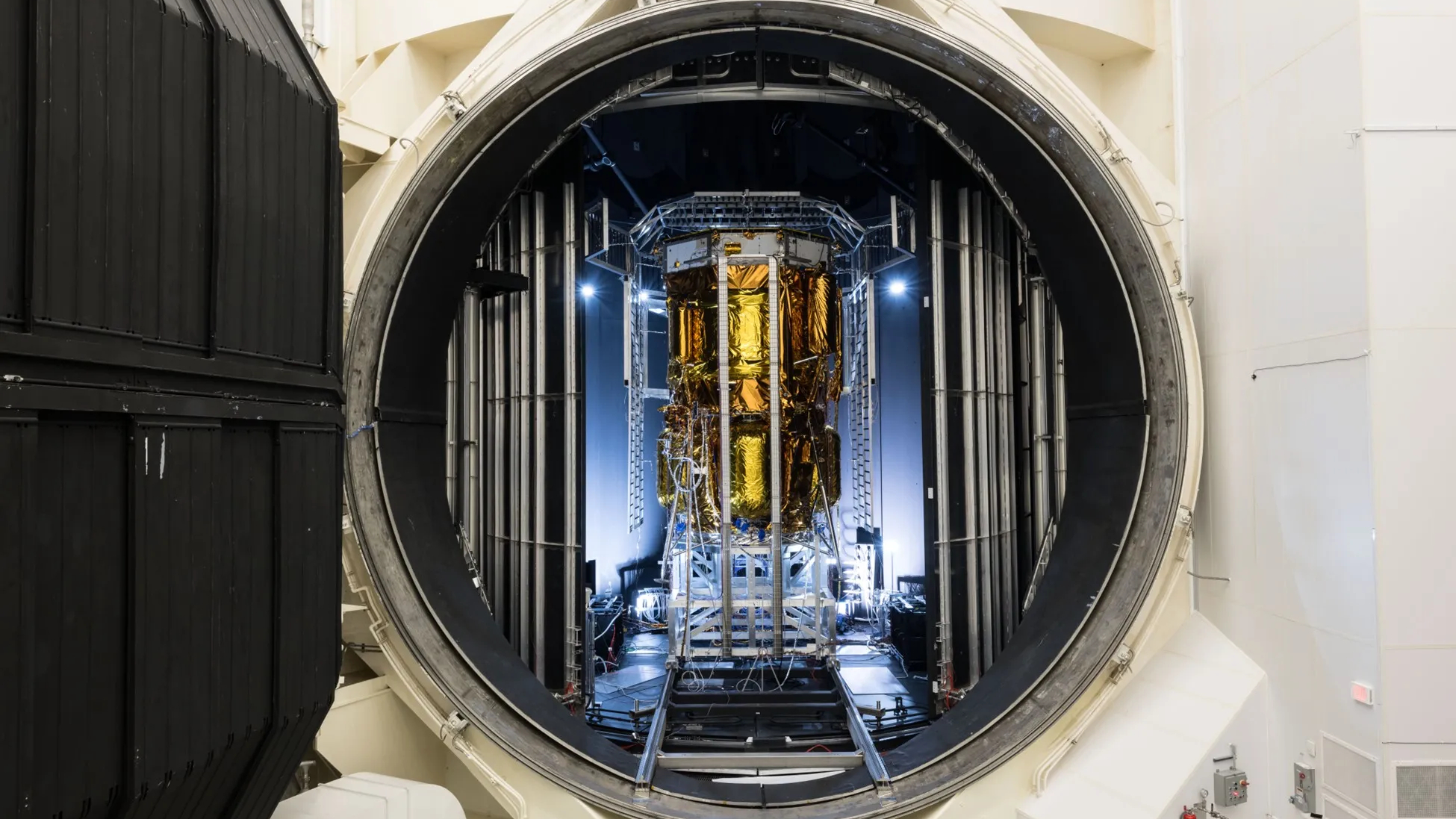
Other new information delivered Tuesday includes an update on the Artemis spacesuits. A spacesuit prototype built by Axiom Space will launch aboard Blue Moon on Artemis 3, and will then be tested out by Artemis 3 astronauts once Orion docks with the lander. That was also a new piece of info — NASA expects Blue Moon to launch with the ability to sustain astronauts onboard.
"On this mission, NASA and Blue Origin will demonstrate rendezvous, docking, hatch operations, ingress, and life support systems in low Earth orbit," said John Coulouris, Blue Origin's senior vice president of lunar permanence, on Tuesday. "This will allow the crew to gain familiarity with our lunar module and practice operations, such as suit donning and zero gravity." Construction of that Blue Moon Mark 2 spacecraft (Mark 1 will be an uncrewed moon lander slated to launch later this year) is well underway, he added.
Starship will apparently only launch with docking hardware, and no crew cabin for the astronauts to enter.
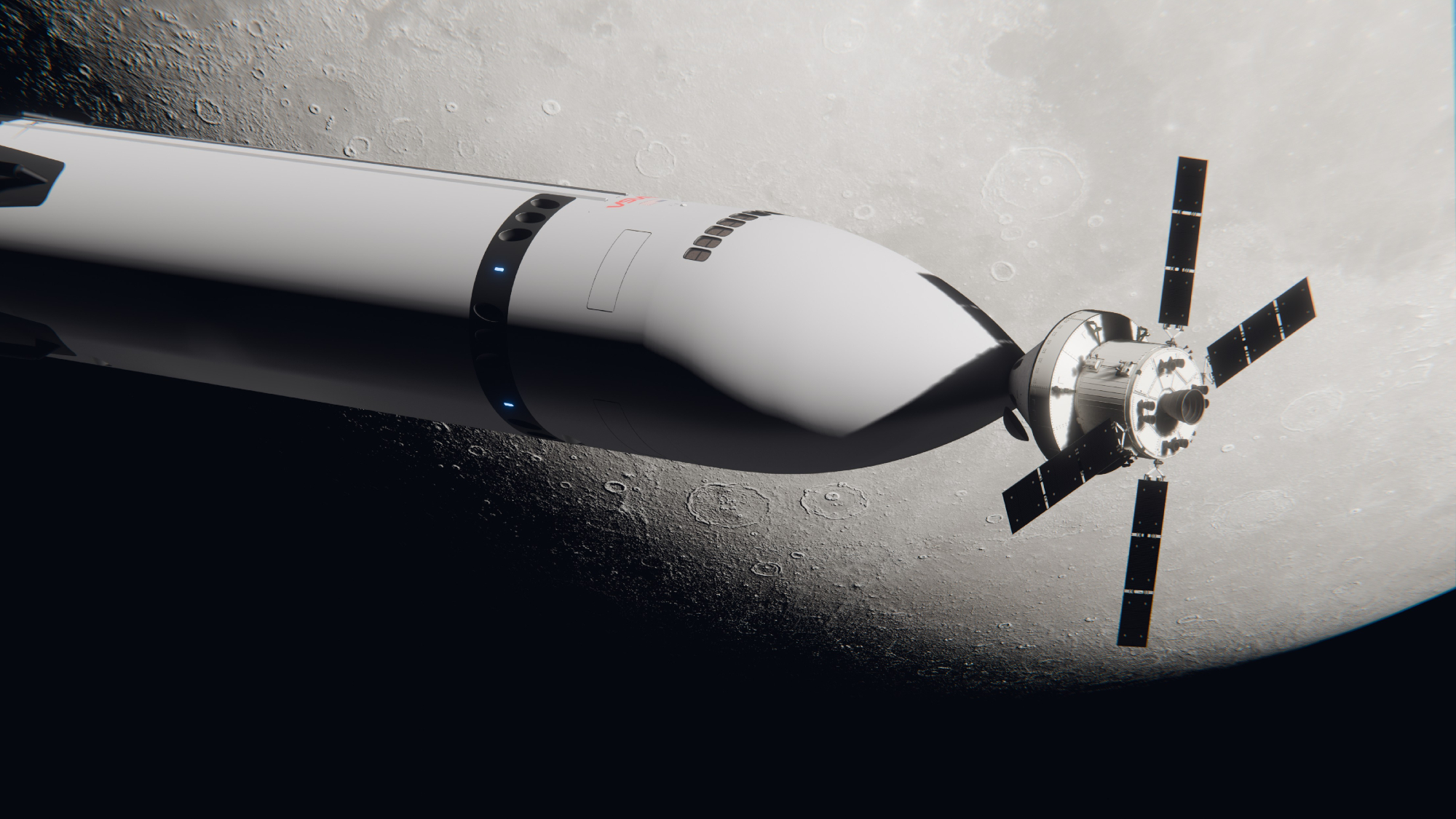
"Next year we'll support Artemis 3 and the planned rendezvous and docking with Orion in low Earth orbit," said Jessica Jensen, SpaceX's vice president of customer operations and intergration. "For that mission, we're going to be using a V3 vehicle off the line with an added docking adapter." V3, or Version 3, is SpaceX's latest Starship design, which the company launched on its first test flight in May.
Jensen said SpaceX aims to launch two Starships to conduct an in-flight refueling demonstration by the end of the year. "We're also actively building our first flight fidelity Starship HLS [Human Landing System] cabin at Starbase," Jensen said. "The primary structure is assembled and prepared to be outfitted with key functional systems like avionics, power, life support systems, and more to come in the next few months." SpaceX unveiled the Starship crew cabin design last year.
Axiom plans to include an Artemis spacesuit in a launch to the International Space Station in 2027, sometime before the Artemis 3 mission, for longer term testing on orbit. The prototype on Artemis 3 will be a "mass simulator" and allow for the testing of hardware interface checkouts, NASA and Axiom officials have said.
The mission timeline was also clarified during the crew announcement ceremony.
"In total, we expect the mission to last around two weeks," Parsons said.
The mission will begin with Blue Origin's launch of the Blue Moon moon lander on a New Glenn rocket. The Artemis 3 crew will launch next and dock their Orion spacecraft with Blue Moon for tests. They'll stay connected for about two days for technology demonstrations and tests inside the new spacecraft.
"After docked operations, Orion will detach and await Starship," Parsons said. "SpaceX's Starship lander test article will launch and meet up with Orion and our crew." They'll stay docked for about a day before the Artemis 3 crew undocks and prepares for landing.
After the end of their two-week orbital stay, Orion will splashdown in the Pacific Ocean for a similar recovery operation that was performed when Artemis 2 astronauts returned from their trip around the moon in April.
"The complexity of our integrated operations across multiple launches, spacecraft, rendezvous, docking, is greater in many ways than Artemis 2," Parsons said. "Human spaceflight is not for those who want to chart an easy course, but every decision we make about Artemis 3 will be informed about how it can help us ensure our mission success for the lunar surface."
View MoreYou must confirm your public display name before commenting
Please logout and then login again, you will then be prompted to enter your display name.
Logout Tariq MalikEditor-in-Chief
Tariq is the award-winning Editor-in-Chief of Space.com and joined the team in 2001. He covers human spaceflight, as well as skywatching and entertainment. He became Space.com's Editor-in-Chief in 2019. Before joining Space.com, Tariq was a staff reporter for The Los Angeles Times covering education and city beats in La Habra, Fullerton and Huntington Beach. He's a recipient of the 2022 Harry Kolcum Award for excellence in space reporting and the 2025 Space Pioneer Award from the National Space Society. He is an Eagle Scout and Space Camp alum with journalism degrees from the USC and NYU. You can find Tariq at Space.com and as the co-host to the This Week In Space podcast on the TWiT network. To see his latest project, you can follow Tariq on Twitter @tariqjmalik.