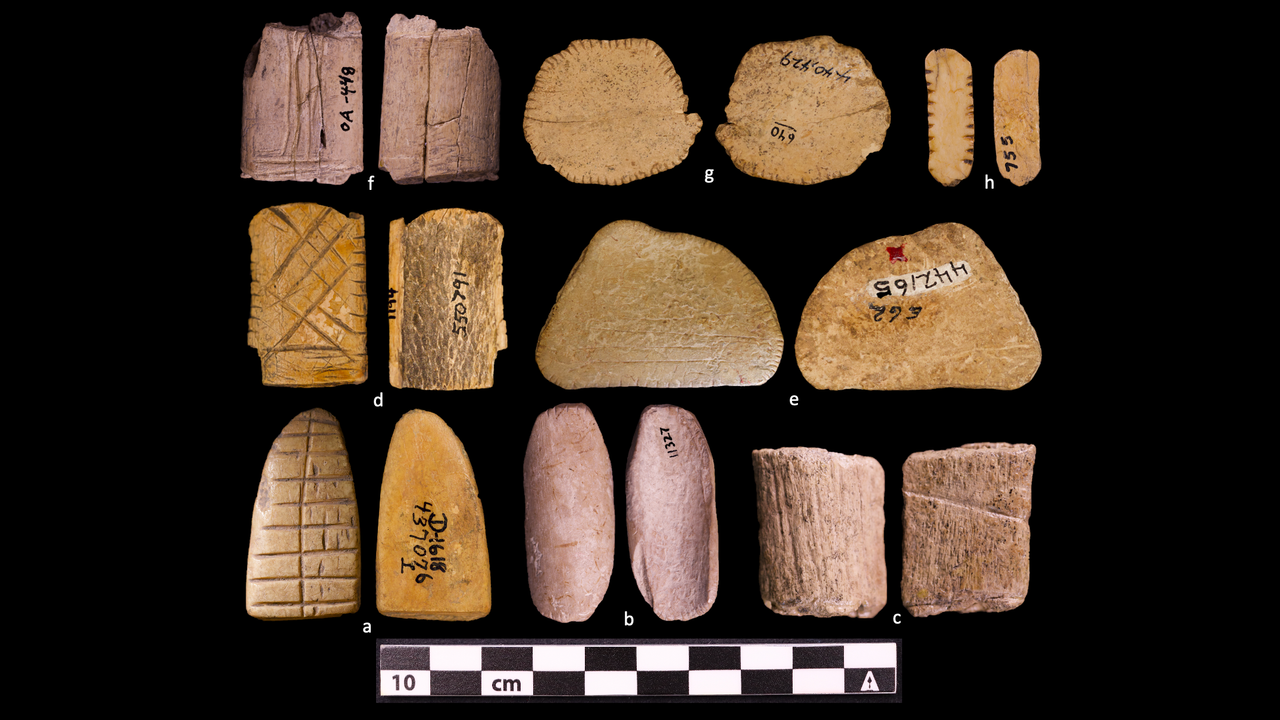
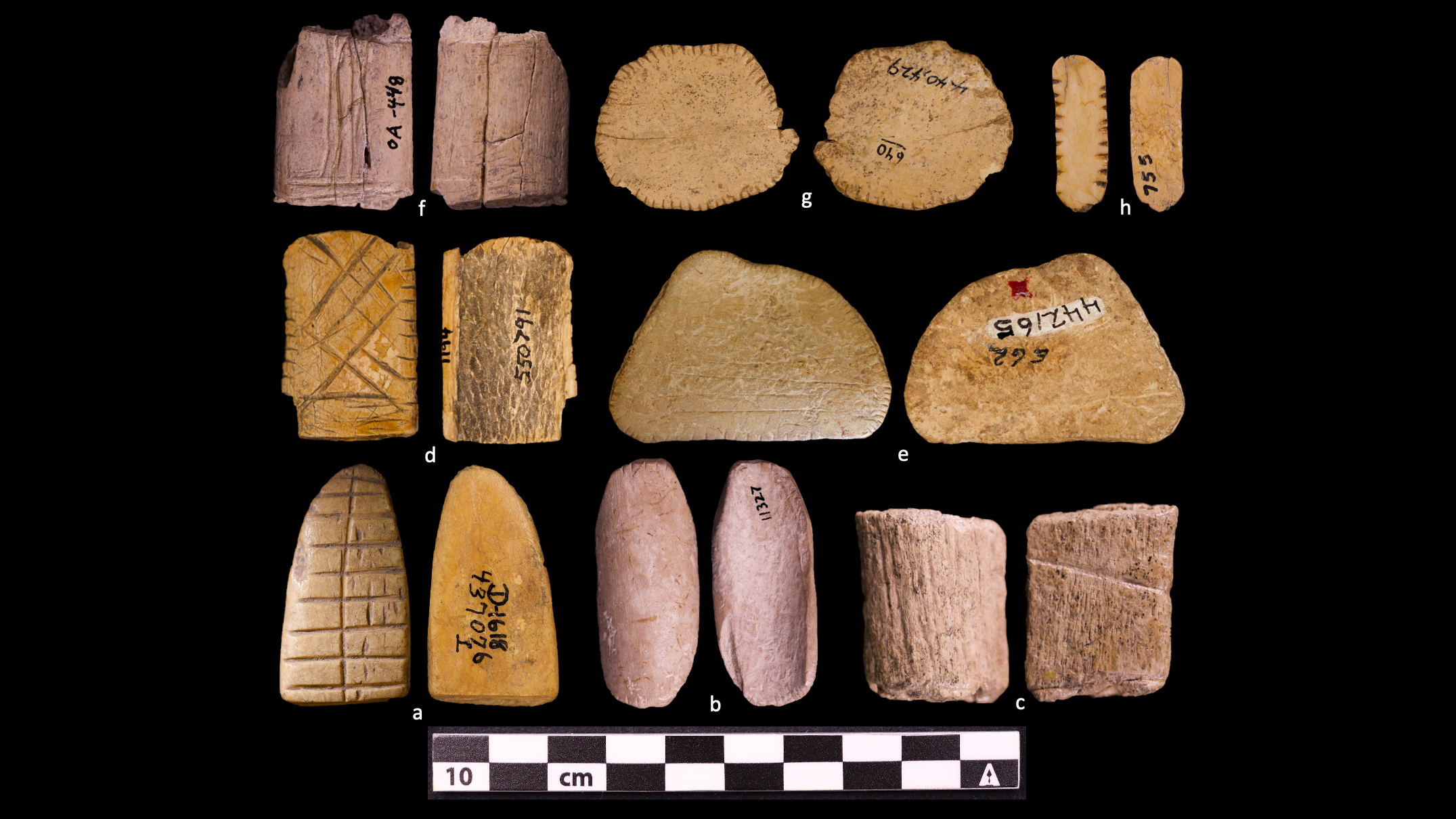
 A series of Native American dice discovered at archaeological sites in the western U.S. (Image credit: Robert Madden) Share this article 0 Join the conversation Follow us Add us as a preferred source on Google Newsletter Sign up for the Live Science daily newsletter now
 Get the world’s most fascinating discoveries delivered straight to your inbox.
Become a Member in Seconds
Unlock instant access to exclusive member features.
Contact me with news and offers from other Future brands Receive email from us on behalf of our trusted partners or sponsors By submitting your information you agree to the Terms & Conditions and Privacy Policy and are aged 16 or over.You are now subscribed
Your newsletter sign-up was successful
Want to add more newsletters?
Join the club
Get full access to premium articles, exclusive features and a growing list of member rewards.
Explore An account already exists for this email address, please log in. Subscribe to our newsletterIndigenous people in the western United States invented dice more than 12,000 years ago, offering archaeologists the world's oldest evidence of gambling and possibly the oldest use of probability, a new study reveals. But the purpose of these games of chance was very different from modern-day gambling, as the games helped people — mostly women, evidence hints — interact with new acquaintances and redistribute goods and wealth.
"There is a deep history of dice, games of chance and gambling in Native America," Robert Madden, an archaeologist at Colorado State University, told Live Science. "This precedes any evidence we have of dice in the Old World by 6,000 years."
"This is the first evidence we have of structured human engagement with the concepts of chance and randomness," Madden said. "We're seeing really complex practices and an intellectual accomplishment here."
To identify the prehistoric dice, Madden first turned to a century-old book called "Games of the North American Indians" by Stewart Culin, an anthropologist who gathered historic accounts of Native American games. Culin described the dice as "binary lots" where one side of the flat or curved object was marked with a specific pattern or color and the other side was blank. Tossing a binary lot and allowing it to fall at random is similar to flipping a coin, and Indigenous people would often toss multiple lots to produce mathematically complicated outcomes.
Using Culin's descriptions, Madden searched archaeological archives for artifacts that could be dice. He found 565 "diagnostic" examples of dice and 94 "probable" examples across 58 archaeological sites in the Great Plains and the Rockies. But there were no dice in the eastern half of the U.S. until after the arrival of Europeans.
"The dice tend to show up in liminal spaces where you have a lot of high mobility," Madden explained. "It might have something to do with how separated these people are and the need to relate to people you don't see very often." That is, dice games may have been invented as a "social technology of integration," he said, or an icebreaker for strangers who wanted to exchange goods, information or mates.
Sign up for the Live Science daily newsletter nowContact me with news and offers from other Future brandsReceive email from us on behalf of our trusted partners or sponsorsThe three earliest dice that Madden discovered came from Folsom culture sites in Wyoming, Colorado and New Mexico dating to nearly 12,900 years ago. These people were hunter-gatherers known for a distinctive stone tool called the Folsom point. "Folsom people liked exotic, beautiful materials," Madden said, and they traveled great distances to source stones like flint and chalcedony (a variety of quartz). Games of chance may have allowed the Folsom people to trade for their preferred stones.
Whereas modern gambling is often undertaken by one person against the "house" — such as using a slot machine at a casino or placing a bet on a horse race — Indigenous gambling was more of a one-to-one, personal interaction, Madden said, where the odds tended toward 50/50 over time and where the stakes were trade items like a set of hides or semiprecious stones.
"It's a kind of leveling device that you see in a lot of cultures with egalitarian social structures," he said.
RELATED STORIES—Lost Indigenous settlements described by Jamestown colonist John Smith finally found
Based on historical accounts of Indigenous gambling, in more than 80% of dice games the participants were exclusively women, Madden said. It is unclear if that figure can be extended into the deep past, but Indigenous "women may have been on the front end of trying to use this social technology to create connections between people," he said.
One of the most significant findings of the study is that the earliest Native American dice predate those found in Eurasia by several thousand years, Madden said. Somewhere around 5,500 to 7,000 years ago, dice showed up in Mesopotamia, the Indus Valley and the western Caucasus. Historians of mathematics often point to the invention of dice as a crucial step in humans' discovery of the random and probabilistic nature of the universe.
"But we see this happening in hunter-gatherer Native American societies in the Late Pleistocene" (126,000 to 11,700 years ago), Madden said. "It shows significant intellectual accomplishment as a social technology" and reveals that the understanding and use of probability may have originated in the New World, he said.
Article SourcesMadden, R.J. (2026). Probability in the Pleistocene: Origins and antiquity of Native American dice, games of chance, and gambling. American Antiquity. http://dx.doi.org/10.1017/aaq.2025.10158
First Americans quiz: How much do you know about the first people to reach the Americas?
See how well you know the first people to reach the Americas with our quiz!
TOPICS Kristina KillgroveStaff writer
Kristina Killgrove is a staff writer at Live Science with a focus on archaeology and paleoanthropology news. Her articles have also appeared in venues such as Forbes, Smithsonian, and Mental Floss. Kristina holds a Ph.D. in biological anthropology and an M.A. in classical archaeology from the University of North Carolina, as well as a B.A. in Latin from the University of Virginia, and she was formerly a university professor and researcher. She has received awards from the Society for American Archaeology and the American Anthropological Association for her science writing.
View MoreYou must confirm your public display name before commenting
Please logout and then login again, you will then be prompted to enter your display name.
Logout LATEST ARTICLES 1Artemis II blasts off: Humans are on their way back to the moon
- 2Astronauts can face 'nearly lethal doses' of solar radiation — so why launch Artemis II during the sun's peak of activity? Space scientist Patricia Reiff explains.
- 3Farting comet seen reversing its spin for the first time ever — and it may soon 'self-destruct'
- 4Extreme wildfires, droughts and storms could happen even under moderate global warming, study finds
- 5Diagnostic dilemma: Teenager's hives turned out to be caused by rare water allergy