Image source, The Quiet Predator by Ali AlobaidlyImage caption,
 The winning image was captured in Jahra Governorate, Kuwait
ByJess WarrenLondon- Published47 minutes ago
The Royal Observatory Greenwich has announced the winner of its Astronomy Photographer of the Year competition for an image of the Shark Nebula.
The dark nebula is made from interstellar dust dense enough to block starlight and is 650 light years away.
Steve Marsh, one of the judges and art editor at BBC Sky at Night Magazine, said the image by Ali Alobaidly showed "flawless presentation, pin-sharp details and dynamic contrast".
He added: "The Shark Nebula is already a striking object, but when it is resolved to the point where even detail-rich distant galaxies can be seen through it, you know you're looking at something very special."
Alobaidly, who won £10,000 for winning the competition overall, said he hoped to use his photographs "to make astronomy more accessible, engaging and meaningful through science communication and education", and described the award as a "tremendous honour".
For the 2026 competition there were almost 4,000 entries from 66 countries.
Alobaidly's entry, taken in Kuwait, was entered in the Stars and Nebulae category.
 Image source, Mineral Moon by Nikolaos StrimpoulisImage caption,
 Mineral Moon by Nikolaos Strimpoulis aged 15 won for ZWO Young Astronomy Photographer of the Year
Nikolaos Strimpoulis, 15, won for ZWO Young Astronomy Photographer of the Year for his image Mineral Moon, taken in Palaio Faliro, Athens, Greece.
The close-up image of the Moon's surface includes dark areas known as maria and bright areas known as the highlands.
The orange and blue colours on the lunar surface are caused by iron and titanium deposits and it was for that reason that the image was given its title.
Marsh said: "Many of us start our astrophotography journey with the Moon – some of us stay there forever! But often we don't delve deep into the subtle colours of its mineral deposits until much later. This amazing young astrophotographer has achieved perfectly developed colouring in this photograph."
Dr Greg Brown, astronomer at the Royal Observatory Greenwich, said the entries from the 18th year of the competition demonstrated "skill and innovation" coupled with improvements in technology.
See more of the winning images:
 Image source, Botswana Star Trail by Stefano PellegriniImage caption,
 Stefano Pellegrini won the Skyscapes category for his entry Botswana Star Trail
 Image source, Saturnian Equinox by Tom WilliamsImage caption,
 Tom Williams won in the Planets, Comets and Asteroids category for his image taken in Trowbridge, Wiltshire
 Image source, A Message from the Ancients by Max InwoodImage caption,
 Max Inwood won in the People and Space category for his image taken in California
 Image source, The Crown by Radoslav SviretsovImage caption,
 Radoslav Sviretsov won the Aurorae category for his image taken of the Northern Lights in Iceland
An exhibition of the winning and highly commended images will be on display at the National Maritime Museum, London from 18 September.
Listen to the best of BBC Radio London on Sounds and follow BBC London on Facebook, external, X, external and Instagram, external. Send your story ideas to [email protected], external
Related topics
Check out some award-winning space snaps that are out of this world!
- Published12 September 2025
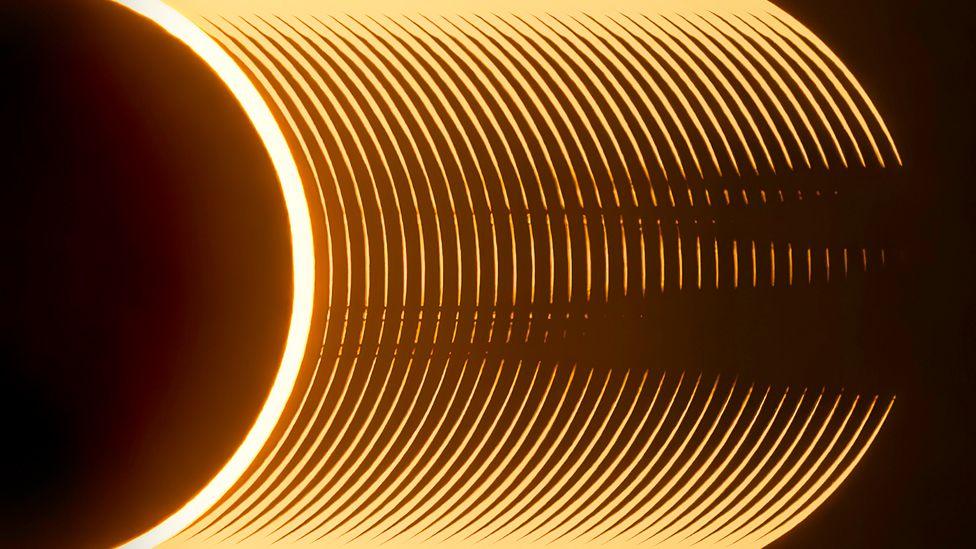
Royal Observatory's photographer of the year won with eclipse image
- Published12 September 2024