Researchers have created a new chip that turns one of quantum computing's biggest frailties into a programmable feature. They say this first-of-its-kind experiment could carry implications for developing error-corrected, fault-tolerant quantum computers in the future.
Unlike digital bits in a classical computer, which are represented as either "on" or "off," a quantum bit (qubit) has a much higher failure rate — roughly 1 in 1,000, compared with 1 in 1 billion for digital bits. That's because quantum computers are susceptible to "noise" — interference that's often cited as the biggest barrier preventing quantum computers from being more capable than the fastest supercomputers.
As engineers develop quantum systems that are large enough in scale to perform useful functions, the amount of noise generally increases. Scientists can combat this noise using various error-correction techniques. But despite recent progress in this field, the challenge of developing a truly fault-tolerant quantum computer remains.
That's because noise comes from various sources, many of which scientists have no control over. These include unpredictable disturbances in Earth's magnetic field, nearby radiation from Wi-Fi routers and other electronic devices, cosmic rays from space, and even neighboring qubits. This unpredictability has made it difficult to study this noise.
But researchers have now devised an experiment that turns the error-correction paradigm on its head. Instead of trying to rid a quantum system of noise, they have created a chip that lets them introduce errors at will so they can examine noise and signal loss in a controlled environment.
In the new study, published May 9 in the journal Nature Communications, the researchers described how this quantum computing chip uses photons captured from laser pulses as qubits. It also has what the researchers called a "side channel" that photons can be diverted to so the team could imitate the losses that occur under normal operating conditions and study them in detail.
"In many quantum experiments, anything that does not fit the ideal textbook picture is simply treated as loss and ignored," Govind Krishna, first author of the study and a doctoral student at the KTH Royal Institute of Technology in Sweden, said in a statement. "The chip enables us to simulate those non‑ideal processes in a controlled way."
(Image credit: David Callahan CC by 0)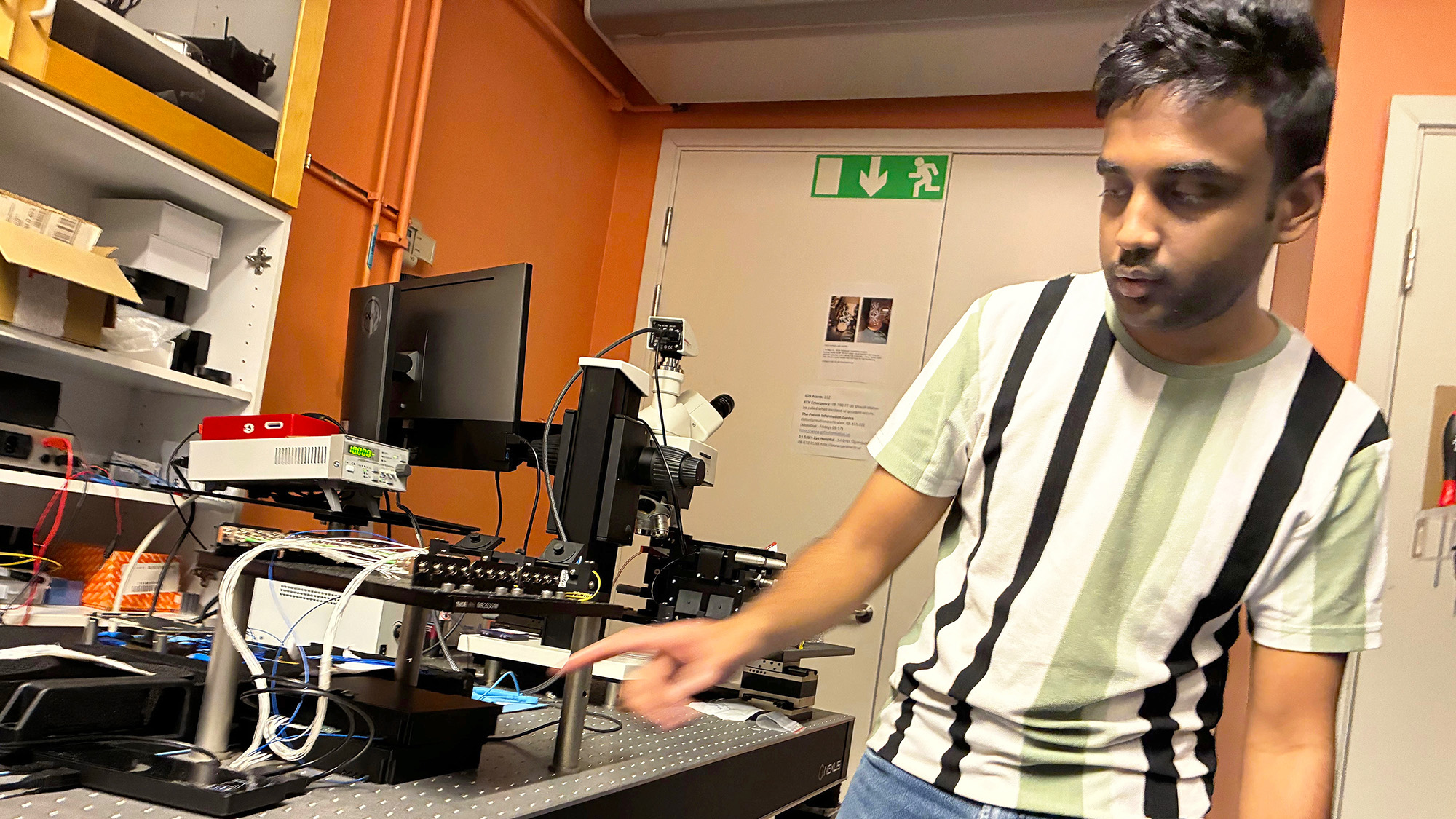
The chip can be programmed to imitate errors in multiple ways, thus making it possible to simulate specific types of loss due to noise. The researchers can essentially modulate the amount of noise the system simulates in order to generate conditions for practical study. They do this by adjusting the number of photons that get sidetracked and the degree of quantum superposition, in which qubits share information over space and time through a process called quantum entanglement.
"The chip works a bit like a programmable railway junction for quantum light," Krishna explained. "By changing the control signals, we can decide whether the photons mostly stay on the main track, are mostly diverted to the loss channel, or end up in superpositions that depend on their quantum interference."
This means the noise itself becomes an asset that scientists can use to further improve quantum computing systems, rather than trying to eliminate it.
Related stories- Microsoft breakthrough could reduce errors in quantum computers by 1,000 times
- Quantum internet inches closer thanks to new chip — it helps beam quantum signals over real-world fiber-optic cables
- Scientists trained an AI model using an IBM quantum computer — and it answered questions correctly that the base model couldn't
According to the study, the novel chip design can model errors in any type of quantum system — even a non-photonic system, like a superconducting qubit-based quantum computer or one designed with neutral atom qubits.
The scientists ultimately want to give researchers more tools to study how noise infiltrates and accumulates in quantum circuits. This could, in theory, lead to a greater understanding of how to perform more effective error-correction techniques in future systems, especially as those systems scale and interact with their environment even more.
"Understanding how quantum systems behave under this messiness is crucial if we want our experiments to say something about nature as it really is, not just idealized setups," Krishna said.