
Good morning, and welcome to our rolling coverage of business, the financial markets, and the world economy.
The peace deal agreed between Iran and the US is sending a wave of relief through the markets today.
Oil has tumbled 4%, and markets across the Asia-Pacific region have jumped, as investors anticipate the reopening of the strait of Hormuz.
Oil prices tumble amid hopes strait of Hormuz will soon reopenRead moreAlthough it is unclear exactly what has been agreed – with the final text of their memorandum of understanding unpublished - Donald Trump’s claim that “oil will flow on both ends again for the region, and the world” is pushing down energy prices – a relief for busineses, consumers, politicians and central bankers alike.
Brent crude has fallen as low as $83.04, its lowest since 10 March, after the prime minister of Pakistan announced the US and Iran will sign a memorandum of understanding in Switzerland on Friday.
That still leaves Brent above its pre-war price of $72.48 a barrel, though.
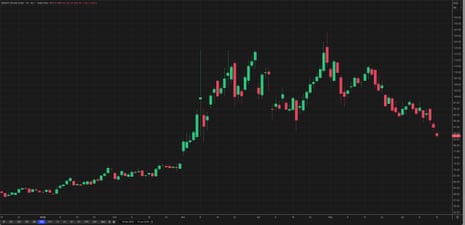 A chart showing the Brent crude oil price Photograph: LSEG
Trump has indicated that the opening of the strait is contingent upon the signing of the peace deal, scheduled for Friday.
Iran’s Mehr state news, though, reported that the agreed memorandum of understanding calls for the reopening of the strait within 30 days under “Iranian arrangements” – an indication that Tehran hasn’t surrendered its control of the waterway.
Chris Weston of IG points out that there are still obstacles to overcome:
double quotation markThe probable reopening of the Strait of Hormuz later this week would represent a significant positive development. Markets had increasingly questioned how long inventory draws could offset supply disruptions and whether physical dislocations would begin weighing more heavily on risk assets. The focus now shifts towards understanding what normalisation of logistics could realistically look like, and how quickly shipping volumes can return to pre-conflict levels of 120 to 140 commercial vessels transiting eastbound and westbound each day.
There are still obstacles to overcome. Mines may need to be cleared, and there may be structural damage to refineries and export facilities around the region that will take time to repair and come back to pre-conflict capacity.
The agenda
-
10am BST: Eurozone trade balance for April
-
1.30pm BST: NY Empire State Manufacturing Index