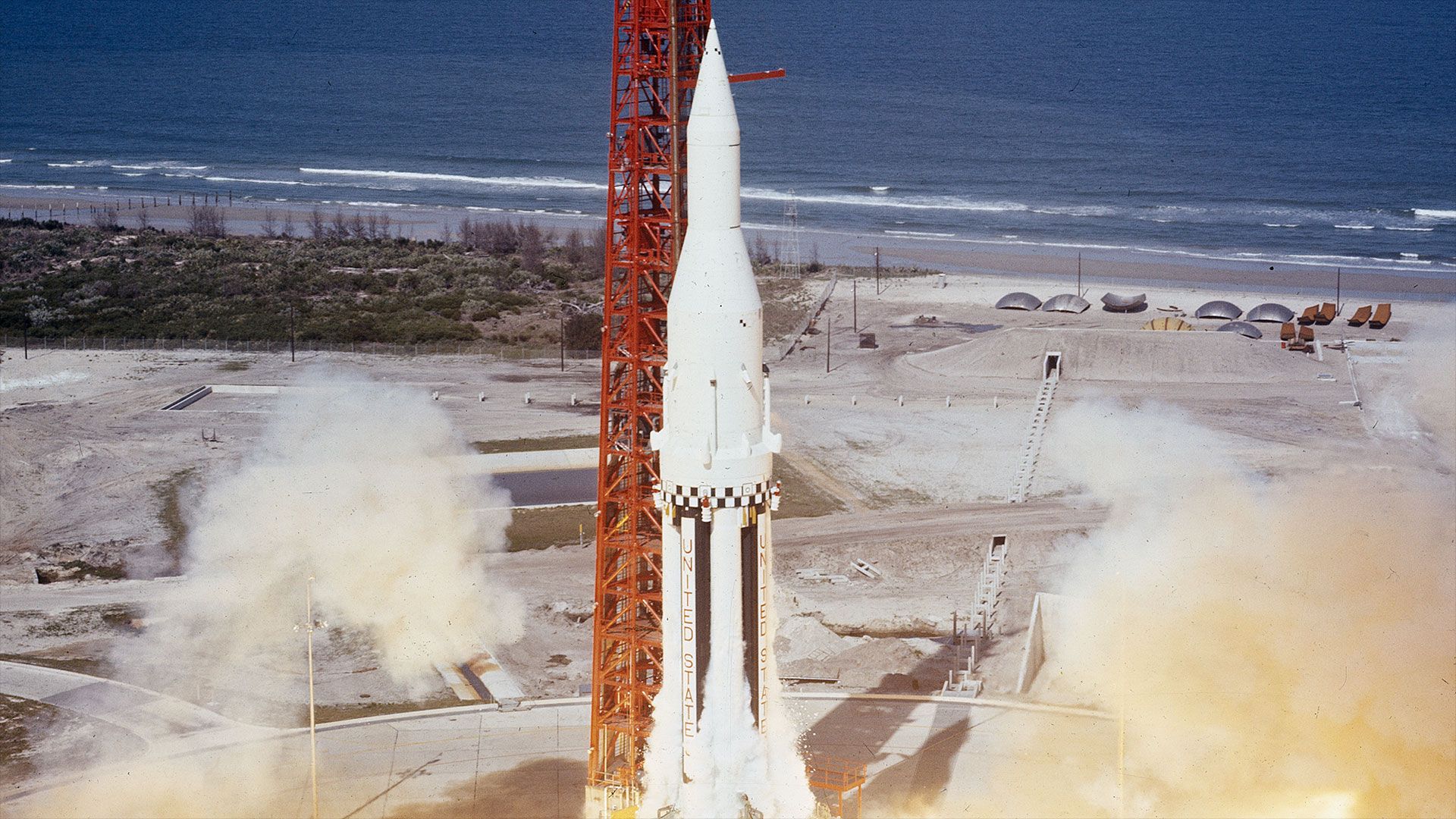
On Nov. 9, 1967, NASA launched the powerful new Saturn V rocket on its maiden voyage.
The Saturn V moon rocket was 363 feet tall. That's taller than the Statue of Liberty! It was the biggest and most powerful rocket ever built at the time (though SpaceX's Starship megarocket has since surpassed it). NASA needed such a powerful rocket to launch astronauts to the moon. However, the first Saturn V launch didn't carry astronauts, because it was only a test flight.
During the launch, the rocket created a loud shockwave that surprised nearby observers. The ground shook so hard that it rattled buildings miles away, and all the shaking caused a huge shower of dust and debris NASA's new launch center, the Kennedy Space Center in Florida.
The mission lasted 8 hours 36 minutes. The rocket carried an uncrewed command module that splashed down in the Pacific Ocean.
Why it mattered
The launch of Apollo 4 in November 1967 was a turning point for NASA on its path to landing astronauts on the moon.
The space agency had bet the moon on its new Saturn V booster, a three-stage heavy-lift rocket designed to fly astronauts in a capsule (as well as their lander) to the moon and back. But the rocket had never been fully tested until the Apollo 4 launch.
NASA also needed a new launch site for its Apollo missions. So the agency built Launch Complex 39 at what is now called the Kennedy Space Center, a Florida spaceport that has become the home port for orbital human spaceflight in the United States. But in 1967, no rockets had ever flown from the site. Yet, everything went according to plan.
“It was really an expert launching all the way through from lifting off exactly on time to performance of every single stage,” rocket pioneer Wernher von Braun, director of NASA’s Marshall Space Flight Center in Huntsville, Alabama, said at the time.
The launch came as NASA was on its heels.
Just months earlier, on Jan. 27, 1967, the space agency suffered a fatal tragedy when Apollo 1 astronauts Gus Grissom, Ed White and Roger Chaffee died on the launch pad after a fire broke out inside their Apollo command module during a ground test.
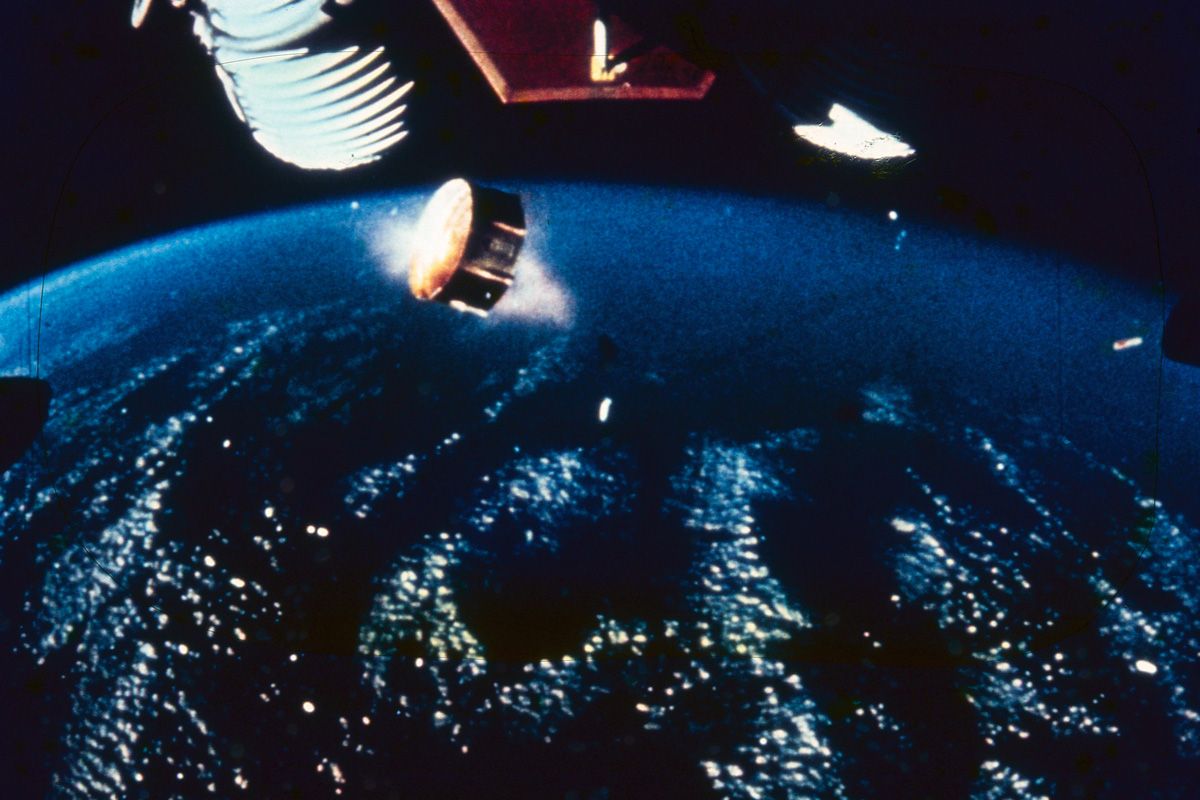 A view of the Apollo 4 launch after stage separation looking back down at Earth from the Saturn V rocket. NASA/Interm Archives/Getty
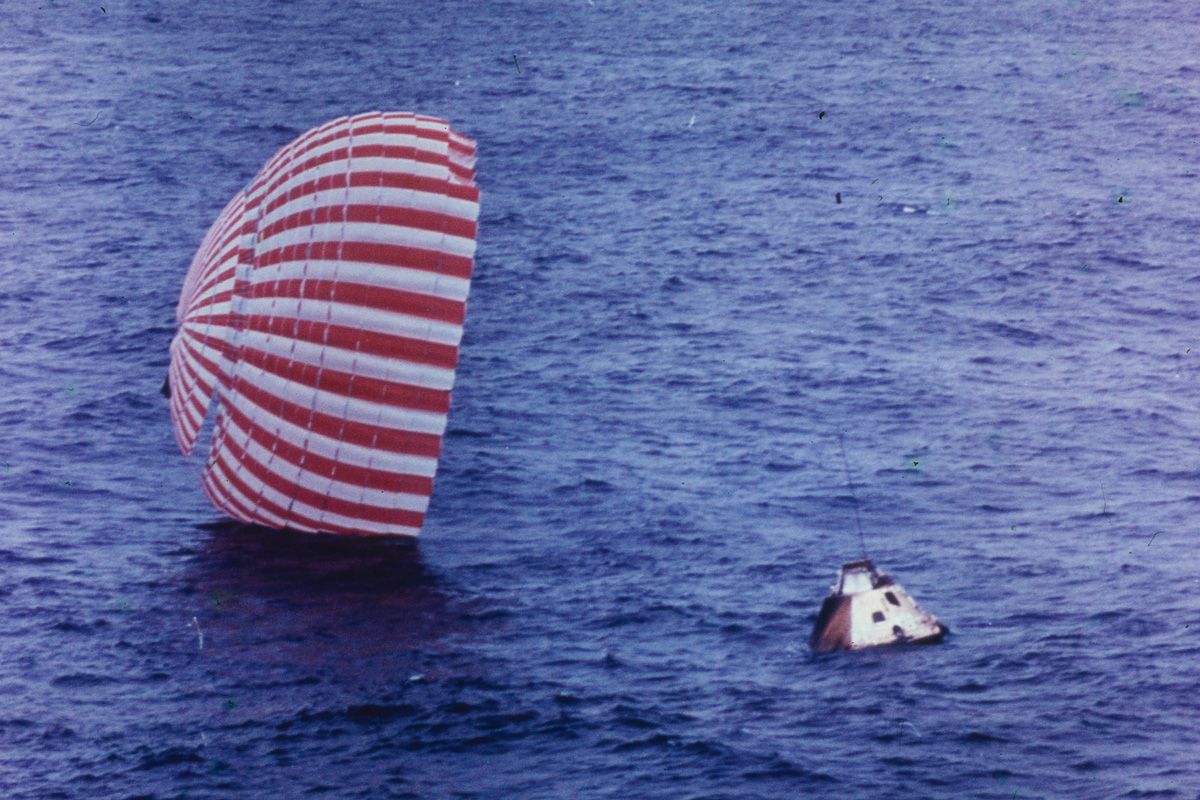 The uncrewed Apollo 4 command module splashes down under parachutes after a smooth test flight.NASA/Interm Archives/Getty
“The maiden voyage of the Saturn V dramatically increased the confidence of people across the nation in the management of the largest research and development undertaking in which the western world has ever engaged,” George Mueller, NASA's then-Associate Administrator for Manned Space Flight, said at the time.
One year later, another Saturn V rocket launched the first astronauts to the moon with the Apollo 8 mission. All of the Apollo missions that followed also launched on Saturn V rockets.
Just two years after its debut, the Saturn V rocket launched the Apollo 11 astronauts to the moon for the first crewed moon landing in July 1969.
Want more space history? Check out our full On This Day In Space Story archive and watch our On This Day In Space videos on YouTube.