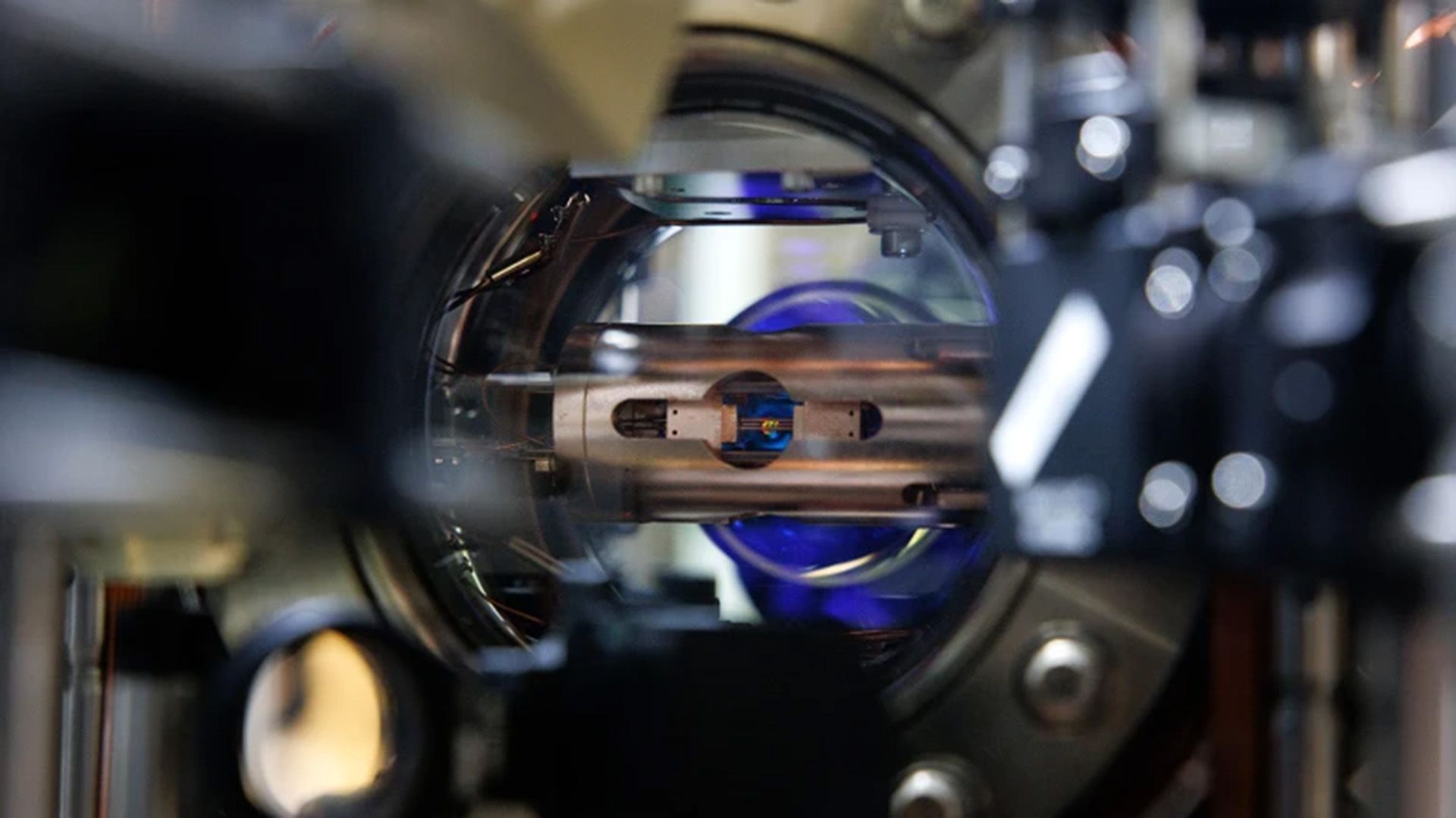
Scientists have created the most accurate atomic clock ever made — and it could literally redefine the second.
Researchers recently unveiled the record-breaking device, which uses the vibration of atoms of an element called lutetium to precisely measure each microsecond. It is accurate up to 19 decimal places — a 41% improvement over the previous record holder. The results were published Sept. 23 in the journal Nature.
Atomic clocks have been around since the 1950s. The first atomic clocks were made with the radioactive isotopes of the element cesium, a silvery metal that quickly became the gold standard for timekeeping. The International Bureau of Weights and Measures (BIPM) revised its definition of the second in 1968 to one based on the radiation emitted from cesium-133. Officially, 9.19 billion vibrations of a cesium-133 atom mark one second. (Prior to this, a second was defined as 1/31,556,925 of the length of the solar year 1900.)
Cesium clocks helped standardize the second into something equally useful for both scientific and everyday timekeeping. Since the 1960s, other radioactive metals, including ytterbium and strontium, have been used to make atomic clocks. Today, they are the cornerstone for systems such as GPS, the internet and military technology.
But even modern, ultraprecise atomic clocks have limitations. For example, they are affected by minuscule fluctuations in temperature, magnetic fields and gravity. According to the researchers, the newly developed clock largely sidesteps those issues.
Physicists at the National University of Singapore inspect their super-accurate atomic clock in the lab. (Image credit: Centre for Quantum Technologies, National University of Singapore)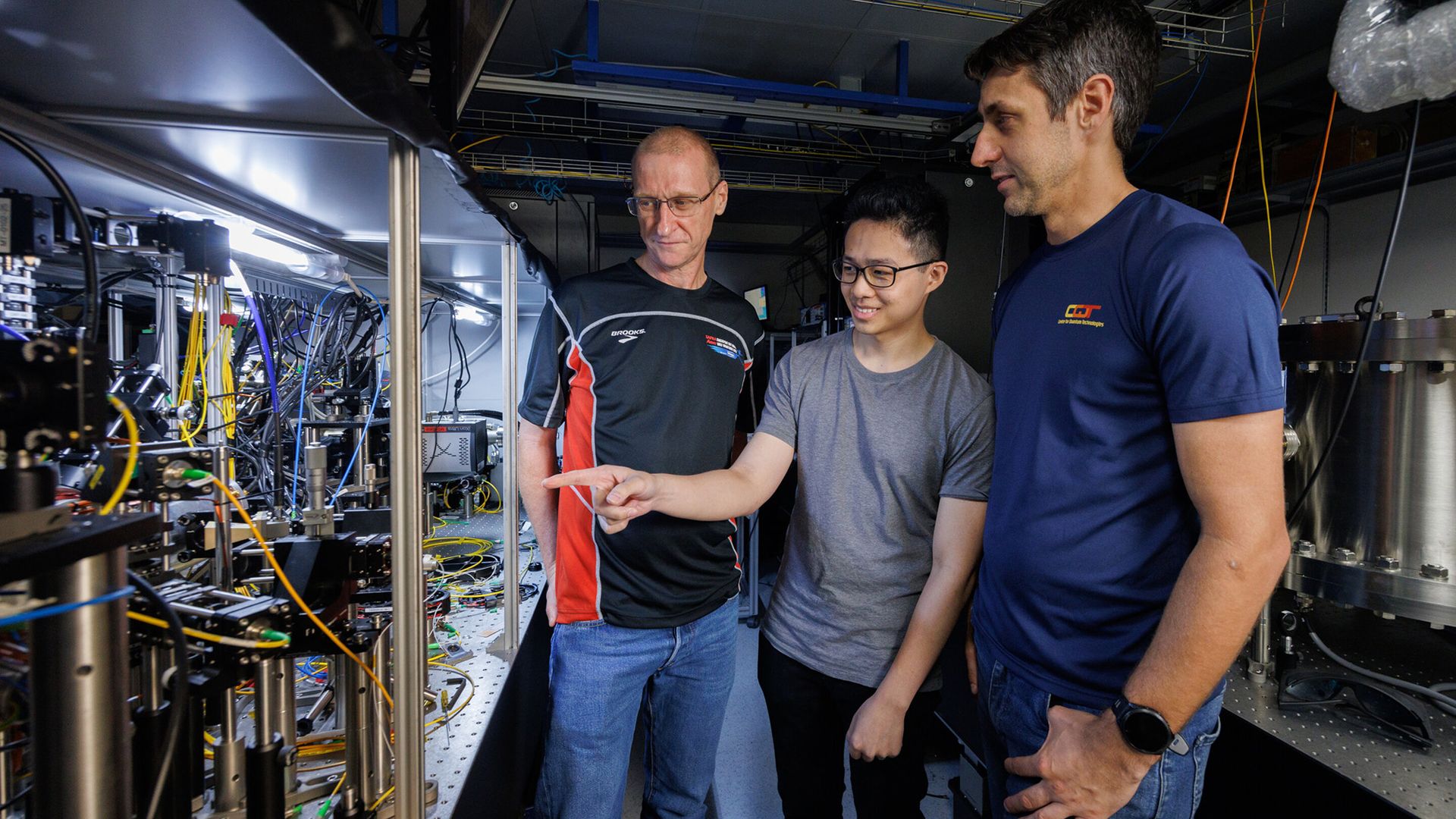
To understand the challenge, imagine precise timekeeping as an ultramarathon and the clock's core elemental isotope as a runner, said study co-author Murray Barrett, a physicist at the National University of Singapore. "Our job is to make sure the runner can go the distance. Lutetium, as it turns out, is a natural born endurance athlete," he told Live Science in an email.
Related stories- Physicists create groundbreaking atomic clock that's off by less than 1 second every 100 million years
- The world's first nuclear clock just ticked on — and it could help detect a fifth fundamental force of physics
- Ultraprecise atomic clock experiments confirm Einstein's predictions about time
Unlike previous atomic clocks, the team's lutetium-176 clock is not very sensitive to external factors, especially magnetic fields and temperature. Whereas other elements might need environmental temperatures calibrated within a few thousandths of a degree, lutetium-176 keeps ticking even with a 5-degree external temperature swing. Barrett's lab also developed a technique called hyperfine averaging to dull the most important environmental effects, like gravitational fields, leaving very little variation in timekeeping.
Such a sensitive atomic clock could become the International System of Units' – a.k.a., the metric system – new gold standard, the team said. The BIPM is expected to redefine the second in 2030 based on modern atomic clock technology. So far, lutetium seems to be the front-runner for accuracy.
The new atomic clock could also help scientists understand something even more basic about the universe: whether the constants at the foundation of physics, such as G, the gravitational constant, are as constant as we think. "There is some speculation that fundamental constants may actually be changing," Barrett said. "So ultra-precise clocks give us the tools to explore that."