

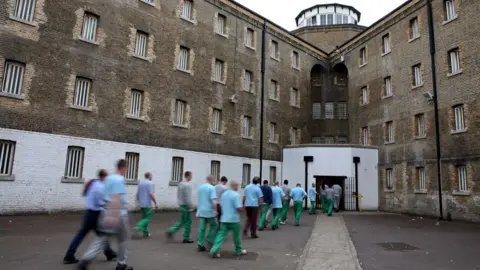
 Corbis via Getty ImagesIt is hoped the reforms will ease pressure on prisons
Most offenders in England and Wales who would have faced up to a year in jail are likely to receive no more than a suspended sentence from Monday, under one of the most significant changes to jail terms in decades.
Under the reform, courts must stop handing out such short prison terms other than in a number of specific or exceptional circumstances.
MPs passed the measure as part of the government's plan to end the population crisis in prisons - with rehabilitation experts saying there's no evidence short jail terms work.
Monday's reforms also include allowing judges to suspend jail sentences of up to three years - another measure which will slow down the rate at which criminals enter jails.
The Sentencing Act 2026, passed in January, is a wide-ranging package of measures which ministers hope will ease overcrowding in jails - but also lead to better rehabilitation.
The new suspended sentences rule applies to offenders who are convicted from Monday - meaning that anyone who has been waiting to be sentenced after being found guilty earlier than this week, will not benefit from the reform.
Government statistics indicate there are more than 6,000 people in jail serving sentences of up to a year at any one time.
These offenders are the most likely to leave prison and commit another crime, according to analysis - and many rehabilitation campaigners say it would be cheaper and more effective to try to turn around the lives of these people in the community.
That was supported by David Gauke, the former Conservative justice secretary who reviewed sentences for the Labour government and made wide-ranging recommendations on how to ease the prisons crisis.
Violence, overcrowding, self-harm: BBC goes inside one of Britain’s most dangerous prisons
Violent criminals could be released early and chemical castration pilot expanded after review
Scottish ministers urged to rethink jail sentences of less than two years
During the Bill's progress through Parliament, the Conservatives said that it would lead to fewer criminals serving jail time - although the government said many of its measures were a consequence of inheriting a prison system "bursting at the seams".
A Ministry of Justice spokesperson said that the measures would not abolish short sentences and would "make sure prisons never run out of space again, while strengthening the supervision of the most dangerous offenders."
Riel Karmy-Jones KC, chair of the Criminal Bar Association, said the reforms would make an almost immediate impact, including on court backlogs because they would encourage defendants to plead earlier.
"The pressure on prisons will be lessened, with more places available for those serving longer terms, especially violent and sexual offences, together with providing them with the additional rehabilitation services.
"This is an important measure, as it will help to prevent them from reoffending when finally released, ultimately providing the best protection for the public."
The legislation does not define what would count as exceptional circumstances for a court to jail an offender - leaving that for magistrates or a judge to decide.
An associated change to bail rules means that defendants who are likely to receive a suspended sentence, if later convicted, will be less likely to be held in jail on remand ahead of a trial.
At present more than 16,000 people are being detained on remand - about a fifth of the total jail population.
Another measure coming into force allows a court to defer passing a sentence for up to 12 months - double the current permissible delay - where it thinks it will give an offender time to address problems in their life at the heart of their criminality - such as drug addiction.


