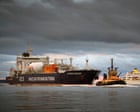
 An Ineos ship bringing the first shale gas from the US arrives in the Firth of Forth in 2016. Photograph: Jeff J Mitchell/Getty ImagesAn Ineos ship bringing the first shale gas from the US arrives in the Firth of Forth in 2016. Photograph: Jeff J Mitchell/Getty ImagesRevealed: how a UK firm is spearheading growth in trade of US fracked ethane
Ineos is driving exports with potentially far-reaching environmental and social repercussions
“My children started getting sick,” says Lois Bower-Bjornson, a campaigner at the Clean Air Council in Washington County, Pennsylvania.
“My oldest son had rashes all over his body. His ears, his eyelids, everywhere. My youngest had terrible nosebleeds, it was so bad that he became anaemic and would almost pass out. He would wake up bleeding.”
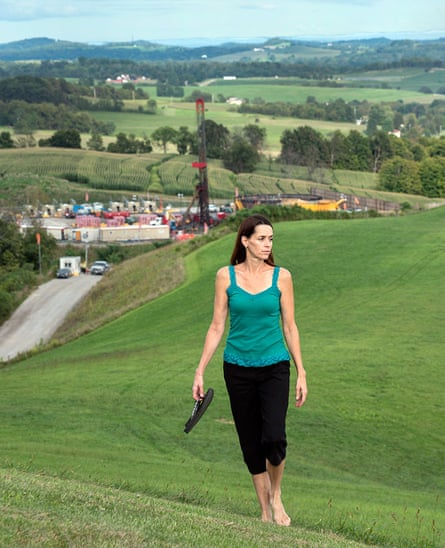 Lois Bower-Bjornson near a fracking well pad 300 metres from her house. Photograph: Scott Goldsmith
Bower-Bjornson blames her children’s health problems on the 36 fracking wells that surround her property in the greater Appalachian region of the US. She also places some of the responsibility on Ineos, a British company privately owned by British billionaire Sir Jim Ratcliffe, the co-owner of Premier League football club Manchester United. New analysis has revealed that Ineos is spearheading growth in the US fracked ethane trade to produce plastic that is used in consumer items in Europe, with potentially far-reaching environmental and social repercussions.
Fracking has been banned across much of Europe due to its environmental impacts and links to seismic activity but European countries can still purchase fracked gas from elsewhere. Tensions have risen recently in Europe over a controversial Ineos development in Belgium, which will use fracked gas from the US. The project has received financial backing from the British government and campaigners argue it could harm communities and the environment along the whole supply chain.
Fracking involves cracking layers of earth with pressurised, chemical-laden liquid to access stores of oil and gas thousands of feet underground. Some of the gas produced as a co-product during fracking is ethane. Ethane is a colourless gas at room temperature, primarily used to make ethylene, the building block for most of the world’s plastics.
Extracting oil and gas through fracking has expanded rapidly across the US over the past two decades, with growing concerns about its impact on the global climate crisis as well as human and environmental health in extraction project areas. Washington County is one of the most heavily fracked counties in Pennsylvania. Located above the rich Marcellus shale formation, in 2023 it had 6,075 gas wells within 861 square miles.
Ineos has a longstanding presence in the region, holding a 15-year deal with US gas company Range Resources, which supplies the British company with the fracked gas.
‘A growing and polluting ethane trade’
In 2016, Ineos completed a $2bn “virtual pipeline” of eight vessels, known in the industry as “dragon ships”, which transport fracked ethane gas across the Atlantic Ocean to Ineos’s European petrochemical facilities.
Data analysed by the Center for International Environmental Law (CIEL) shows that since the completion of this route in 2016, the volume of ethane shipped by or for Ineos has grown roughly 7.3-fold, with almost consistent year-on-year growth. The total volumes shipped by or for the company grew from 429 kilotonnes in 2016 to 3,130 kilotonnes in 2025.
As of 2024, the most recent year for which global data is available, US ethane exports were more than four times the rest of the world combined. According to CIEL’s analysis, Ineos is responsible for at least two-thirds of all ethane exports from the US. This has led CIEL to conclude that Ineos is the main company behind this rapidly growing global trade in US fracked ethane gas.
“For the first time, new data reveals the true extent of Ineos’s ethane supply chain. The petrochemical giant has operated a growing and polluting ethane trade,” said Steven Feit, senior attorney and legal and research manager at CIEL.
Between March 2016 and November 2025, CIEL identified 790 shipments of US-sourced ethane on Ineos-branded vessels, with the majority of these going to either Rafnes in Norway or Grangemouth in Scotland. Both ports are home to major Ineos petrochemical facilities.
CIEL says this growing ethane trade falls between industry regulations, as while fracking is banned in Europe, fracked gas can still be imported and used in European facilities. CIEL says that Ineos’s controversial Project One development in Antwerp, Belgium, is a key example of this.
 Ineos owner Jim Ratcliffe at a Manchester United match in 2024. Photograph: Tom Jenkins/The Guardian
If built, Project One will be Europe’s largest plastic factory. Ineos has said it intends to use a selection of US suppliers to provide the plant with the necessary fracked ethane gas.
Ineos told the Guardian it does not own or operate any wells in Pennsylvania and that the ethane it ships comes from “many independent producers”.
It said: “When Project One comes on stream, it will require approximately two million tonnes of ethane annually, equivalent to just 3% of US ethane production […] the idea that Project One is driving that industry is simply not credible.”
It added that “natural gas production [in the US] does not depend on Ineos buying that ethane”.
Bower-Bjornson travelled to Antwerp last year to share with local politicians her concerns over the effects the plant might have on the health of residents in Washington County.
Research has found that children who lived within one mile of a fracking well had approximately five to seven times the chance of developing lymphoma, a relatively rare type of cancer, compared with children who lived in a place with no wells within five miles. However, it is not possible to know if one person’s cancer or ill health is linked to the pollution from fracking.
An Ineos spokesperson said: “We take the concerns of people living near natural gas production seriously.” It added that the study, which does not mention Ineos by name, “examined associations, not causes”.
In 2020, a grand jury criticised the US government for failing to protect residents in Pennsylvania from the harmful health effects of fracking. The then attorney general, Josh Shapiro, stated that there is a “profound gap between our constitutional mandate for clean air and pure water, and the realities facing Pennsylvanians who live in the shadow of fracking giants”.
The jury recommended the authorities conduct an investigation into the health impacts of living near fracking sites, but Bower-Bjornson says this is yet to happen.
Upstream emissions
Environmental law firm ClientEarth, along with 14 other NGOs, is taking legal action against Ineos over Project One. A key argument is that the firm’s environmental impact assessment has failed to calculate the impact of the upstream emissions from the fracked ethane gas, such as those produced in Pennsylvania.
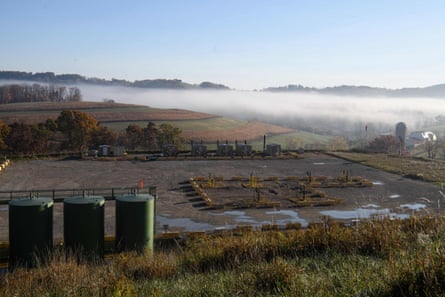 A fracking facility in Washington County, which is one of the most heavily fracked counties in Pennsylvania because of its location above the Marcellus shale formation. Photograph: Nicholas Kamm/AFP/Getty Images
Since the legal battle began in 2020, courts around the world have clarified that so-called scope 3 emissions should be included in environmental impact assessments. These are emissions that do not happen on site but would not be released if the facility did not exist. This week, the issue over scope 3 emissions at Project One was escalated to the EU’s highest court, with the court asked to clarify whether Ineos needed to quantify its full climate impact when it applied for a permit to build and operate.
“Ineos has not accounted for the fracked gas that [Project One] will depend on, painting a downright inaccurate picture of the climate damage it would cause. In the face of this increasingly strong case law all around the world, that puts it on shaky ground,” said ClientEarth lawyer Gautier Rolland.
Feit accused Ineos of “hiding the true environmental footprint of its entire supply chain”. The organisation said the emissions associated with the fracked ethane supply are “glaringly absent from the company’s public documents”.
An Ineos spokesperson said the environmental assessment for Project One has been updated and “subjected to extensive regulatory scrutiny. We remain committed to defending the project and its environmental performance on the evidence”.
The UK government has given substantial backing to Project One with a €700m bank guarantee.
A spokesperson from UK Export Finance, a government department that has provided Ineos with a guarantee to allow a bank to then provide them with a loan, said: “Our financing guarantee for Project One creates new export opportunities for British businesses and supports UK jobs, while remaining consistent with our commitment to the global transition to net zero.”
However, Rolland says the government’s backing of this project is “highly problematic” as it is based on “environmental claims from Ineos that are, from our legal analysis, incomplete”.
“The financial guarantee has helped enable a vast, fossil fuel-fed project that would produce the ingredients for plastics on a huge scale. It’s people that will pay the price for this project, from communities affected by fracked gas extraction in the US to those faced with air, soil and water pollution in Belgium and in the Netherlands,” Rolland added.
CIEL also says this guarantee reveals “deep contradictions” between the UK’s policy of ending overseas fossil fuel finance and backing a project that runs on fossil-fuel-derived raw materials – imported ethane, sourced largely from US gas fracking operations.
“Ineos has been marketing its Project One plant as the most sustainable investment in the European chemical industry, but the project’s low-carbon claims overlook significant upstream emissions and health risks borne by frontline communities,” said Feit.
CIEL is calling on EU policymakers and state backers to implement measures that better protect people and planet, including mandating independent lifecycle emissions reporting for imported petrochemical raw materials such as ethane.
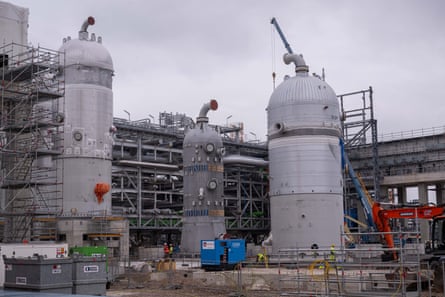 The Ineos Project One site under construction in Antwerp last year. Photograph: Jonas Roosens/BELGA MAG/AFP/Getty Images
A spokesperson for Ineos said: “We have invested heavily in the ships, terminals and infrastructure needed to bring ethane to Europe, helping protect thousands of skilled manufacturing jobs. We turn that ethane into materials the world cannot do without. Medical equipment, pharmaceuticals, pipes that deliver clean drinking water, food packaging, construction materials, transport and renewable energy, all depend on these products. They are not optional.
“Ineos takes the health and safety of its employees and neighbouring communities extremely seriously. We operate under strict environmental regulations and invest heavily in making our facilities safe, clean and efficient. Protecting people and the environment is fundamental to our business and our licence to operate.”
It added that “closing European chemical plants will not stop the world needing essential chemicals. It will simply move factories, skilled jobs and potentially higher emissions to other countries”.
Bower-Bjornson said: “People in Pennsylvania are paying for the cost of this industry. From the impact on our health, on our land and on our air, we don’t get anything from it.”
Explore more on these topicsShareReuse this content