
In what could be a groundbreaking discovery, scientists report they may have detected the first direct evidence of dark matter. The potential detection came from the LUX-ZEPLIN experiment, in the form of a single suspected interaction between a Weakly Interacting Massive Particle (WIMP), one of the leading hypothetical particle candidates for dark matter, and an everyday particle. Dark matter has been a headache for scientists because, despite accounting for 85% of the mass in the universe, scientists have no idea what it is. The fact that dark matter doesn't interact with electromagnetic radiation, or light, means that it can't be composed of electrons, protons, and neutrons, the particles that make up the atoms that compose stars, planets, moons, our bodies, and everything we see around us on a day-to-day basis.
This has spurred on the search for new types of particles beyond the limits of the so-called Standard Model of Particle Physics. So far, this search has been frustratingly fruitless — but the LUX-ZEPLIN experiment may have finally caught a glimpse.
An analysis of data from LUZ-ZEPLIN, a detector composed of 10 tons of ultrapure liquid xenon, one mile underground at the Sanford Underground Research Facility (SURF) in South Dakota, showed a single particle interaction that scientists can't explain with known background signals from normal matter. "This was a detailed study in a region we hadn't explored within this dataset, and we spent months of additional effort to understand all the possible causes of background events," team leader Sam Eriksen of the University of Bristol in the U.K. said in a statement. "We understand our detector and the backgrounds so well that even a single outstanding event, like the one we found, is important."
What does this tell us about dark matter?
If the event detected by this team was caused by the rare interaction between two WIMPs, this would tell scientists some things about these currently hypothetical particles.
Firstly, the signal indicates that WIMPs have a mass around 200 times greater than the mass of a proton. It also suggests that WIMPs would interact with ordinary matter in a way that hasn't been predicted by the simplest modelling of these particles before.
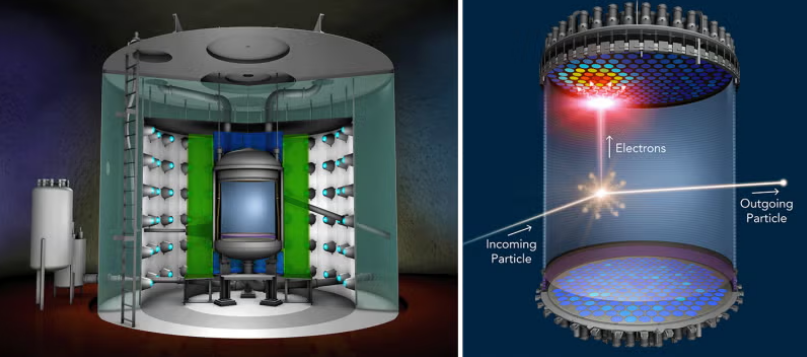
Of course, these results are not definite yet. This one potential detection isn't statistically significant enough to confirm that what has actually been detected is an interaction between a WIMP and an everyday matter particle. There still remains a 0.5% chance that the event could be explained by known backgrounds. As LUX-ZEPPLIN continues to gather the largest dataset in dark matter science, the team will determine if this event has grown in significance or if its significance fades. One definite positive is the fact that WIMP/ matter interactions are so rare that it wouldn't take many detections such as this to confirm the existence of WIMP dark matter, thus solving the puzzle of what the universe's most mysterious stuff actually is composed of. "We expect dark matter events to be extremely rare, so only a handful could mark the first detection of WIMP dark matter," Eriksen said.
The team's results were presented at the 2026 TeV Particle Astrophysics conference and have been submitted to the journal Physical Review Letters.