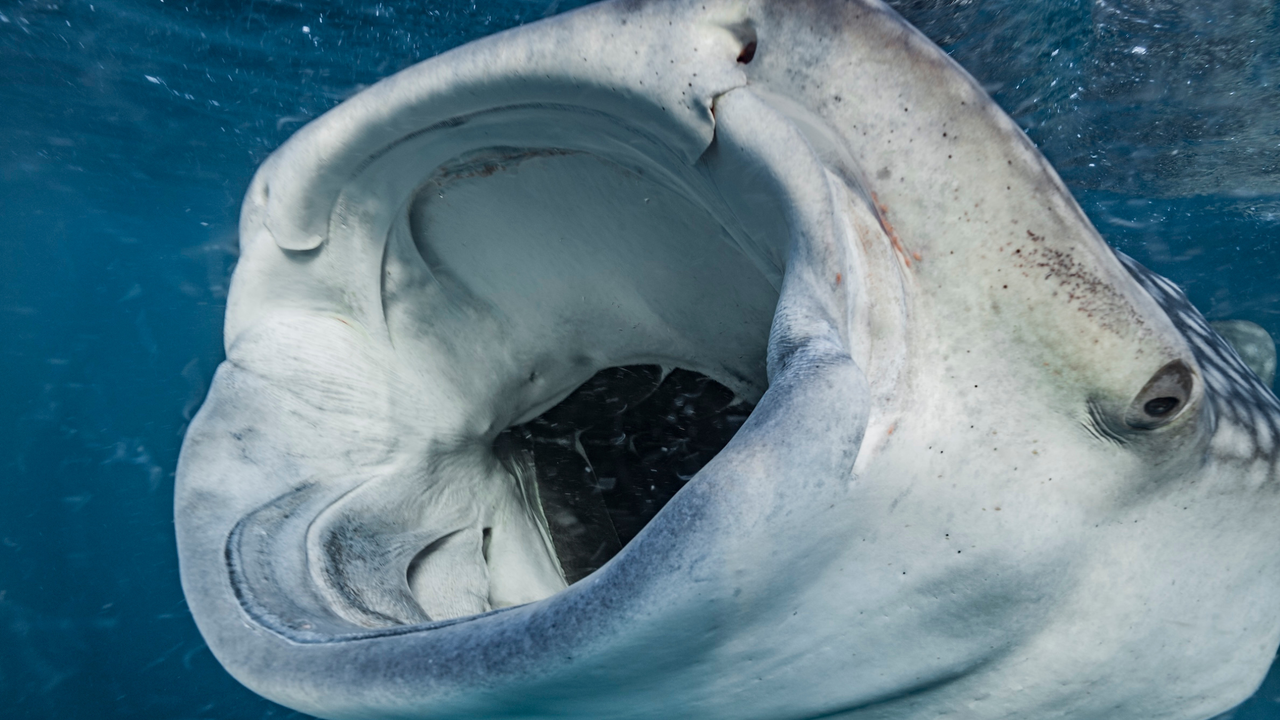
Whale sharks may be the biggest fish in the ocean, but their feeding habits have remained mysterious. Now, new camera footage from the backs of these gentle giants has captured them doing something scientists rarely get to see: hunting for food far below the surface.
The footage reveals that whale sharks (Rhincodon typus) spend far more time feeding underwater than scientists realized and that they use a surprising variety of foraging techniques that had never been documented before.
The videos show whale sharks filtering food while cruising through open water, gliding downward as they feed during dives, climbing back toward the surface with their mouths still open, and cruising just above the seafloor to feed. Slow, steady underwater feeding turned out to be one of the sharks' most common activities.
Philip Motta, a professor emeritus of biology at the University of South Florida who was not involved in the study, said the videos provide "very valuable" new information on the variability of whale shark feeding behaviors, which have been poorly documented to date.
Cameras reveal whale shark feeding
Before this study, whale sharks had been studied from boats, from planes and by divers swimming alongside them. But those methods shared a blind spot: They could only follow the sharks when they were near the surface.
Earlier research had hinted that whale sharks spend a lot of time feeding out of view, at varying depths. In a 2020 study, researchers estimated that whale sharks may forage at these depths for up to 20% of the day and feed at the surface for less than 1% of their time.
In the new study, scientists strapped cameras directly onto the whale sharks, offering a rare shark's-eye view beneath the waves.
They deployed camera tags on 10 whale sharks at Ningaloo Reef in Western Australia and gathered more than 22 hours of footage from the sharks' own perspective. They combined that footage with a review of 106 previously published studies to build the most comprehensive catalog of whale shark behavior to date. Ultimately, they cataloged 36 distinct behaviors — 12 were related to feeding, and of those, six had never been recorded before. The findings were published July 21 in the journal Marine Biology.
RELATED STORIES- Whale sharks are the world's biggest omnivores, scientists discover
- Watch 1st-ever footage of whale shark eating from the bottom of the ocean
- Attempted whale shark mating caught on camera for the first time in History
Whale sharks can grow to 60 feet (18 meters) in length. And yet, this enormous fish survives on tiny prey — like krill, fish eggs and plankton — in tropical waters that are notoriously poor in nutrients. The ability to switch between so many feeding techniques may help to explain the long-standing puzzle of how such a large species can survive in these nutrient-poor waters.
However, even with a shark's-eye view, the cameras captured only part of the story. Whale sharks are known to dive hundreds of feet below the surface, where sunlight disappears and conventional cameras can no longer record.
"The most important new discoveries could be what these gentle giants are doing when they perform really deep dives," Motta said.
Shark quiz: How much do you know about these iconic ocean superstars?