The full moon of September 2026 will occur at 12:49 p.m. EDT (1649 GMT) on Sept. 26 as the moon glows opposite the sun in Earth's sky.
September's full moon is often referred to as the Harvest moon — a traditional name for the full moon that falls closest to the September equinox, according to the Old Farmer's Almanac.
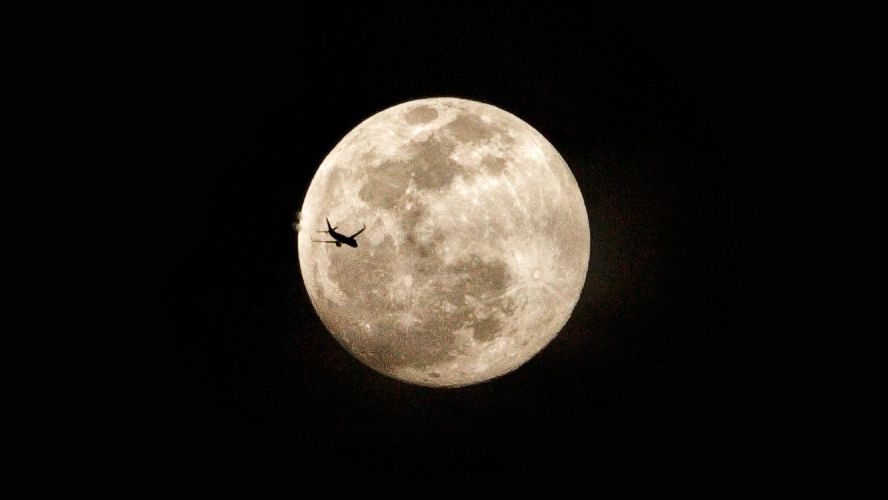
Sadly, the sun, Earth and moon won't line up again to create a spectacular lunar eclipse, as was the case in August. But it'll still present a magnificent treat for stargazers hoping to explore the majesty of the lunar disk with the naked eye, a telescope, or a camera.
When to see the September full moon
Stargazers in the U.S. will get their first look at the Harvest Moon when it rises over the eastern horizon among the stars of the constellation Pisces at sunset on Sept. 26.
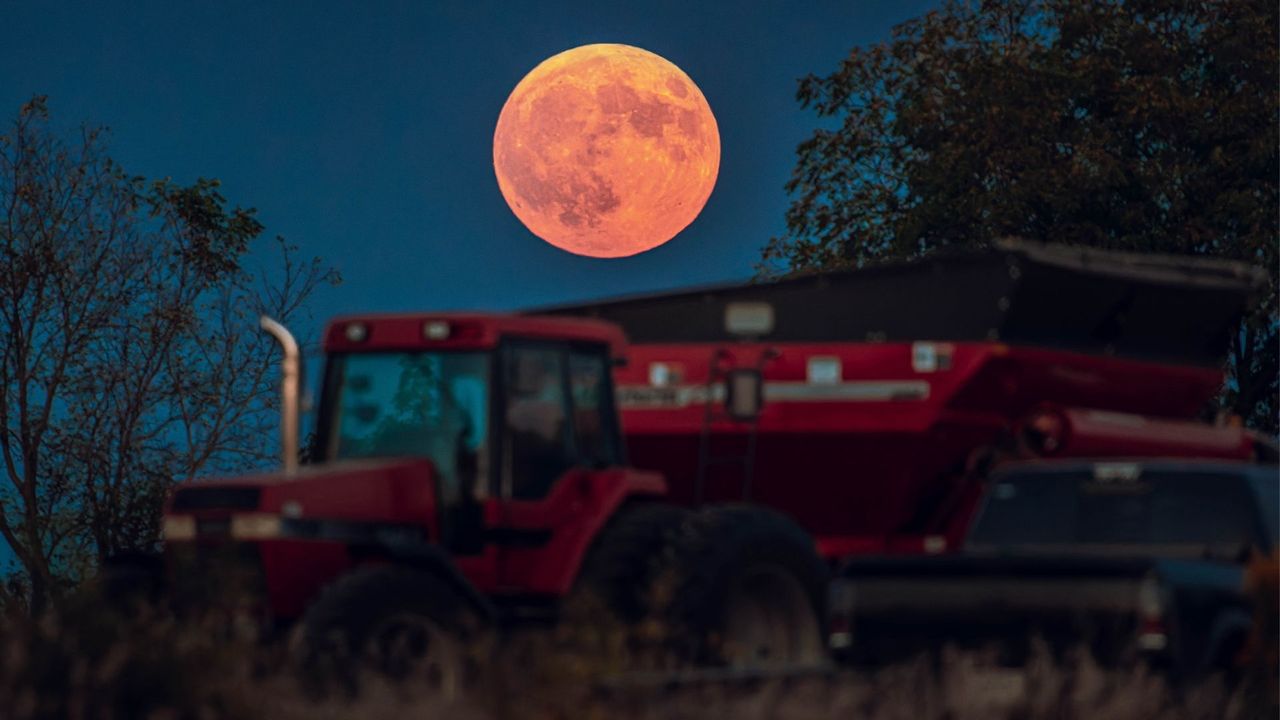
The moon will adopt a beautiful yellow-orange glow as its reflected light is filtered through Earth's atmosphere while close to the horizon, thanks to a process known as Rayleigh scattering. That strange hue will gradually fade in the hour following moonrise, as Earth's satellite arcs away from the skyline.
An orange full moon rises behind the Statue of Liberty in New York. (Image credit: Photo by Gary Hershorn/Getty Images)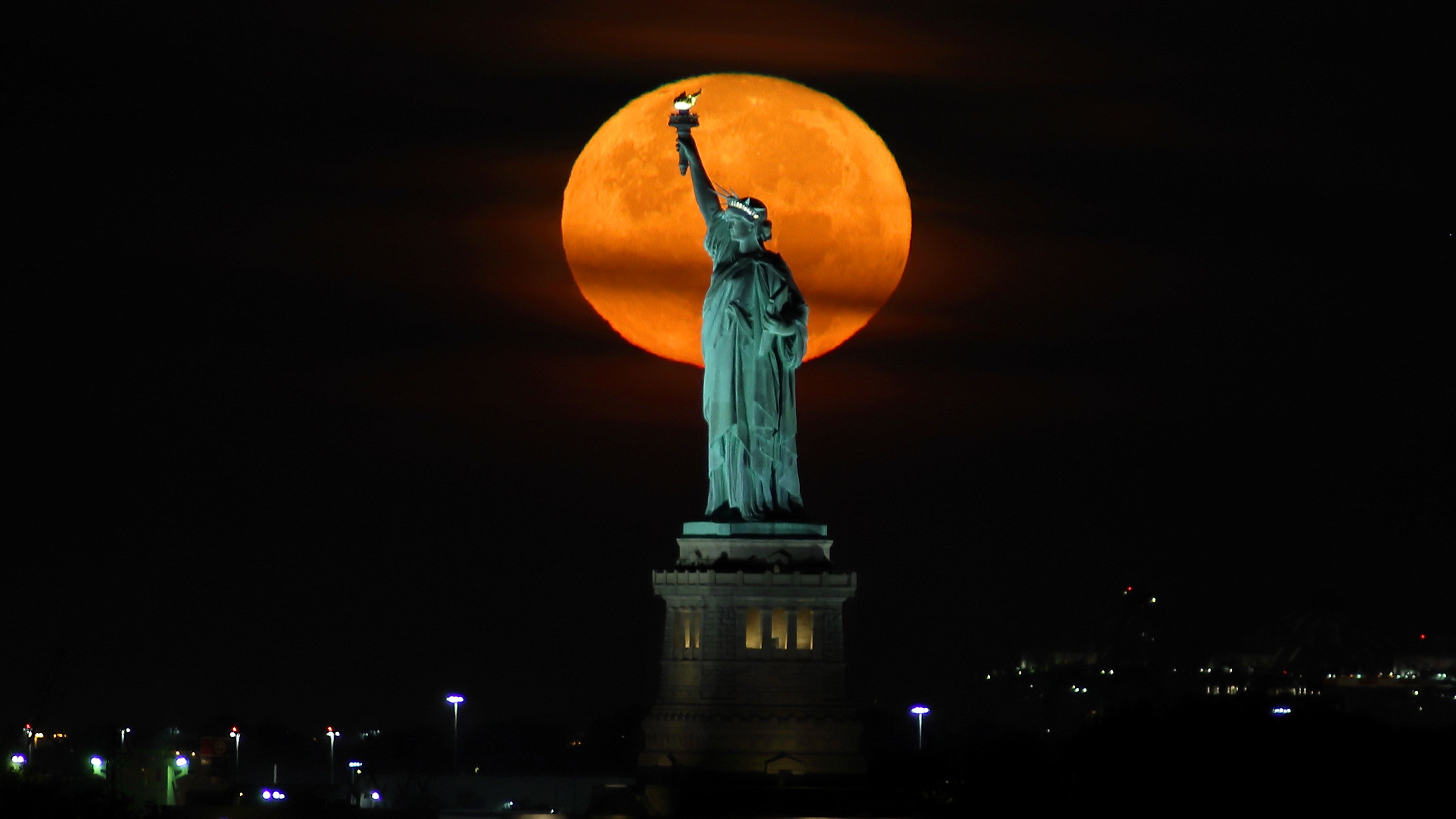
Its disk will appear particularly large while close to the horizon thanks to a phenomenon called the "Moon Illusion", which tricks our senses into thinking that the lunar disk is larger than it really is while close to the horizon, as opposed to when it glows directly overhead.
The table below details local full moon timings for when the moon is 100% illuminated for a selection of cities spread across the globe (local moonset and moonrise times will vary based on your location):
Local full moon timings for September 2026
Local full moon timings for September 2026City
Local time
New York
12:49 p.m. EST on Sept. 26
London
5:49 p.m. BST on Sept. 26
Beijing
00:49 a.m. CST on Sept. 27
Tokyo
1:49 a.m. JST on Sept. 27
Sydney
2:49. AEDT on Sept. 27
Why it's called the Harvest Moon
The September full moon is called the Harvest Moon when it is the closest full moon to the September equinox, when the sun crosses the celestial equator moving from north to south, marking the beginning of astronomical autumn in the northern hemisphere.
It's often called the Corn Moon, to reflect the time when the summer crop was ready to harvest. It is also known as the Turning Leaves Moon by the Native American Anishinaabe people, per the Old Farmer's Almanac.
The Ojibwe Tribe of the Great Lakes of North America and Canada also know it as the Falling Leaves Moon, while the indigenous Assiniboine people named it the Yellow Leaf Moon, referring to the the transformational effect of Autumn on seasonal trees.
September's full moon coincides with the Mid-Autumn Festival in China dating back 3,000 years to the Shang Dynasty, which is traditionally a time to reconnect with family and celebrate Earth's natural satellite, often with festive moon cake treats and the lighting of lanterns.
Its rise also marks the beginning of the Hindu celebration of Pitru Paksha, during which worshippers perform rites to honor ancestors by offering prayers and food to past members of their families.
What else to see in the sky around the full moon
The Harvest Moon will make for a spectacular sight as it rises over the eastern horizon on Sept. 27, but it won't be the only naked eye astronomy target on display in the transitional summer/autumn sky.
Saturn will be visible as a dazzling star-like object less than 10 degrees to the lower left of the lunar disk roughly one hour after moonrise. A 6-inch telescope will help reveal the gas giant's iconic ring system surrounding its amber disk, along with its brightest moons, Rhea, Tethys, Dione and Titan extending in a line away from the jewel of the solar system.
The diamond formation of stars that form the Great Square of Pegasus will listen to the upper left of the lunar disk after sunset, remaining visible while fainter stars become lost behind the deluge of moonlight that floods the sky around the full moon phase.
Early risers, meanwhile, will be treated to a spectacular view of Jupiter and Mars, as the two solar system planets line up either side of the constellation Cancer, the crab.
Castor and Pollux, which represent the heads of the twins depicted in the constellation Gemini, will shine to the upper left of Mars, while the multi-colored stars of the constellations Orion and Taurus will twinkle above the southern horizon, granting us a sneak peak of the winter sky to come.
Observing tips
The September full moon is a perfect time to try your hand at astrophotography! Why not try to capture the moon using a DSLR camera and a telephoto lens when the Harvest Moon rises and in the weeks that follow to track how the shifting shadows alter its appearance?
Be sure to make use of our expert guide to photographing the moon, along with our picks of the best cameras and lenses for astrophotography, if you want to upgrade your equipment.
Top tips to photograph the moon
- Use a tripod to keep your camera as steady as possible.
- Use a remote shutter/timer to prevent camera wobble.
- A smartphone stargazing app can help you find the exact point of moonrise on your local horizon.
- A lens with a focal length of 12-50 mm is useful for landscape photography, while a focal length of at least 400 mm is advised for capturing more detailed views of the lunar surface.
- The moon can be made to appear particularly large while close to the horizon next to foreground objects, where it may take on an orange-yellow appearance thanks to Rayleigh scattering. A cleaner, more "classic" view can be captured as it soars high overhead.
Upcoming full moons
Month
Full moon name
Date and time
October
Hunter's Moon
11.12 p.m. EDT on Oct. 25 (0312 GMT) on Oct. 26
November
Beaver Moon
9:53 a.m. EST (1453 GMT) on Nov. 24
December
Cold Moon
8:28 p.m. EST on Dec. 23 (0128 GMT on Dec. 24)
These times mark the exact instant of full illumination. Your own moonrise or moonset may be hours earlier or later, depending on your location. For the best viewing plan, use an app such as Stellarium or SkySafari 7 Pro to find your local moonrise time and be sure to read our full moon calendar for comprehensive timings for each full moon in 2026.
Editor's Note: If you would like to share your full moon photos with Space.com's readers, then please send your photo(s) along with your name, the location and any comments on what it was like to capture the picture to [email protected].